Welcome to our community

Be a part of something great, join today!

  • Hey all, just changed over the backend after 15 years I figured time to give it a bit of an update, its probably gonna be a bit weird for most of you and i am sure there is a few bugs to work out but it should kinda work the same as before... hopefully :)

Tow Generators, Cam Locks, and More...Oh My!

Thanks so much for the information, everyone! I really appreciate it and have found it very helpful. While we're here and tangentially related: how does one gel fixtures as large as an 18k? From what I understand, you use a 4x4 gel and get it a decent distance away from the fixture. How far? I'm assuming gelling a PAR at 18k levels is just not possible.
 
Everything Paul Dean said on electric side is absolutely correct. (In my own answer(s) I did not get specific about 208/220/240v, referring to them all nominally as "220" as in practice they can all fire the same light. Was trying to stay simple for a relatively lay questioner.)

Now you are asking about Grip World.... 4 x 4 open frames can be filled with color correction or diffusion. In some cases (condor mount, non-windy conditions) they can ride on the light with ears or grip savers; more commonly they are raised on their own stands. Color would go closer to the light than diffusion in sequence since diffusion would spread the beam beyond the color. The distance from the (12-18K non-par) unit can vary from roughly 2 to 4 feet depending on the unit and degree of spot vs wide. Too close and the frame will burn, too far and the frame will not cover the beam. With diffusion you usually want to fill the frame with light but not have spill beyond. (except in the case of a close up, where the frame can be very close to subject.) A clear 4 x 4 heat shield can be placed closest to the light to protect the other frames (or widows which can crack, or butterflies/ rags, which can burn). In some cases this is definitely necessary. An Arri-max, for example, requires heat shield as you begin to spot it down. Not sure if it is possible to put color on an 18k par, even with several layers of heat shield. It will absolutely burn through gel very quickly without heat shield.

Smaller lamps can often be gelled closer or right on the doors of the lamp. The effect of diffusion changes with distance from the lamp/ proximity to the subject, so that is part of the decision making process. There are also smaller (18 x 24, 24 x 36 and 36 x 36) open frames available for the smaller units.

Grips work either because of electric (stabilizing and sculpting lights) or instead of electrics (bouncing natural light). But, as Mr. Dean said, they do not touch lamps, cable, or "anything with a plug". However, they must have an idea of the size and type of electric units on the job to calculate the appropriate level of equipment and manpower to support those, among their other responsibilities.

Hope that helps.
 
Thanks much for the additional information. Directing, cinematography, and writing are basically my three favorite things in the world, so anytime I have an opportunity to learn about any of them and also about filmmaking as a whole I eat it up. Over the years I've seen myself start with being nervous to use 300 watt tungsten lamps to now wanting to get into 18k's and not feeling terrified by the prospect. I love the journey of learning and so appreciate the help in broadening my horizons and helping me gain knowledge :)
 
Hey, all

I think I'm starting to understand this more. Tell me if I'm on the right track?

I was googling photos of distro boxes, and since doing my reading here and other places, I noticed something on this photo (coincidentally from a rental company in my state!):
0600A-0900A%203-Phase%20Front-Rear%20800x600.jpg


This is a 900A 3 phase distro box. I noticed on the back that the three bates outlets have two color codes on them, whereas the ones on the front have one color code on them. This is to signify the three hot lines (or legs) of three phase power. The rear bates outlets use two hot phase lines and a ground (with no neutral), whereas the front outlets use one hot phase line, a ground, and a netural. This would mean that if you're using a wye configuration on your generator that the rear bates outlets are (for example) running 208V on phases AB, BC, and CA. Whereas on the front, each bates outlet (from left to right) is running 120V on phase A, 120V on phase B, and 120V on phase C (as well as the convenience edison outlets on phase A).

Am I correct in all of that? If so, my question following that becomes: how do you balance your loads when you're using a disproportionate amount of lighting/gear? For example: suppose I had an 18k HMI on phase AB on the back outlet. This means my light is drawing 80-90A at 208V. Cool. From what I understand, if there are no other loads on the system, this is basically considered an even load because the third leg is not being used. The question becomes, what happens when I need to plug lights in on the third phase?

Supposing again I have an 18k on phase AB, but now I want to plug in another (for example) 5k of gear at 120V (maybe smaller lights, batteries, monitors, whatever). If I'm understanding correctly, the proper procedure would tell me to plug in to phase C. The problem is though, how do I account for the fact that AB is loaded to 18k and C is only loaded to 5k? Won't that that essentially lead to around 108A on the neutral wire at 120V? Or am I missing something here?

Thanks again all!
 
Can anyone tell me if I'm on the right track? Thank you!
 
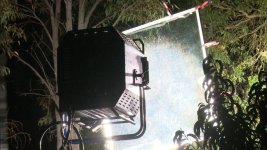
Gels. - With the 12K HMI at the "3RD NIGHT" shoot, this was how we did it, a gel sheet fastened to a frame on a C-Stand.. This lamp is compact compared to a full-sized 18K. There was sometimes a reflective flickering interaction due to slight wind moving, between the gel sheet and the fresnel lens on the lamp and also to the side/rear but this did not seem to spoil the lit area. It might pollute the lit area if it comes back in from another reflective surface like a flat window glass on a building. Proper lighting guys will be the best advisers here.

Our setup for power was very basic, a line straight from the 20K trailer generator's Mareschal deconnector outlet socket to the Lightmaker ballast. The trailer was on its tyres and rubber jack-up wheel. The Manfrotto lampstand was also on hard rubber tyred castors. There was mothing conductive in contact with the ground and the generator was not powering anything else. The soil was bare and dusty summer-dry. There was a qualified electrician on set.

Our biggest worry was setting fire to the place during extreme bushfire conditions. During the shoot, an historic timber milling town about 70km south of us was totally devastated by a fierce fire which raged uncontrollable for about a week.
 

Attachments

  • DESISTI 10.jpg
    DESISTI 10.jpg
    101.4 KB · Views: 0
Last edited:
You are essentially correct; the upstream side of the box with cam lock male has 208v (in 3 phase) Bates ports and the downstream cam lock female side of the pass through box has 110v Bates ports. You can notice the Bates pin spacing differs slightly from one side to the other. The 208v side Bates pins are slightly more evenly spaced. This differentiation between 110v Bates and 208/220/240v Bates is relatively recent and the box is a relatively modern type. Not all gear in real world conforms to this newer standard yet.

Yes, if your one 18k is powered from red/ blue, then your next load, e.g. 5 K, would go to black. When balancing legs, you are only concerned with the 3 hots, not with the neutral. In this example, in addition to the 5K tungsten, you would look to run set 110v off of black as well with 100a Bates cable to a breakout box behind camera.

Also worth noting is that when an HMI strikes, it draws a large spike in power, as much as 1.5x or more than the rated draw, which drops to the rated amperage as the lamp gets up to speed. Initial spiked HMI current draw must be factored into overall capacity of the system.
 
Robert, thank you so much for the info!

You are essentially correct; the upstream side of the box with cam lock male has 208v (in 3 phase) Bates ports and the downstream cam lock female side of the pass through box has 110v Bates ports. You can notice the Bates pin spacing differs slightly from one side to the other. The 208v side Bates pins are slightly more evenly spaced. This differentiation between 110v Bates and 208/220/240v Bates is relatively recent and the box is a relatively modern type. Not all gear in real world conforms to this newer standard yet.

Yes, if your one 18k is powered from red/ blue, then your next load, e.g. 5 K, would go to black. When balancing legs, you are only concerned with the 3 hots, not with the neutral. In this example, in addition to the 5K tungsten, you would look to run set 110v off of black as well with 100a Bates cable to a breakout box behind camera.

Also worth noting is that when an HMI strikes, it draws a large spike in power, as much as 1.5x or more than the rated draw, which drops to the rated amperage as the lamp gets up to speed. Initial spiked HMI current draw must be factored into overall capacity of the system.

Thank you! Glad to know I'm on the right track. When you say I should run set off the 110V with a breakout box, do you literally mean run the set of the movie (ie cameras, monitors, hair dryers, etc.)?

Additionally, is there a difference in load requirements since phase AB are loaded with 208V 90A and phase C would be (ideally) loaded to 90A at 120V. Does this difference in voltage on the phases matter at all when load balancing?

Finally, is it a huge problem if I can't find 90A worth of stuff to load up Phase C with? If so, what do I do to balance it out?
 
You are essentially correct; the upstream side of the box with cam lock male has 208v (in 3 phase) Bates ports and the downstream cam lock female side of the pass through box has 110v Bates ports. You can notice the Bates pin spacing differs slightly from one side to the other. The 208v side Bates pins are slightly more evenly spaced. This differentiation between 110v Bates and 208/220/240v Bates is relatively recent and the box is a relatively modern type. Not all gear in real world conforms to this newer standard yet.

Yes, if your one 18k is powered from red/ blue, then your next load, e.g. 5 K, would go to black. When balancing legs, you are only concerned with the 3 hots, not with the neutral. In this example, in addition to the 5K tungsten, you would look to run set 110v off of black as well with 100a Bates cable to a breakout box behind camera.

Also worth noting is that when an HMI strikes, it draws a large spike in power, as much as 1.5x or more than the rated draw, which drops to the rated amperage as the lamp gets up to speed. Initial spiked HMI current draw must be factored into overall capacity of the system.

Just had this conversation in the Facebook G&E group yesterday. From the Set Lighting Technician's Handbook:

"To increase stability, it helps to put a bit of a resistive load on the generator. Adding a tungsten light to the generator before striking an HMI dampens the hit and helps the generator pick up the load. With no load on the generator, when the HMI is struck, the generator voltage dips, this can set up an unstable oscillation, with the ballast trying to draw more current. This usually causes the ballast to shut down. A small incandescent load on the generator – even as little as 300 W – will stabilize the voltage when the HMI strikes."

Something worth considering when striking large lights!

 
Also worth noting is that when an HMI strikes, it draws a large spike in power, as much as 1.5x or more than the rated draw, which drops to the rated amperage as the lamp gets up to speed. Initial spiked HMI current draw must be factored into overall capacity of the system.

A distinction between magnetic and electronic HMI ballasts is required here. It is magnetic HMI ballasts that have a high front-end striking load - the opposite is true of electronic ballasts. Magnetic ballasts draw more current during the striking phase and then they “settle down” and require less power to maintain the HMI Arc. For this reason you must leave “head room” for the higher front-end striking load and oversize your generator. By contrast, an electronic ballast “ramps up”. That is, its’ current draw gradually builds until it “tops off.” In fact, a 5kw tungsten light has a higher front-end load than does a 4k HMI operating on an electronic ballast. For details on how to size generators for different types of loads see the article by Guy Holt referenced above.

Paul Dean
 
Hopefully a properly experienced lighting guy will add to and correct the following comments where needed.


On "3RD NIGHT" and other projects, the generator for the HMI was quarantined from other power use except for a 500watt incandescant work light whilst the light was operating. HMI electronic ballasts apparently significantly deform the AC sine wave and if several HMI lamps are connected to different outlets from the one generator, then the neutral line can become overloaded, cause breaker trips and may overheat the windings of generator itself.

The waveform can be so mutilated that sensitive appliances should not share the same generator. Giving the generator a base load as suggested in a previous post is also a good move.

Key words in searching may be "switchmode power supplies", "electronic ballast", "power factor correction". Newer electronic ballasts are better performers. If you connect older non-power factor corrected electronic ballasts to a generators then its output for peace of mind and reliability should be in the ballpark of 50% more than the power to be drawn.

So the for the 12K HMI with a non power factor corrected Lightmaker ballast, we had a 20K single-phase 240AC 50Hz generator. ( Australia ).

There's also some good info and links to be found here.

http://www.galaxylightingrepair.com/
 
Last edited:
Hopefully a properly experienced lighting guy will add to and correct the following comments where needed.

I would just make the distinction between power factor corrected (pfc) and non-power factor corrected electronic HMI ballasts clearer. Non-pfc ballasts draw harmonic currents that react with the impedance of the generator and distribution system to distort the waveform of the voltage throughout the distribution system (measured in total harmonic distortion.) PFC ballasts do not draw harmonic currents and so do not distort the voltage. (For more details read the article I mentioned above titled “Portable Generators in Motion Picture Production.”) Other than making that distinction more clear, your summary in on the whole correct.

Paul Dean
 
This is a scary post. You should try and work under people who know what their doing as well as learning as much as you can from books.
There's a reason electricians in training in the real world have to work under an actual electrician, it's dangerous.
My advice is to work as an electrician on set and then work your way up, or at least work long enough to learn a lot from people in the field.

Double yep!
 
Along the lines of what Nick and others are saying, how much power do you need?

I'd say check out the portable generators that can give you up to about 5000W output each, and if you need more than that then get someone else more qualified in to help you.

If it gets more complicated to set up and run and maintain than what you're already managing on household power, it's too dangerous to be learning by trial and error as mistakes can be deadly.

Mentioning tow generators and distro boxes like that, while also saying you're just starting to get into powering things via generators, naturally rings alarm bells with the kind of people who are more familiar with such things.

Probably better to say what/how much lighting you want to run and ask how best to do it.

And then do another really good behind-the-scenes video so the rest of us can learn about it too, lol.

Triple yep!
 
Don't run with scissors ;-)

I say . . . go for it!! Don't listen to all this panty waist "safety first" nonsense . . . light up the fuckin city with that mac daddy generator and be a Billy badass!! YOLO!!
 
I'd say check out the portable generators that can give you up to about 5000W output each, and if you need more than that then get someone else more qualified in to help you.

There are Honda EU6500s modified to put out 7500W that when used with a step-down transformer/distro will give you a 60A circuit. If that is not enough power you can parallel two of them for 120 amps of power, which is enough to run an Arri M90 or 12k HMI.

Paul Dean
 
I applaud your research, but PLEASE spend some time in a pro lighting training situation.
 
There are Honda EU6500s modified to put out 7500W that when used with a step-down transformer/distro will give you a 60A circuit. If that is not enough power you can parallel two of them for 120 amps of power, which is enough to run an Arri M90 or 12k HMI.

Paul Dean

Nick and others have mentioned running the larger Honda portable-type generators in parallel.

Some of them seem to be priced and aimed at more of a DIY owner/operator multi-purpose market than the larger, less portable generators, but I'm guessing once you're running them in parallel with distro boxes etc you'd still have to follow the same procedures you would when using the larger units?

Taking on board your earlier warning that even the smaller portable units can fry people and things if not used with care, would those more accessible kinds of portable units be considered easier or better to use when starting out than the larger towed units?

How about noise levels too? Some of those smaller portable generators are loud. Is the comparative noise output something that might make using a bigger but more sound-proofed generator a better option?

Sorry for the noobie questions, not going to be using generators myself in the near future, just asking out of curiosity and in case they're something Tommy and others should consider using as an interim step before moving onto bigger things.
 
Back
Top