Welcome to our community

Be a part of something great, join today!

  • Hey all, just changed over the backend after 15 years I figured time to give it a bit of an update, its probably gonna be a bit weird for most of you and i am sure there is a few bugs to work out but it should kinda work the same as before... hopefully :)

Stops lost in the darks?

Ryan Emanuel

Well-known member
Joined
Nov 6, 2011
Messages
160
Reaction score
0
Points
0
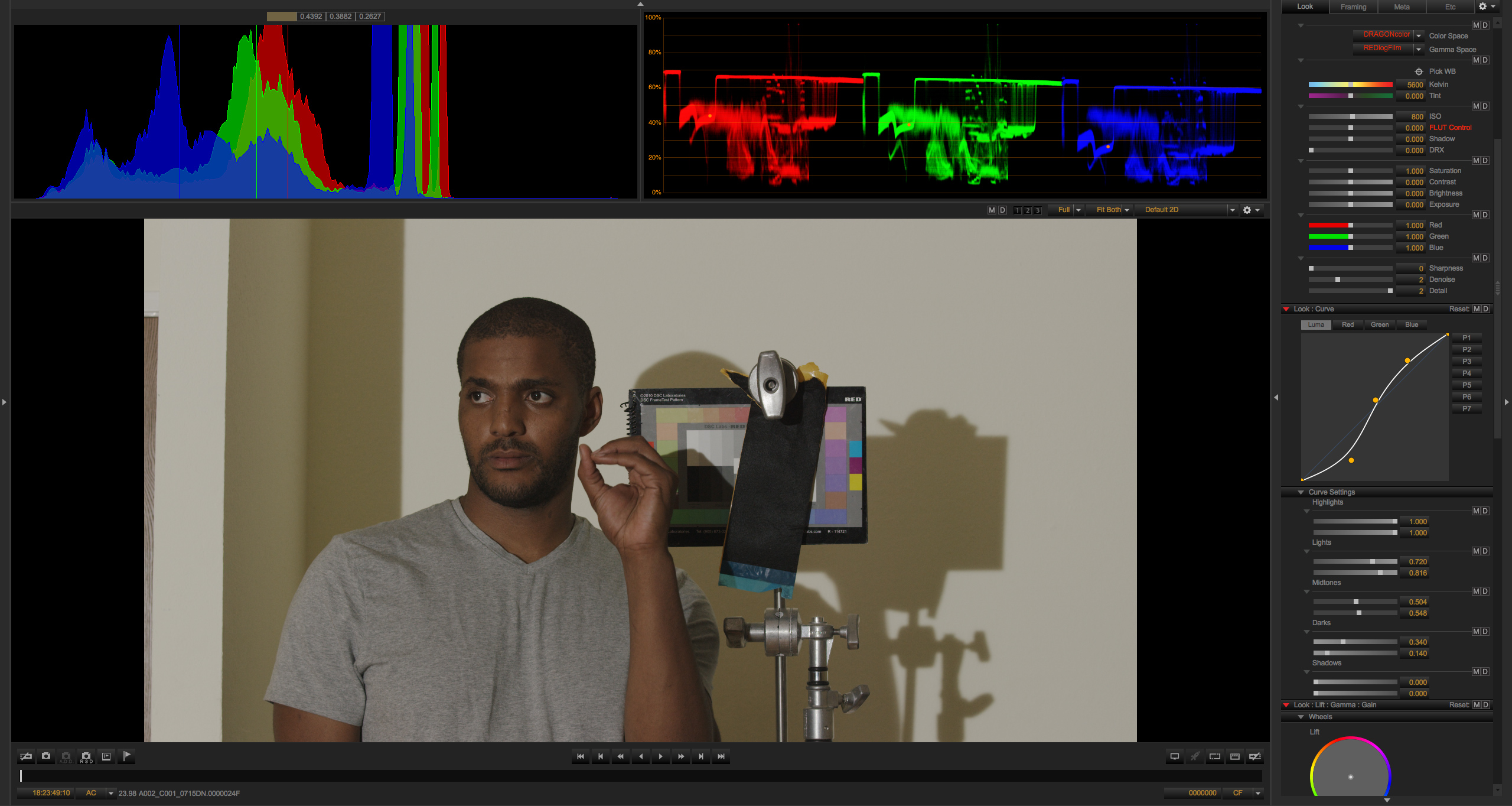
I've read that some have experienced two extra stops in the darks. I have been testing DR all day and each test has shown the same results with my Dragon Scarlet. I feel like I only have 3-4 stops under where I can see detail in darks. You can argue that 5-6 stops under can differentiate between tones (those tones being buried under noise) . I'm not complaining about the noise, and I know overexposing clears all of this up. Nonetheless, I feel like my MX performed better with rendering detail in darks. The extra highlight room in Dragon is nice, but I was used to seeing more detail in 4-5 stops under in darks. I feel like DR was shifted and not added.

The mediafire link has a test I did exposing for 800 ISO. The Duvy Tape was two stops under on spot meter. I feel like after 1 stop under the fabric detail is lost. My overexposure tests lead me to believe that there is around 6 stops above middle grey and I can't see any differentiation in tones more than 6 stops under. Thats 13 total with 11 usable. I felt like the MX had around the same. Please let me know if you've seen the same thing or if I'm missing something.

https://www.mediafire.com/?jys7czy7ob5v0j0
 
http://we.tl/YXfvZns3Ek

this is the Raw of my rough test yesterday. except the red noise "issue" i see the MX image in the shadow of the lense left side more muddy, ... it feels bit like a noise reduction, as Dragon has bit more noise, but stays clearer with finer detail (you see it at the ring)
in this frame, MX is also totally clipped. but you are right, the bigger deal of Dragon is the highlight perfomance, for me, much more important. will be interesting to do this with the new firmware and redcine ... as you can push the Dragon file much more with the highlight protection
 
I've read that some have experienced two extra stops in the darks. I have been testing DR all day and each test has shown the same results with my Dragon Scarlet. I feel like I only have 3-4 stops under where I can see detail in darks. You can argue that 5-6 stops under can differentiate between tones (those tones being buried under noise) . I'm not complaining about the noise, and I know overexposing clears all of this up. Nonetheless, I feel like my MX performed better with rendering detail in darks. The extra highlight room in Dragon is nice, but I was used to seeing more detail in 4-5 stops under in darks. I feel like DR was shifted and not added.

The mediafire link has a test I did exposing for 800 ISO. The Duvy Tape was two stops under on spot meter. I feel like after 1 stop under the fabric detail is lost. My overexposure tests lead me to believe that there is around 6 stops above middle grey and I can't see any differentiation in tones more than 6 stops under. Thats 13 total with 11 usable. I felt like the MX had around the same. Please let me know if you've seen the same thing or if I'm missing something.

https://www.mediafire.com/?jys7czy7ob5v0j0
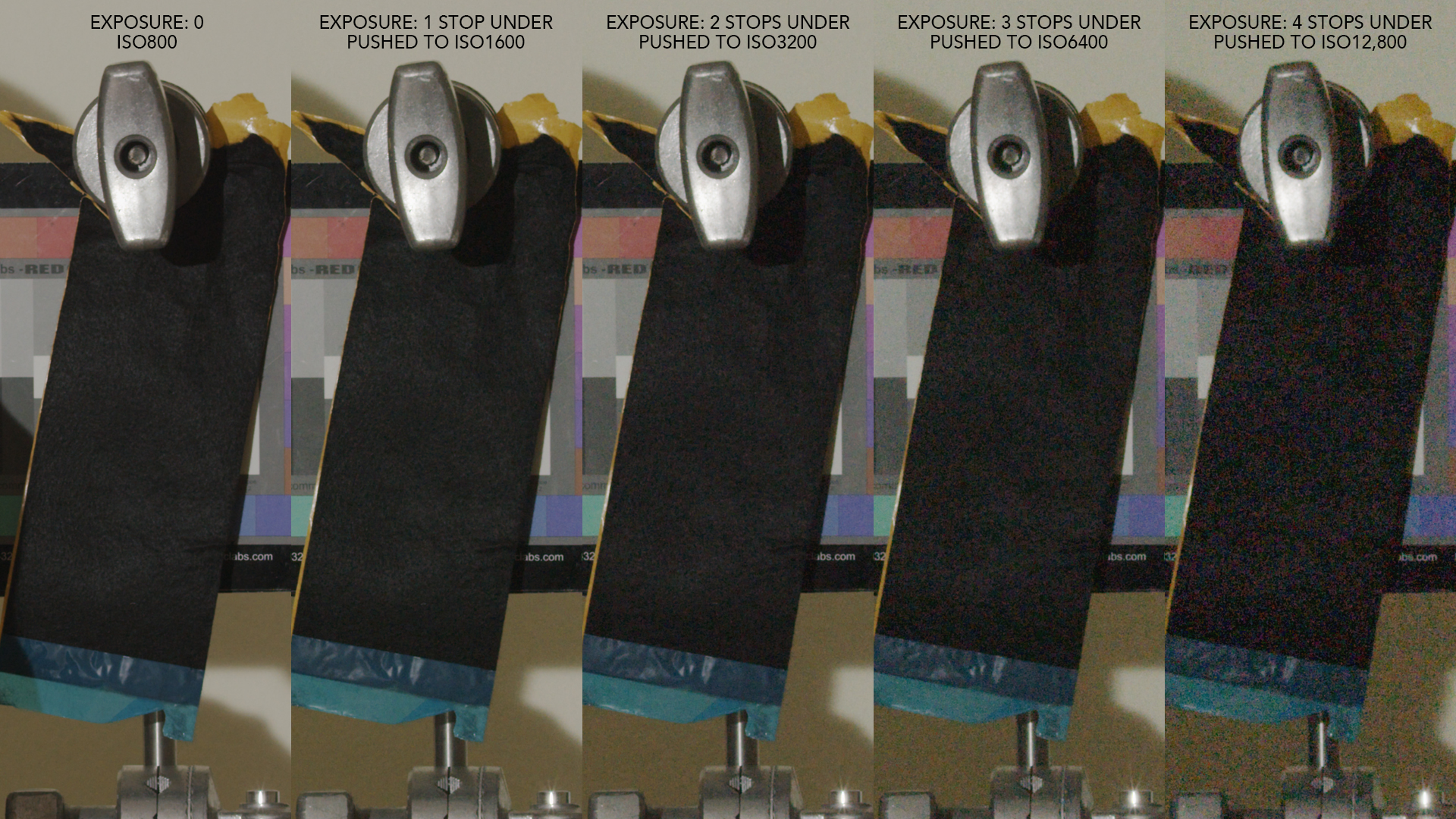
Unless I'm the one missing something, I'm seeing detail all the way down to 3 stops under. Since the tape is already 2 stops under to begin with, when underexposed by 3 stops, the tape should actually be 5 stops down, correct? It's noisier, obviously, but detail is still reasonably discernible.

I applied the same, light s-curve to all five images, set a Denoise value of 2 and pushed the ISO to compensate for the number of stops of underexposure (click for a larger image).


Last edited:
Ryan, this is a bit of an odd methodology... When you're looking at the detail in the black tape you've got next to nothing to make a judgement with. The range between the brightest and darkest feature of the black tape will be just a tiny fraction of a stop, so as soon as the sensor noise exceeds a very small error range you lose the ability to discern the detail. That happens sooner than the point at which the sensor stops responding to light.

You should take a look at some shadow detail which has a stop of variation in it at least, then you'll get a better idea.

A neat way of doing it is to set up a scene with a moving / movable gray object against a darker background - get a measurable 1 stop difference between them with a spot meter, and then stop your camera down progressively until you can no longer discern the movement nicely in redlogfilm. That's a fair judgement of where the sensor gives up to your taste. You can take that setup and exposure as a baseline to discover the clipping level - that part will then be a scientific measurement based on your personal taste for the bottom end.

Its very important IMHO to view this kind of stuff in motion.
 
John your right, I had the same thoughts about the Duvy late last night and did another test with a detailed glove at 3200k. There was clear detail on dark materials 5 stops down for a total of 7 stops. But interestingly, I got far better noise performance at that color temperature over daylight. Is that common? I'm assuming it has to with the red channel. I'm on the latest firmware.
 
John your right, I had the same thoughts about the Duvy late last night and did another test with a detailed glove at 3200k. There was clear detail on dark materials 5 stops down for a total of 7 stops. But interestingly, I got far better noise performance at that color temperature over daylight. Is that common? I'm assuming it has to with the red channel. I'm on the latest firmware.

When you balance for tungsten you're reducing the red channel (which is the most sensitive on Dragon) so I guess one way to think about Dragon is that it's kind of a Tungsten sensor now.
 
Interesting thought. A tungsten balanced CMOS sensor.
 
Actually if the red channel is the most sensitive it would still be daylight that would create the best overall result. The reason we use the CTB filters is to give the blue channel more blue light to compensate for the sensitivity of the other channels. In practice properly exposed daylight would still be better because if you are at the bottom end of exposure or underexpose a tad at tungsten temperature and then correct in post you are going to see the blue noise we are familiar with on the MX sensor.

Again, I don't have a Dragon to test this yet so if this isn't the case then let us know what you find.

That logic doesn't work with dragon. The blue channel is one of the healthier ones, the red channel is the one that needs help. So apply your methodology for the blue channel on MX, with the red channel on Dragon.

I would say its safe to say the 3200k has better noise performance, I ran some outdoor tests with a tiffen 85 balancing daylight for tungsten and got less color noise. Less magenta less green and less red noise. The rental house asked if we were shooting on film, I guess they don't rent out the 85, but I believe I will be using it on all day light material.

I'll post sample r3ds soon

Thank you. I was going off the statement of the red channel being the most sensitive. If its the other way around it makes complete sense. That being the case, I would be happy to ditch the CTB gels, save some money, save some time, and get some extra light out of my kit! Of course I would still need them for mixed sources, but it does make controlled lighting situations a little easier.

I would be interested to see if this holds up before I ceremoniously burn my blue gels ;D
 
Back
Top