
Bob Gundu
Well-known member
- Joined
- Mar 17, 2011
- Messages
- 10,238
- Reaction score
- 3
- Points
- 38
- Location
- Toronto, ON Canada
- Website
- www.10fh.com

Follow along with the video below to see how to install our site as a web app on your home screen.

Note: this_feature_currently_requires_accessing_site_using_safari

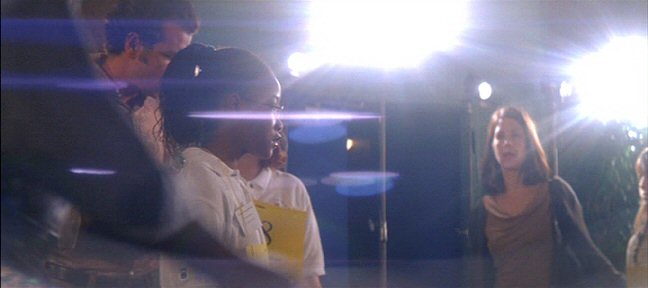
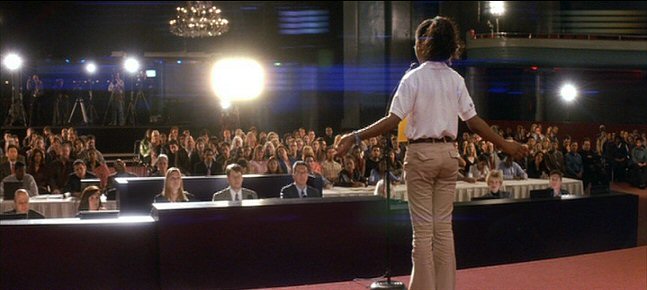


From the American Cinematographer article on Star Trek:
"Much of the lighting built into the interior was designed to cause lens flares... "The Enterprise has lights set in the frame that basically point down the lens of the camera in every direction," says Mindel. "Whenever you look, you get a flare. It goes against everything one learns as a camera technician, which is to shield the lens from any extraneous light and stop it from flaring. We'll either get slaughtered by our peers or be really admired for it!" ... If the built-in lighting wasn't providing the desired flare, the crew aimed Xenon flashlights at the lenses as the cameras rolled. "Our A and B camera operators... would tell us if we needed to go a little farther in or out of the frame, or up or down, to get the ultimate flare... it was funny to watch, Dan and I were running around, ducking, jumping, and hiding behind things so we wouldn't be seen by the cameras. The flashlights were so bright that there are probably several instances where Dan's actually in the movie, but you can't really tell!"
Doesn't sound like the net result was that a lens flare only occurred in 2% of the footage despite all that effort and they had to add them to 98% of the footage.
 Thanks David.
They shoot Fringe on Alexa. You can't shoot anamorphic on RED and get the flares?
Yep... Exactly. And anything with CG added into a scene, flares were avoided and but put in later.
They shoot Fringe on Alexa. You can't shoot anamorphic on RED and get the flares?
I haven't talked to anyone directly involved, but my guess is that some of these shots were done twice, once for a flare reference and once clean, but as we both know, shots done for reference often have a way of becoming final plates if the performance works.
It's funny that you mention that. In an interview for the new movie, it was mentioned that they're doing something similar for the 3D conversion - they do a clean pass of each setup (with no actors) before moving on. Is that kind of thing common practice for converted pictures?
It's funny that you mention that. In an interview for the new movie, it was mentioned that they're doing something similar for the 3D conversion - they do a clean pass of each setup (with no actors) before moving on. Is that kind of thing common practice for converted pictures?
Geez, Mark, were you involved in the picture that you're talking about that you make these kind of statements? Or are you guessing, based on your own projects and the degree of difficulty involved in doing these kind of VFX?
I wonder if they are shooting 3d for the next star trek? if so, do flares become like a NIGHTMARE for 3d line up guys. I was reading a article just a little while ago.. it may have been cineflex, ill see if I can find it, but they did say they had unwanted lens flares that were so hard to line up and to comp to plates that they had to re-shoot the scene again paying careful attention to not have flares at all. I'm going to get into those mag's again and find the article, it was very interesting reading in regarding 3d stereo and lens flares.
I believe principal photography is wrapped. The picture was shot on film, in 2D, in anamorphic format.
Flares are a serious problem if you're using a mutlicamera rig. They are not nearly as much of a problem if you're shooting 2D and doing a conversion because the same flare will be used as the source for both eyes, so they already match. In fact, there are a number of 3D production issues that are instantly solved by going the conversion route, such as mismatched lenses, color matching issues, and geometry disparities. I'm not saying that conversion produces a superior product, or that doing it effectively doesn't involve an awful lot of tedious work, but it is absolutely true that a number of stereoscopic production issues are by definition eliminated.

Speaking of flares, I'd rather just shoot without it (clean on spherical or filters on ana) and then add lens flares in post. There's a few free and commercial plugins to replicate that flare effect pretty much spot on. Also not a big fan of conversions, to be perfectly honest. I always watch converted films in 2D anyway.
