Welcome to our community

Be a part of something great, join today!

  • Hey all, just changed over the backend after 15 years I figured time to give it a bit of an update, its probably gonna be a bit weird for most of you and i am sure there is a few bugs to work out but it should kinda work the same as before... hopefully :)

So what is a "normal" lens anyway?

This whole debate annoys me. When we view the world with our naked eyes, in order to see a different part of the image, we move our eyes. When we watch something that has been recorded with a camera, we can look at different parts of the image. In other words, our "natural vision" always has our focus centered on the center of the image, but viewing a recorded image, we can focus on the peripheral.

So even if our eyes had a seriously wide-angle effect going on in our peripheral vision, it's not the same as looking at the edge of a wide-angle image.
 
What is “normal” or how do we see?

What is “normal” or how do we see?

The question of a “normal lens” got me to thinking about a class that I gave to students quite a few years ago. Actually about 30 years, take or give a few. IN MY HUMBLE OPINION THERE IS NO SUCH THING AS A NORMAL LENS. Let me explain.

Generally human vision is composed of a series of rectangles, the exact number I really don’t know, but for arguments sake let’s say there might be 100. Looking at a wide vista one might need to spread them out over a huge field, thus the lack of resolution, but nonetheless there is enough to see what’s going on. On the case of the tiny “ant”, the rectangles kind of go right on top of each other; there is resolution, concentration, and thus the narrow field of view is really good.

All of this happens in your brain, just like breathing, or reaching out for whatever or whenever other natural instantaneously things occurs within the human body that don’t require you to think too much or none at all, it’s just simply a natural reaction that we’ve become adopted to doing.

Then there is panning, it’s a continues motion of the camera (or the head) from left to right, or from right to left. There is the movement from looking down to looking up, sometimes opening to a wider vista.

Now in a movie, in order to interpret what we see of feel, we’ve got to use different types of lenses, from the wide angle to the extreme close up. And like in real life, we must go from one to the other with a fluid motion, when it’s done right we do not see the change, it’s just kind of normal to see it happening. We transcend time and space, in minutes or in hours. We take time and space and slow it down, or make it go fast, or normal speed. Movies are a human’s representation of a story we are telling, so we can do whatever is good for the story, and when it works, it really works good.

So what is a Normal Lens, it’s whatever is required at the moment that we chose to use it to represent reality. Not the actual thing that we live every day, every second, but a representation of it. I always go back to Citizen Kane; it begins with the ending, then a documentary about him, they a series of stories told about him, then the story.

Humberto Rivera
 
Then there is panning, it’s a continues motion of the camera (or the head) from left to right, or from right to left.

I think it is very difficult for our eyes to "pan" like a lens would, mainly because our eyes (and mind) have a tendency to focus on discrete objects thereby limiting a continuous panning motion. Try it out, see if you can pan the room smoothly by moving your eyes right to left (moving your head right to left does not necessarily mean you are panning anything, as focus can stay fixed). What you will notice is that your sight is sticky, and the panning is non-continuous, unlike the smooth pans that lens/cameras are capable of. That's because, like David Mullen told me, a lens/camera is dumb.


Now in a movie, in order to interpret what we see of feel, we’ve got to use different types of lenses, from the wide angle to the extreme close up. And like in real life, we must go from one to the other with a fluid motion, when it’s done right we do not see the change, it’s just kind of normal to see it happening.

In terms of what is a "normal" lens, I believe that is based on a focal length which is fixed in humans. In other words, we as humans can't just "zoom in" to whatever focal length we want. What you are referring to in your post seems more related to focus and depth of field, which indeed do change fluidly in human sight based on what you are looking at -- similarly, in a camera, you don't need to change into various focal lengths to mimic sight, but rather just adjust the focus.

Depth of field, however, is related to the particular person's eye sight. I, for instance, am very near sighted and without my contacts I have an extremely narrow depth of field. Someone with better eye sight than me probably has a much wider DOF.

Just some things I've thought about over time.
 
Here is my unscientific opinion:
For S35mm (24mm wide active image plane)

The full peripheral vision of two eyes (BTW women have more) = 10mm
"Normal" wide angle view = 14-18mm
Natural field of view and perspective in normal concentration = 40-50mm
FoV when concentrating on a specific object to see detail = 75-90mm

What I have noticed is that different focal lengths have a perspective that stays the same regardless of focal length. To me the most pleasing perspective is 85mm and the most natural is 40mm. And it's true in S16mm, S35mm and even VistaVision (Leica frame still).

I mostly agree with this, epecially the last part about perspective, with the correction that perspective, i.e perceived depth separation of objects, stays the same with a given focal length regardless of field of view. For me something in the 80-90mm range has the closest correlation to accurate depth perception, but then I am very near sighted so maybe my eyes are just naturally a longer focal length.:devil:
 
I think it is very difficult for our eyes to "pan" like a lens would, mainly because our eyes (and mind) have a tendency to focus on discrete objects thereby limiting a continuous panning motion. Try it out, see if you can pan the room smoothly by moving your eyes right to left (moving your head right to left does not necessarily mean you are panning anything, as focus can stay fixed). What you will notice is that your sight is sticky, and the panning is non-continuous, unlike the smooth pans that lens/cameras are capable of. That's because, like David Mullen told me, a lens/camera is dumb.

In terms of what is a "normal" lens, I believe that is based on a focal length which is fixed in humans. In other words, we as humans can't just "zoom in" to whatever focal length we want. What you are referring to in your post seems more related to focus and depth of field, which indeed do change fluidly in human sight based on what you are looking at -- similarly, in a camera, you don't need to change into various focal lengths to mimic sight, but rather just adjust the focus.

Depth of field, however, is related to the particular person's eye sight. I, for instance, am very near sighted and without my contacts I have an extremely narrow depth of field. Someone with better eye sight than me probably has a much wider DOF.

Just some things I've thought about over time.

Exactly.

I'm interested in buying a Scarlet 2/3" Cinema with a "normal" mini-RED Prime lens. When I say normal, all I mean—and all that's practical to ask for—is a lens which creates the least perceivable distortion, whether it be in the relative sizes of objects at various distances, or skewing of perspective. I want a ballroom in my recording to look similar to the way the ballroom looks in person—I don't want it to look bigger, the way the photographs for an apartment you're looking to buy make the rooms look bigger when taken with a typical wide-angle point-and-shoot.

I think any debate beyond that may be interesting, but it's not practical. A normal lens is a lens that makes things look "normal".

Incidentally, which of the mini-RED Primes would you recommend for the Scarlet 2/3" Cinema?; and will I be able to buy it without buying the entire set? For my purposes (not to mention my budget), I don't want multiple lenses, but I don't want the fixed zoom lens either. That may be an unorthodox approach . . .
 
Part Two Normal Lens

Part Two Normal Lens

“Depth of field, however, is related to the particular person's eye sight. I, for instance, am very near sighted and without my contacts I have an extremely narrow depth of field. Someone with better eye sight than me probably has a much wider DOF.” Yousuf Abbassi.

Yousuf you are absolutely right, we are all different, so we have a different experience, that’s why a “Picture” might work for someone and not the next person. When we look at a distance object we might want to use a pair of binoculars to bring the image in closer or a 300mm lens on a camera. Yet when pieces of “Time” are being juxtaposed from one shot to the other it might seem just like the right thing to do. It’s a matter of perception, subconscious perception. It’s also a matter of choice by the filmmaker!

BUT on the screen we all get to see it the same “Movie” the same way because it’s ONE persons “interpretation” of a moment in “Time”, and in a film we must all consume that moment as “that person” saw it. It’s not real; we only think that is real, because of the skill of the filmmaker in elongating time or shortening “Time”. We try and get it right in terms of how we see the image on the screen, glasses, no glasses for those to see the movie, whatever it’s necessary, but our brains are going to act different base on our experiences.

That why I don’t belief in “Normal Lenses”, I do have a preference for the wider lenses, but it’s only a preference. Finally I chose the lenses that it’s going to make my story right, my interpretation of time, many things go into a movie, the period, what the space dictate, the list goes on and on.

Humberto Rivera
 
50mm is a normal lens

50mm is a normal lens

For what it's worth, I find that perspective wise, 50mm lens is a normal lens. Normal being that it sees the way our eye sees, i.e. perspective changes in the same way and the objects in the foreground are in the same relationship size wise to the objects in the background. Easy way to check this is to grab your still camera [or a director's viewfinder], pop a 50mm lens on it, look through it with your right eye, open your left eye - and the images will align perfectly, apart from the focus. Put a shorter lens and you cannot align it with what you see. Same goes for longer lenses. I did this test with my Leica R and

As far as I know this should hold over all formats, the size of the format would only determine the area of coverage.

Does this make sense?

I think so . . .

So you're saying that a larger sensor/format just means there will be more image, further out from the center, than a smaller sensor/format? But that regardless, the lens alone is what determines the distortion at the center of the image (like the size the moon compared to a subject's silhouette)?

Is that right? That makes sense to me, but I have very little hands-on experience or technical knowledge about how cameras work.

It would explain why I hardly ever take the 50mm prime off my Nikon D50—it just looks right when I look through the viewfinder and pan around. Doing the same thing with the wide-angle zoom lens makes me sick.
 
For what it's worth, I find that perspective wise, 50mm lens is a normal lens. Normal being that it sees the way our eye sees, i.e. perspective changes in the same way and the objects in the foreground are in the same relationship size wise to the objects in the background. Easy way to check this is to grab your still camera [or a director's viewfinder], pop a 50mm lens on it, look through it with your right eye, open your left eye - and the images will align perfectly, apart from the focus. Put a shorter lens and you cannot align it with what you see. Same goes for longer lenses. I did this test with my Leica R and

I think what you're saying is true for still photography, or video to be viewed on a monitor directly in front of you. But for motion picture to be viewed in a large theatre, a "normal" picture means you have to choose a longer lens to compensate for the distant seating in the theatre (i.e. ~85mm focal length, in a large theatre, could be considered normal). In other words, normality is related to how the viewer sees the image, not the filmmaker.
 
I think what you're saying is true for still photography, or video to be viewed on a monitor directly in front of you. But for motion picture to be viewed in a large theatre, a "normal" picture means you have to choose a longer lens to compensate for the distant seating in the theatre (i.e. ~85mm focal length, in a large theatre, could be considered normal). In other words, normality is related to how the viewer sees the image, not the filmmaker.

I don't see how this is true at all. The size of objects relative to each other in an image has nothing to do with seating distance. If a man (the subject) has a head that appears on screen to have a pixel diameter of X, and the moon in the sky behind him has a pixel diameter of 4X (due to the use of a telescopic lens), that's not "normal". The moon looks bigger than it does in real life, and likewise, if the shot was panned, there would be an illusion of speed with distant objects like the moon or the horizon that you can't replicate in real life without the use of a lens (like a telescope or binoculars).

When it comes to perspective, I think that gets thrown out the window when the size of the image doesn't sync up with real life. In other words, if you are watching a human subject on an enormous screen, his gigantic proportions are being compensated for, along with the perspective to match the size of the image, and even where the image is in the room. It's pretty simple for our brain to sort out.

ON THE OTHER HAND, the effects that wide-angle or telescopic lenses have on the image itself, regardless of where the viewer is sitting, do create effects that are clearly "movie-like" or "photographic", such as the skewing of the peripheral with a wide-angle lens, or the increased or decreased sensation of speed (depending on the lens and what you're doing with the camera), or the aformentioned changes in the relative size of objects in the foreground and background.

So I actually disagree with your statement, and would say that a normal lens is "normal" from the perspective of the filmmaker.
 
I think what you're saying is true for still photography, or video to be viewed on a monitor directly in front of you. But for motion picture to be viewed in a large theatre, a "normal" picture means you have to choose a longer lens to compensate for the distant seating in the theatre (i.e. ~85mm focal length, in a large theatre, could be considered normal). In other words, normality is related to how the viewer sees the image, not the filmmaker.

The opposite actually tends to be true -- when an image is viewed on a very large screen so that it fills the peripheral vision of the viewer, like in an IMAX theater, you would compensate by using wider-angle lenses because the viewer is basically concentrating on the center inside the overall frame and thus is mainly seeing a more telephoto perspective inside a wider-angle frame. This is one reason why IMAX photography often resorts to wide-angle optics, and even the Cinerama process had an extremely wide angle of view (146 degrees or so). The image as a whole is very wide-angle but the edges of the frame are supposed to lie within your peripheral vision and you are supposed to concentrate on the more "normal" perspective inside. When the images are viewed on a small screen, they look too wide-angle.

You can see some of this effect in the Todd-AO production "Around the World in 80 Days", which tried to mimic Cinerama's wide view (from using three 27mm lenses on three negatives) with a single lens on a 65mm camera:

atwied1.jpg


atwied2.jpg


atwied3.jpg


Though the barrel distortion is quite extreme, on a large curved screen where you would tend to concentrate on the center, it feels less distorted.
 
Last edited:
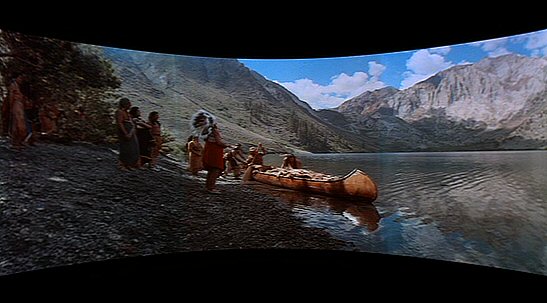
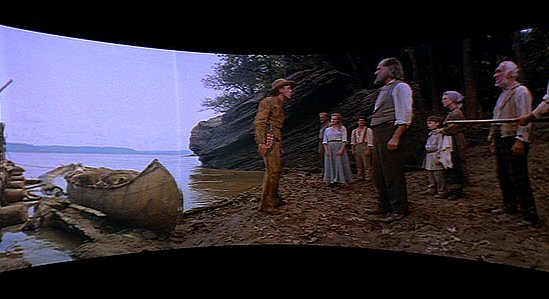
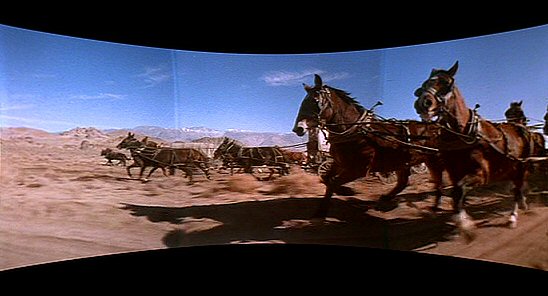
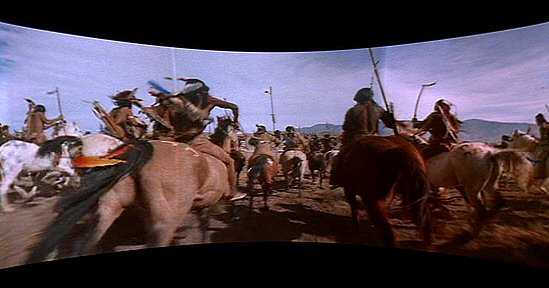
Here are some frames from the 3-camera Cinerama production "How the West Was Won" (I took these off of the old DVD and created the fake curved screen effect -- the new Blu-Ray has a "Smilevision" version on it):

htwww1.jpg


htwww2.jpg


htwww3.jpg


htwww4.jpg


You see that the basic principle behind Cinerama was very wide-angle image on a very large curved screen to create an immersive "you are there" experience where the side information sort of wraps around your vision. You'd have to use something like a 9mm lens on a Super-35 camera to get a similar horizontal view.
 
I don't see how this is true at all. The size of objects relative to each other in an image has nothing to do with seating distance. If a man (the subject) has a head that appears on screen to have a pixel diameter of X, and the moon in the sky behind him has a pixel diameter of 4X (due to the use of a telescopic lens), that's not "normal". The moon looks bigger than it does in real life, and likewise, if the shot was panned, there would be an illusion of speed with distant objects like the moon or the horizon that you can't replicate in real life without the use of a lens (like a telescope or binoculars).

When it comes to perspective, I think that gets thrown out the window when the size of the image doesn't sync up with real life. In other words, if you are watching a human subject on an enormous screen, his gigantic proportions are being compensated for, along with the perspective to match the size of the image, and even where the image is in the room. It's pretty simple for our brain to sort out.

ON THE OTHER HAND, the effects that wide-angle or telescopic lenses have on the image itself, regardless of where the viewer is sitting, do create effects that are clearly "movie-like" or "photographic", such as the skewing of the peripheral with a wide-angle lens, or the increased or decreased sensation of speed (depending on the lens and what you're doing with the camera), or the aformentioned changes in the relative size of objects in the foreground and background.

So I actually disagree with your statement, and would say that a normal lens is "normal" from the perspective of the filmmaker.

Thanks for the feedback. You have a point that image size can be blown up or shrunk down, so in that sense normality is really from the photographer's perspective, not the viewer's. But this is interesting, because then it only seems like normality applies through the lens, not really on the projector or screen. Once images are blown up or shrunk down, how then do we judge what is normal? This discussion has really made me re-think the whole notion of normal lenses.

@ David Mullen: I also understand that in an IMAX setting, it makes sense for the viewer to be able to see a wider angle of view so that his focus is not just zoomed into a large image, hence the use of wider lenses. But isn't this more related creating a better movie-viewing environment for the viewer, rather than creating a "normal" look for him? The reason I thought a longer lens would make for a normal image for the viewer is because if, say, the image represents a man standing right in front of you, using an 85mm lens makes the man seem closer to you given that you are sitting further away in a movie theatre. Of course this wouldn't make for a very pleasing movie to watch, being so zoomed into the man, but in terms of representing how close he is to you I would think its closer to being normal. Or maybe I'm just thinking about this in the wrong way.
 
Back
Top