Welcome to our community

Be a part of something great, join today!

  • Hey all, just changed over the backend after 15 years I figured time to give it a bit of an update, its probably gonna be a bit weird for most of you and i am sure there is a few bugs to work out but it should kinda work the same as before... hopefully :)

simulating sunlight through windows

kerry burrow

New member
Joined
Dec 28, 2012
Messages
1
Reaction score
0
Points
0
there are a number of scenes in a film i am DPing that will be shot in a basement with small windows at ground level, and when the natural sun is at a certain spot during the day it is exactly what we need naturally to shoot these scenes, however, the sun is only in the right place for about fifteen minutes. i am looking for to most effective way to simulate that light. i know in theory how to do it, but if there are any suggestions on low budget work around it would be great! if not i suppose we will have to rent a professional grade light... so i will probably need suggestions on that as well! thanks guys!
 
A Bright and hard light about 10 feet away from the window - Preferably daylight balanced.

Since they are small windows you don't need a lot of spread. A gelled fresnel or HMI.

If you are late in the day with low ambient light, a few LED panels can pull this off (I just did it outside a doctors office to brighten up our sun-goes-down-at-4-days-of-december-in-the-northwest).
 
My suggestion would be to bounce leko's (source 4's) into a mirror board. David Mullen ASC regularly does this. I'll see if I can find his examples.
 
Here's the post and image sample:

"Quote:
Originally Posted by Impagliazzo
David, I'm looking at some Roger Deakins' diagrams here and I see that in some setups sometimes he bounces the light with a mirror (eg. He bounces a 7K onto a mirror to produce a hard sunlight coming through a window - according to the diagram).

What's the advantage of that? Does the mirror affect the light in any special way?

Thanks in advance.
David, I hope you don't mind me answering, but I would think a mirror would just be to allow you to put a light where there isn't room or a way to mount it. Similar to aiming a Source 4 at a bounce card. With a mirror, it would also make the rays more parallel, and the light would fall off more gradually, as if the light is farther away. Maybe there wasn't room to put the light a long way away outside the window.


05-11-2009, 06:27 PMDavid Mullen ASC
Yes, a mirror may allow an effective "backing up" of a light to make it sharper, with more parallel rays, when you don't have room to back up the light along a direct line. Or it may help in getting certain angles.

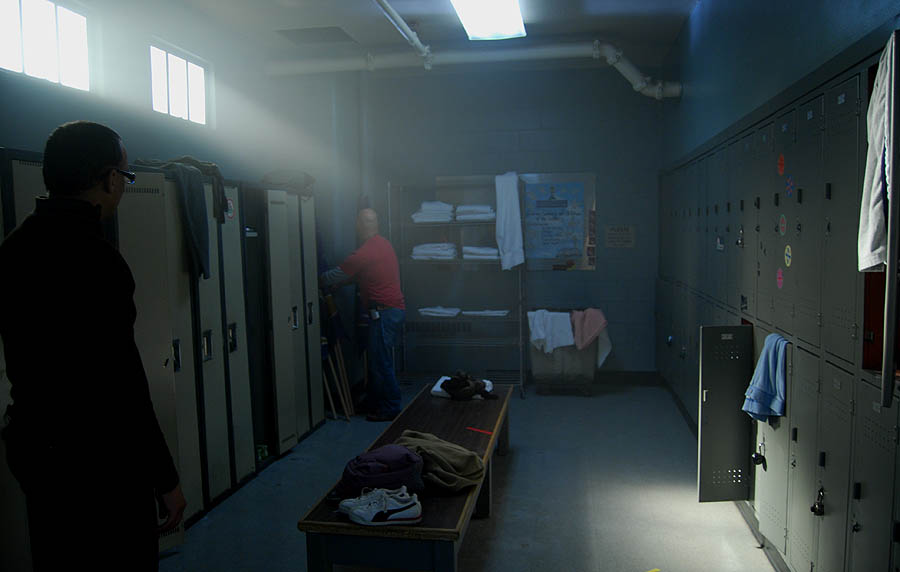
I recently was in a windowless, high school locker room and we added a false wall to make the space smaller. We put some casement windows at the top of the false wall so I could have a light source, but the ceiling behind the false wall was too low to allow me to have lights high above the windows streaming downwards. So I put some 4'x4' mirrorboards outside of each window, more or less tabled against the ceiling so I could bounce a light on a low stand on the floor up into the mirror and then back down through the window. I took this photo as we were finishing setting up the shot -- you can see how the light looks like it is coming from a high angle outside the false windows (I used 1K PARCAN's for the beams. That's Arv, the production designer, watching our set decorator Kevin finish dressing the room...)"

jb44.jpg
 
For small casement windows, I'd probably use Source-4 Lekos converted to use a Joker 800 HMI, maybe with a 36 degree lens, just depends. If I didn't mind a very warm sunlight effect, even cheaper would be to use 1.2K tungsten PARCAN's with very narrow spot globes ("Firestarters").

Mirrors reflecting the sun work great... if it's sunny. For one scene, that may be fine, but for a full day of shooting, I'd probably rather rely on a lamp than count on sunlight.
 
Back
Top