Welcome to our community

Be a part of something great, join today!

  • Hey all, just changed over the backend after 15 years I figured time to give it a bit of an update, its probably gonna be a bit weird for most of you and i am sure there is a few bugs to work out but it should kinda work the same as before... hopefully :)

Simulating Moonlight

Joe Taylor

Well-known member
Joined
Jun 29, 2007
Messages
1,146
Reaction score
0
Points
36
Location
Las Vegas, Nevada
Website
www.joetaylorcinema.com
Going to be shooting an extensive sequence using a Sony A7s II next Friday under direct full moonlight. A reverse angle will have a character situated in a small pocket/cove that is about 5' back and will have the moon to its back. For the sheltered cove shots I will need to simulate to match the natural moonlight using an LED.

Does anybody know what sort of gelling one might need to simulate this effect?
 
Hello Matthew, Many thanks for the tips. We have a portable LED (battery powered) with variable color temp and power. Even on low setting, I'll likely need to gel with ND's. I'll also likely need a bit of diffusion and certainly some blue gels. Just wondering what combo I might need to sort off.
 
But the human eye is not working color linear at this low "exposure" as the retinal cones need some amount of light. So the perception of a less saturated slightly blue image might not be so far off.
 
Hello Matthew, Many thanks for the tips. We have a portable LED (battery powered) with variable color temp and power. Even on low setting, I'll likely need to gel with ND's. I'll also likely need a bit of diffusion and certainly some blue gels. Just wondering what combo I might need to sort off.

Not sure about the diffusion, Moonlight -at least in a clear night- would not create a soft shadow. But think about desaturation, the human eye is not very capable of seeing colors in the dark.

Cheers
Ulf
 
Hello Ulf. Indeed about the hard-light the moon reflects, but my character is hiding behind a boulder in a shallow cove/cave/pocket and I'll likely need to tame the shadows some.
 
Hey David Mullen, but it almost appears "colorless" to the human eye, or at least teases the eyes with a blueish cast since our eyes have a tough time picking up on the color at such low light levels. That is how I've been educated from various Astonomy magazines. The important thing I need to do, and I'll have little time before next Friday, is matching the wide angle moonlit landscape shots (actual moonlight) and the medium closeups of my guy in the cove. The "Moonlit" reels on youtube and Vimeo of Sony A7 cameras all have a cool cast to them. I understand online examples are less than ideal but that's all I have for now.

I appreciate everybody's help!

Joe T
 
Push come to shove, you could just take a shot of an actual full moon to plant the seed in the viewer's mind, and shoot day for night.
 
Hey Elsie. The beauty of the new A7's is that they are so sensitive and so clean, even at 35,000 Iso (and higher I'm told) is that they capture brilliant starlight as well. There is NO WAY I'll simulate my landscapes or cheat with CGI. I've been researching these cameras and their low light abilities and limits for months. These cameras are completely capable of achieving what I'm going for.
 
Hey Elsie. The beauty of the new A7's is that they are so sensitive and so clean, even at 35,000 Iso (and higher I'm told) is that they capture brilliant starlight as well. There is NO WAY I'll simulate my landscapes or cheat with CGI. I've been researching these cameras and their low light abilities and limits for months. These cameras are completely capable of achieving what I'm going for.

O.K.
 
Yes, moonlight looks desaturated because the rods in our eyes work more than the cones in low light levels. But you aren't trying to match your lighting to your eyeball, you are trying to match it to the Sony A7S's response to daylight balance at very high ISO's, and if the daylight LED is similarly dim, then the color saturation should be similar. You may find that the LED lighting is higher in contrast though because you don't have moonlight hitting the atmosphere and scattering some light, except of very clear nights.

Also, since moonlight is daylight-balanced, how blue it looks is mainly just in comparison to a tungsten source. If you are out in the desert with no tungsten around, then your eyes adjust to the color and it is more or less white, not blue. It only looks blue if you see moonlight falling on a house with a tungsten lamp in the window, etc.
 
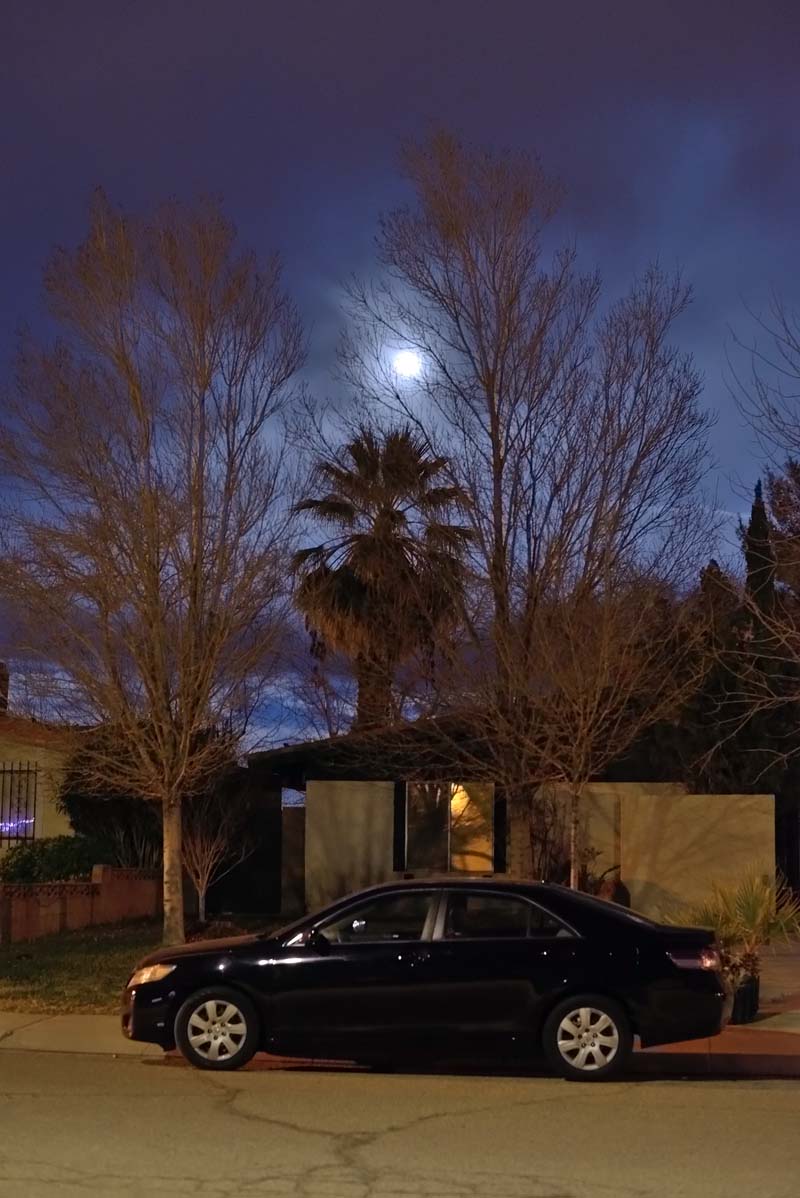
Here's a recent photo that I took with my still camera set for 3200K of a sodium-lit street with the moon rising in the background -- so can see that the daylight-balanced moon is blue compared to the sodium-lit street and the tungsten windows:
moon1.jpg
 
Hey David Mullen, but it almost appears "colorless" to the human eye, or at least teases the eyes with a blueish cast since our eyes have a tough time picking up on the color at such low light levels.
The thing you have to remember is: films are generally about emotion, not about scientific accuracy. Lots and lots of filmmakers go for heavy blue filtration for moonlight, and it's been a movie cliche for many years. I don't have a problem with it -- damned near every horror/fantasy show on television does this. It's more about style and what feels right, not what is technically right according to astronomers.

Here's a recent photo that I took with my still camera set for 3200K of a sodium-lit street with the moon rising in the background -- so can see that the daylight-balanced moon is blue compared to the sodium-lit street and the tungsten windows...
And I think "The Moon Is Blue" is a famous 1950s romantic comedy.
 
Another important bit of info needed to consider, as David brought up about mixed color temps, is that my character walking through the moonlit landscape is carrying a fire-lit torch. That is an important element that needs to be addressed as far as balancing for realism. Another concern is that if I'm shooting at ISO 25,000 or thereabouts, will I be blowing out or even clipping the torch if I'm exposing mostly for the moonlit landscape.

In some the demo videos, folks are wearing head lamps and there are bonfires that manage to look natural in relation to the moonlit environments, so that eases some of my concerns. I'll be able to test the torch out on Wed before our shoot on Friday night.
 
I'd set up as many lights as you'd need and gel blue and diffuse to taste basically. For recreating things, you're not going to get the vast moonlight expanse that you'd see on a full moon night with the A7S series unless you had one of those big tethered blimp light rigs. If it's lighting the lip of a cave or backlit cove or whatever it is that you're doing, I'd say pick an angle of light, fix up additional area lights if you can for scene fill, and make it blue.
 
Many thanks Zack. The shots of the character in the cove will only be filmed at medium shots and some close ups. The LED panel we are using throws plenty of light for these shots. In fact a bit too much even at it's lowest setting. If I do go with some cooler gels and a bit of light diffusion and have the panel placed back far enough to evenly light the small area, I should be fine.

Monday I'm picking up some gels from JR lighting and we found time to test the rig on Wednesday night. I do appreciate everybody's advice and knowledge shared here.
 
Just for safety, we are filming the same sequence at dusk and again just at the cusp of darkness. These shot's I'll shoot with a Red. Ideally though, I really want real night using true moonlight and providing a clear night, I really want those stars to shimmer. That's the shot I've envisioned for so long.
 
Here's a recent photo that I took with my still camera set for 3200K of a sodium-lit street with the moon rising in the background -- so can see that the daylight-balanced moon is blue compared to the sodium-lit street and the tungsten windows:
moon1.jpg
I really like this shot as explaining the problem. I'm doing a lot of mixed indoor/outdoor shots and this is helping me think through them. I am also using what you have been saying on parabolic lighting, and beefing up the the outside "blue" light into the inside practical "redish" lights using parabolics. I've actually confused some people recently on what time of the day it is as they walk into a set. I btw am using the hive lights with the knob turned into the blue area for night "moon" lighting shining into things like kitchens. I also find this problem very similiar to external "rain" based indoor shots.
 
Hello Ulf. Indeed about the hard-light the moon reflects, but my character is hiding behind a boulder in a shallow cove/cave/pocket and I'll likely need to tame the shadows some.

Not sure if I understand the situation correct, but with the moon in the back you will probably just have a bounce of the environment so a board should be fine. If the rock is blocking the moonlight and you want to replace it with the LED I think David was spot on just use it daylight balanced through a very light diffusion (ideally not directly on the LED better keep it 10" in front) and add a board for fill. Desaturation / look might be better done in grading and will probably don´t be different from the moonlit footage.
Sounds like a very interesting project, good luck!
 
Back
Top