Welcome to our community

Be a part of something great, join today!

  • Hey all, just changed over the backend after 15 years I figured time to give it a bit of an update, its probably gonna be a bit weird for most of you and i am sure there is a few bugs to work out but it should kinda work the same as before... hopefully :)

Shooting Fire

paulherrin

Well-known member
Joined
Oct 13, 2008
Messages
3,555
Reaction score
0
Points
0
Location
Johnson City, TN
Does anyone have experience, especially on RED, shooting in and around extreme heat and fire?

Specifically, heat and safety issues with the camera's stability in such an environment. I'm talking about getting close. Also, any general things like gauging exposure, etc.

I'm a volunteer firefighter, thinking about making a short, just to give some reference of scope. I'm not wishing to lose a camera or person making it, either.

Any thoughts or ideas would be really cool, thanks!
 
Which sensor are you using? The Mysterium is quite responsive to IR contamination, the MX not so much. With either sensor you'll probably want to use a 'hot mirror' IR filter to get rid of the purple hues from the infra red light.
 
Consider using Pancro IR Mirror filters, which reflect heat.
Consider making a heat reflective jacket (maybe aluminium foil) with good ventilation for the camera .

Edit: Better still, consider a long lens and keep your distance :)
 
Edit: Better still, consider a long lens and keep your distance :)

lol, if only we could... we seem to end up right in it one way or another...

even with some kind of silver jacket, which i'd probably try to use some of the same materials they make our suits of, it still gets pretty hot in there... i'll try to look up some temperature data here, but suffice it to say, you're not getting cold in there.

this would likely be a future job for the scarlet 2/3...

thanks so far!
 
I've shot fire before with the red.

You need a decent sized fire to get exposure, and one with a lot of flame. Shoot full open and you should be fine.

In terms of safety, when you start to really feel the heat, you are probably too close, so just back up a few feet and use a long lens.

Are you planning on using any other lights besides the fire?
 
i'm assuming you're referring to a campfire? as it happens, i'll be shooting a scene in that scenario at the first of the year, any lighting tips?

for this thread i was speaking specifically of large fires, as in structure fires, as in you call the fire department to pull you out and put it out, so i think the characters will be well lit... haha.
 
Get a couple of ice packs like the one below. Fill them with ice and tuck them under the top handle and maybe gaffe taped to the RED Drive. They don't leak and they are easily refillable from the craft ice chest.
 

Attachments

  • blue-ice-pack.jpg
    blue-ice-pack.jpg
    18.7 KB · Views: 0
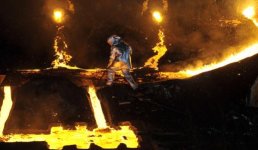
Recently did a shoot where 5 blast furnaces were used to do a 25 ton cast iron pour. The heat was pretty insane. They used 5, 480 volt fans and many tons of coke to get enough heat to melt the iron. In the end we only lost one lens. One of the operators who had a red on a mantis rig went a bit too close to the pour, fortunately he had steel workers or welders leathers on but his AC did not and was not able to help him. The imagery is pretty awesome. I was surprised how much light the molten iron put off, if you are shooting with mx sensor, no worries. Protect the lens though.
 

Attachments

  • Cu,Iron,worker.jpg
    Cu,Iron,worker.jpg
    29.3 KB · Views: 0
Speaking about direct heat - if you are okay camera will be okay too.

If you are shooting in extreme heat and fire with no experience camera's stability is the least of your worries. Your face will burn before camera will get damaged. Don't stand long in a very hot place, take a shot and move away. It would be smart to have someone to watch the fire while you watch the shot.

You don't need one minute shots very close to the fire. If you do hire someone who specializes in this.

You might want to cover the vents with a cloth to prevent tiny particles from going inside vents but the cloth has to be thin to allow normal airflow.

If you have no experience with large fires and don't know what is burning inside, don't go close. If the fire is large and uncontrolled by trained people don't go close. If it's very noisy environment don't go close.

You might end up with smoke aroma on your camera which is temporary and not a problem.
 
very awesome! thanks man! did ya'll use any kind of protection for the cameras to keep the heat away, or keep them cool?
 
hrvoje, i would be wearing protective gear and breathing apparatus, are there any options you know for going in close without melting or damaging the camera? (i.e. some kind of housing or jacket?) or do i just have to keep a certain distance?
 
Red is not made of plastic. If the metal melts you are in worse trouble. It won't cook before your skin unless you leave it closer to the fire. I wouldn't suggest shooting a scene which demands that type of protection if you have no experience.

Keep a distance which is comfortable - temperature wise. When you start feeling stronger heat on your face or hands step away and cool down. Camera will be fine. Don't try to catch "this" and "this" and "just this one more" shots. Start recording when away and stop recording when you get back.

Needless to say - no poking through menu or settings while close...as in any other dangerous shooting situation. :)

For this purpose I'd suggest ditching focal lengths up to 80ish, except for wider shots. If you really need something closer shoot smaller fire shots and edit them together.
 
Well, if you're wearing Nomex you must be IN the fire, so...
Clairmont Camera makes a steel housing that you hook up to a water source. It's constructed with an inner and outer wall of steel, and the water flows between them. As long as you can feed it water, your camera will stay cool.
They built them for the Ron Howard movie "Backdraft".
I got to use one for an insurance company commercial a few years back. Worked like a charm. We put it in a real live fire in a house the city had condemned, under the supervision of the local FD.
Be careful.
Cheers,
Harry
 
here's some fire I shot under public basket ball court lighting last night.. it's a tricky balance to expose skin and flame in the same frame... http://www.vimeo.com/17362104

The more light the better in my opinion : )
 
thanks guys, cool stuff! i'll check into that housing, harry, do you happen to have a link? thank you!
 
In general flame is as bright as sunlight. (you can see flame in daylight, right?)

Reflective material like aluminised blankets reflect 90% of radiated heat.
If you wear fireman's structure fire outfit and use a reflective cover for the camera then you can go hand held quite close to a structure fire, basically you can go where firemen go.


However any exposed skin will be burnt, perhaps in as little as 5 seconds.
So your hands should be gloved.

To protect the lens use a shott glass filter, clear and good for 450C.

For locked off shots with a very well protected camera the use of ceramic filter (pink and slight diffusion effect like a promist or warm soft fx) offers protection to 2000C.


I've shot with the above setups where the BA visor melted (800C) and where the structure kid began to smoke yet the (f900) was ok.


Numerous tests, practice runs and training help ensure controlled shooting methods.


Mike Brennan
 
great info and advice, thanks mike! would the ceramic filter break easily with too much pressure on it? i.e. moving around, or bumping, etc.
 
Back
Top