Welcome to our community

Be a part of something great, join today!

  • Hey all, just changed over the backend after 15 years I figured time to give it a bit of an update, its probably gonna be a bit weird for most of you and i am sure there is a few bugs to work out but it should kinda work the same as before... hopefully :)

Shooting 2.35:1 on Scarlet.

Daniel Valle

Well-known member
Joined
Dec 14, 2009
Messages
65
Reaction score
0
Points
0
Does anyone have any idea of how this will work, both on the 2/3 and S35 Scarlets?

Will it be a window mode on the sensor?
 
Most people just frame for cropping to 2.35, so they record 16:9 or 2:1, frame for 2.35 but protect the whole recorded area.

Red can be selected to window/crop the left & right sides of the sensor in ANA mode when a 2X anamorphic lens is used on the camera. This is because when the image has a 2X optical squeeze, the recorded area only has to be 1.20 : 1 in order to get a 2.40 : 1 image once unsqueezed.

Are you asking if that mode will be in the Scarlet's? I suspect for sure in the S35 Scarlet since Red is making 2X anamorphic lenses, but since the 2/3" Scarlet uses a different mount, not sure the ANA mode will be included there -- though there's nothing stopping you from not windowing and just doing the trim of the sides in post. And I doubt it's a big deal for Red to put the ANA mode in the 2/3" Scarlet either.

But it's far more common to just shoot with normal spherical lenses and frame for cropping top & bottom in post. In that case, Red cameras do not have a mode where they only record a 2.35 window of the sensor. You just select framelines in the menu to help you compose for cropping later to 2.35 -- I'm sure the Scarlet will have the same selectable frameline system.
 
I think I'll mainly be shooting 2:1 and cropping. It really depends on the native aspect of the sensor - I think it's 2:1 on the 2/3" at least.

The 2/3" was spec'd in the October 30th announcement as being 10.1mm x 5.35mm with an active pixel count of 3072x1620.

3072/1620 =1.896296296296296:1

So not quite 2:1. Although, honestly...trimming it down a bit shouldn't be anything to worry about, IMO.

3072/2.35
=1307.23404255319133

SO you're looking at 3072 x 1307 at 2.35:1. That's still a lot of real estate, IMO. I mean, we'll have to see how it works out in practice, but as long as there's no issue with moire or other artifacts the resolution itself should be plenty for most uses.

BTW, be sure that the material you want to shoot is well-suited to a big wing like 2.35:1. Like, I'd have hated to shoot something like The Killing of a Chinese Bookie in 'Scope. Honestly, I'm always amazed by all the hand-held stuff in The Graduate. The camera follows Hoffman up the stairs and in and out of clumps of people at the party and it never turns into nausea-cam. But it could have pretty easily. I don't know if Robert Surtees operated the camera himself for those hand-held shots, but they're some great stuff.
 
I haven't shot anything above 1080p, but I don't understand why people crop their stuff to such a wide ratio. 16:9 seems plenty wide, and I find it awkward to frame shots into a wider thinner strip.
I'm creating an animation at the moment so I have the freedom to make the resolution higher than 1080p. But the presets in After Effects for cineon, 2k and 4k are all 4:3!
Can someone give me a straight answer as to what size above 1080p would be the most accessible to theaters? These threads always get into the complicated math of the sensors. I just want a standard square pixel widescreen resolution so that I can get to work.
 
Theatrical projection is either 1.85: 1 ("flat") or 2.39 : 1 ("scope"), and it's about 50/50 in terms of number of releases in each.

So if you don't like the 2.39 ratio, then use the 1.85 ratio -- which is so close to 16x9 (1.78 : 1) that you can complete the animation project in 16x9 full-frame it will be slightly trimmed during projection top & bottom to 1.85.

The 2.39 ratio (CinemaScope) has a long history to it; it's just another aspect ratio, one that emphasizes horizontal width and usually is a larger image horizontally on many theater screens, so the image seems to "open up" on the big screen, at least laterally. Yes, it's an awkward aspect ratio to frame for, but that's just one of its unique qualities, the extreme width of the frame.

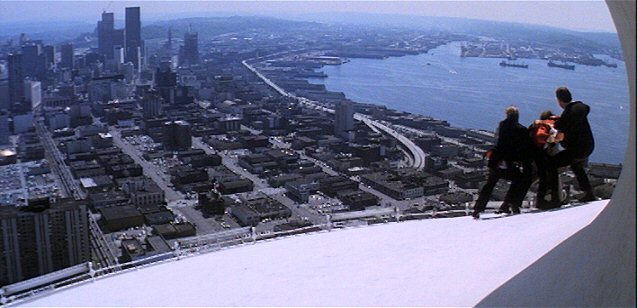
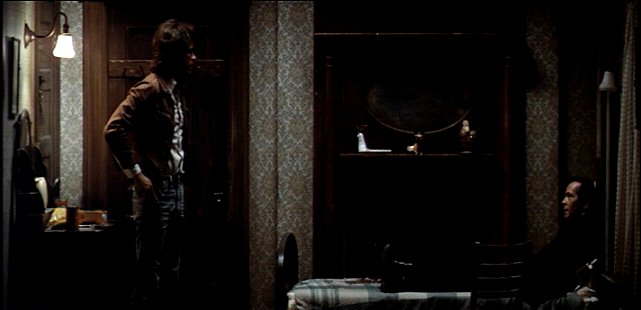
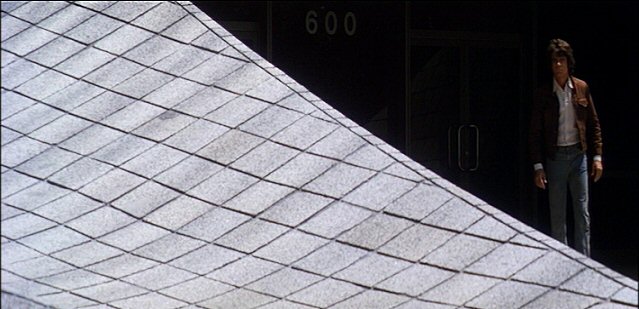
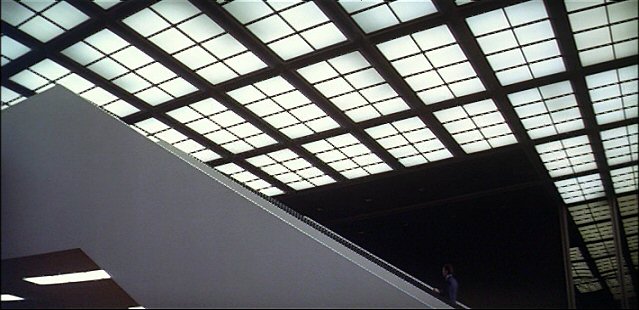
In modernist composition, it tends to emphasize negative space and imbalance, isolating a character in an environment, or setting two characters apart. Like in Gordon Willis' cinematography of "The Parallax View":

parallaxview1.jpg


parallaxview3.jpg


parallaxview4.jpg


parallaxview7.jpg
 
Had to rent that movie because of those screens.

I like the 1.85 ratio, so for 2k my resolution would be 2048x1107 square pixels? Or is there a more standard resolution for 1.85?
 
That's official ratio?
Well, I should have missed something. But... Well done!

I think there isn´t officials, but modern lens developers bet for the 2x and Red offers this crop factor.

Aguanta la calor, Quillo!!
 
2X isn't the aspect ratio, it isn't a crop ratio, it's the optical squeeze / horizontal compression ratio. On a 2:1 recording, when using a 2X anamorphic lens, the unsqueezed image would be 4:1.

2X has been the standard for 35mm anamorphic shooting since the beginning, the original Hypergonar lens invented by Cretien in the late 1920's that was used for the first CinemaScope movie in 1953.

The original intent for CinemaScope was to shoot and project 4-perf 35mm Full / Silent Aperture (1.33 : 1) so that the unsqueezed image on screen would be 2.66 : 1 (same as Cinerama's), with the sound run in interlock on a separate 35mm mag roll. But then they decided to put mag stripes on each side of the 35mm print, using a print stock with smaller sprocket holes ("CS perfs") which shaved the sides of the projected image from 2.66 : 1 to 2.55 : 1. Even later, they decided to use a standard optical soundtrack on the left side, as with Academy movies, which shifted the optical center over and shaved the overall width of the unsqueezed image to 2.35 : 1.

Then in the early 1970's, they decided to make the projector mask a bit less tall in order to hide frameline splices better (the anamorphic projector mask is basically Academy in width but Full Aperture in height.) Trimming the top & bottom off of the projected image turned 2.35 into 2.39, often rounded up to 2.40 in print literature.

So if the projected image is nearly 2.40 when unsqueezed, it means that the projector mask and image on the print itself is nearly 1.20 : 1 with a 2X optical squeeze. What this also means in digital terms is that the area of the sensor that will actually be used in the final image will also be 1.20 : 1 whether or not you record more width like 1.78 or 2:1. Hence the 1.20 : 1 "ANA" recording mode of the Red One, which basically saves you from having to record more horizontal information than you need when using 2X anamorphic lenses (you'd want to record 1.78 / 16x9 if you were using 1.33X anamorphic lenses.)
 
Thanks David for the technical and history explanation!!

Sometimes is difficult to explain if you don't know the right words.

So... If you use a RED S35 sensor, with a 2x RPA you will use 18mm x 15mm sensor area for the squeezed 2.4:1 image. You will have the DOF of a 36mm x 15mm sensor and the anamorphic artefacts.... So you could have the same DOF (without the pretty anamorphic artefacts) using a RED FF35 sensor (36mm x 24mm) and cropping. Isn't it?
 
I've never used a RED ONE, so I don't know if it already has this, but it would be great if RED could add an option to "darken" the area of the frame that you're not using, when shooting 2.35:1.

So you can see what's outside the intended aspect ratio, but still protect the entire frame.
 
I believe this is already done with the GUI on scarlet and epic. I don't know about R1 either.
 
I've never used a RED ONE, so I don't know if it already has this, but it would be great if RED could add an option to "darken" the area of the frame that you're not using, when shooting 2.35:1.

So you can see what's outside the intended aspect ratio, but still protect the entire frame.

Never used the Red One (yet ?) but as some people said on this forum, we can have guidilines on the display to know what won't be in the image after croping.

Have those portions darken won't help as we won't see anymore if the boom is close to get in the frame or not.
 
By darken I mean cut the luminosity by 50% or something. Or make it black and white, desaturated, what have you.

You could still turn it off quickly with an assigned user button.

Guidelines don't give you the exact feel of the frame you're creating, in my opinion.
 
Thanks David for the technical and history explanation!!

Sometimes is difficult to explain if you don't know the right words.

So... If you use a RED S35 sensor, with a 2x RPA you will use 18mm x 15mm sensor area for the squeezed 2.4:1 image. You will have the DOF of a 36mm x 15mm sensor and the anamorphic artefacts.... So you could have the same DOF (without the pretty anamorphic artefacts) using a RED FF35 sensor (36mm x 24mm) and cropping. Isn't it?

Sort of, it's a bit apples and oranges in the sense in that the DOF characteristics are warped a bit in one direction (lateral or vertical) by the squeezing and enlarging, etc.

But in theory, yes, in that if you used a 20mm spherical lens on a R35 camera, cropped vertically to 2.40, and then switched to a 40mm anamorphic lens to get a 2.40 image... you'd then switch to a 40mm spherical lens on a format that was twice as wide to get the same 2.40 image, so the DOF would be similar between the two 40mm shots.

Right now, the 4K ANA frame on the R1 is 14.93 x 12.44mm, so one could get the same 2.40 image with a 40mm anamorphic lens on the R1 as a 40mm spherical image on the FF35 Epic if one used a 29.86 x 12.44mm area of the sensor. So if the 4K ANA mode ever could be increased to 18 x 15mm on the R1 with a M-X sensor (or let's say, a S35 Epic) then yes, you'd get the same DOF (more or less) as using the same focal length but in spherical instead of anamorphic on a 36 x 15mm area of the FF35 sensor. Because you are using the same focal length at the same distance to subject in both cases for the same field of view.

But as I said, the anamorphic aspect does have some minor effect on DOF calculations if you want to be really picky. Vertical DOF would be the same either way -- 40mm for a 15mm tall sensor area for example -- but because the anamorphic 40mm version would have to be enlarged by 2X horizontally to match the spherical 40mm version (18mm versus 36mm), in theory you'd be using twice as critical a CoC figure for the anamorphic version, i.e. you'd have less depth of field. But only horizontally, if that makes any sense...
 
Back
Top