Welcome to our community

Be a part of something great, join today!

  • Hey all, just changed over the backend after 15 years I figured time to give it a bit of an update, its probably gonna be a bit weird for most of you and i am sure there is a few bugs to work out but it should kinda work the same as before... hopefully :)

Sennheiser MKH-416 Mic High Frequency Problem ?

King Cheung

Well-known member
Joined
Dec 6, 2009
Messages
229
Reaction score
0
Points
0
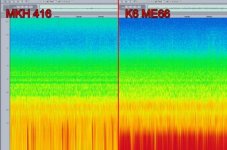
Recently when I use my Sennheiser MKH-416 mic, there is always a boost of high frequency noise (11kHz+, -55dB), which cost me a lot of time and effort in post-production. So I tried to conduct a experiment, using a K6/ME66 mic to compare with the MKH-416. In the experiment, I used Sound Devices 702T, and made everything else as controlled variables (time / place / direction/ gain/ input terminals… ). However, no matter how the independent variables changed, the high frequency noise was always there.Have you come across the same problem? Is it an inherent self-noise of MKH-416? Do you know how to fix it?

Please find the attached image showing the problem.

Thanks for your answer in advance. Best wishes and kind regards.


Attachments

  • ac4bd11373f0820225a1cad649fbfbedab641b23.jpg.jpg
    ac4bd11373f0820225a1cad649fbfbedab641b23.jpg.jpg
    19.3 KB · Views: 0
there is a bit of a bounce around 10khz in the mic, but shouldnt be noise. i know when i use my 416 in the city, it picks up part of the city general rumble if i am not careful and pointing at a dead surface when i'm working a boom. u can always do a sample and post it on gearslutz, they have a ton of 416 experts overthere.
 
Replace the mic and try a different one. I actually prefer the MKH60, and the Schoeps CMIT is also an extremely good shotgun mic (arguably better than either Sennheiser). My bet is that you may be picking up HF noise in the room, or the mic is defective. I've never, ever heard 10kHz noise in the 416's I've owned.
 
This is probably a silly question or two but here goes anyway which might prompt somebody else into a thought that solves your problem..


Is your 416 the 48v phantom power version or the "T" power version?

Are you operating it near any other similar mic? The Sony C64 and C76 will mess with each other if two of either are paired too close.

What is your phantom power source?
 
I bought a used 416 and sent it to Sennheiser for evaluation. They tested it and it passed and they sent it back to me. No charge.
 
This is probably a silly question or two but here goes anyway which might prompt somebody else into a thought that solves your problem..


Is your 416 the 48v phantom power version or the "T" power version?

Are you operating it near any other similar mic? The Sony C64 and C76 will mess with each other if two of either are paired too close.

What is your phantom power source?


Thank you so much for your reply. I am quite interested in how phantom power affects microphones ?

Actually both my 416 and ME88 use 48v phantom power. I tried to turn off the other inputs and the phantom power, only left the 416 to record, and the result was the same.
 
Again: get a different 416 and compare it. It's very possible the one you have is simply broken. I have found that different generations of MKH416's do sound different. They've been making this model for I think at least 30 years, so you may have a 30-year-old mic with 50,000 hours of use on it, or it may be a year old and only have 100 hours on it. Getting a second mic would at least give you a point of comparison.

Robert above has a good point: the mics do misbehave if they're not getting clean 48VDC current. They'll do strange things with 12 volts, for example.
 
Regarding 48v phantom power and "T" power models, apparently a "T" power model may work on 48v for a while but eventually die. This happened on a shoot a few years back over here when a "T" power 416 was powered off a JVC GY-HD111 which was a 48v system. I vaguely recall "T" power may be only found on older mikes but again, the better knowledge possessed by others here will hopefully fill in the gaps.
 
The Sound Devices 702T. To anyone else out there, does the 702T supply a choice of 15v and 48v power to mikes? My older Sony C74 mike will not work with 15v but a newer Sony ECM-674 seems quite content with either.

I have also observed that newer XLR plugs with black painted casework rely entirely on the shiny retention spring for electrical connection of the outer case to the Mix-Pre I use. They have been a problem causing intermittent crackling even though there should be internal connection to the cable shield. I have three dud cables which do this on the Mix-Pre. Given the AC nature of phantom power, there may be a harmonic loop being set up which reproduces as an int4erference in audio spectrum. - Pure wild guess on my part.
 
More suggestions which may or may not send you and other respondents here down an investigatory dead-end.


On your 702T, do you have the limiter selected "on"? Does selecting this "on" or "off" have any influence on the issue you are experiencing?

What power source are you supplying your 702T itself from? Does the issue vary when different power sources are used?
 
Back
Top