Welcome to our community

Be a part of something great, join today!

  • Hey all, just changed over the backend after 15 years I figured time to give it a bit of an update, its probably gonna be a bit weird for most of you and i am sure there is a few bugs to work out but it should kinda work the same as before... hopefully :)

Scarlet '2/3 cinema' clarification ...

David Nardini

Well-known member
Joined
Jan 5, 2007
Messages
546
Reaction score
0
Points
0
Location
Hampshire, UK
Can I just check that the whole 2/3 chip will be a 3k chip ... ie: if one was to use a 2/3 HD lens (say a Canon HJ11, 4.7-52mm via a B4 mount adapter) it will cover the whole chip with each frame (in theory) being 3072 x 1728 (approx) in 16:9 ? ie, no frame crop ...

Cheers
 
I would imagine that would be the case from the name designation, but I cannot directly confirm it - perhaps someone at Red will be able to. Do bear in mind though, that it is not a finalised system yet (although the chip may be by now), and Red are famous for last minute changes to spec - granted, usually for the better, but all the same, I wouldn't count on anything until they ship, and that's Jim's own advice!

One thing I can tell you though, is that the Scarlet will be a single chip system and will therefore require an optical adapter of some kind in order to focus the different wavelengths correctly onto a single plane. This adapter would - presumably - also scale the image slightly if required, as does the current Abakus adapter.

It may well also be the case that the "2/3" Scarlet is being intentionally designed with an S16 sized sensor to make use of the already existing Abakus adapter...

Just some food for thought, maybe others will have more definitive answers!
Dom.
 
Hmmm... OK, just had a look at the 2/3" spec up at red.com/epic_scarlet, and found that the sensor size is listed as 10.1 x 5.35, which is significantly larger than 2/3" which is 8.8 x 4.95, iirc.

Now, some of that may be look-around area (it's unclear whether those are active pixel areas, full pixel areas or recorded areas), but either way it looks like, despite it's name, it is actually aimed at the 16mm format (Standard 16mm is 10.3mm x 5.8mm) but that's perhaps quite good news as it means that your HD video glass should cover the full frame after going through the Abakus without any crop factor to speak of, and the image will focus correctly...

Cheers,
Dom.

Cheers for the research ... essentially I am hoping that the HD video glass (via a B4 adapter similar to the existing RedOne version) 'will' cover the full frame (none to minimal crop) and therefore be able to get as close as possible to 3k output files from the basic Scarlet model.
Main reason I ask is that on the R1 (with the Red B4 adapter) at 2k it's fine, at 3k it vignettes (with the Canon HJ11; 4.7-52mm); thus I assume the pixel density on the Scarlet 2/3 chip must be higher.

Thanks and fingers crossed this is the case ;-)
 
No worries mate!

Sorry for the over-complicated response - I seem to have spent most of it telling you stuff you already know!!

So, in an attempt to be more useful:

Yes, higher pixel density in the Scarlet chips - the Red one is about Super-16 @ 2K, whilst the Scarlet will be (by the sounds of things) about standard 16 @ 3K...

You can - I believe - safely uncross those fingers! :)
Dom.
 
The 2/3" HD 16:9 reference frame for lens coverage is 9.6x5.4mm nominal. The Scarlet 2/3" chip is 1.89:1 2k theatrical format widescreen rather than 16:9. B4 lenses should cover no problem. Active pixel area for 2k format is approx. 9.8x5.2mm. Active 16:9 area based on the previously stated pixel size of .0032 is approx. 9.2x5.2mm. Both fall within the nominal 11mm image circle of the 2/3" spec.
 
Hmmm... OK - thanks for the exact info David.

The challenge there is that a standard Abakus (or Red, same thing) adapter for B4 lenses is going to needlessly loose you FoV and stop.

So perhaps it's time for a new adapter to the Scarlet chip size? I would have thought it would have been more sensible to build the Scarlet chip to match the S-16 size that the Abakus adapter is designed for, it (or something similar) being a necessary part of shooting to single-plane devices with video lenses, but hey-ho!

Dom.
 
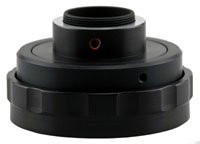
Why are people assuming there will be a need for an adapter. I understand that most 2/3 video lenses were designed with a prism beam splitter in mind but isn't that just a flangefocal distance issue. My understanding of the current B4 adapter optic was to increase the image circle size, but as dominic pointed out that won't be necessary for 2/3 scarlet. So, I believe B4 lenses can be accommodated with a much simpler mechanical adapter or B4 mount (i.e. something RED makes or if the FFD is okay we could just adapt a B4 mount from an old camera.

I question this as I have seen (and purchased from NASA JPL via an auction) single chip high end cctv cameras that used standard (but expensive - nasa paid over $15K for the one on the unit I bought) B4-type video lenses via an adapter to c-mount that does not have any optic in it. (which I still have by the way and will keep or sell depending on my Scarlet purchase).

PS just found the info on Century Schneideroptics C mount to 2/3" Bayo for $499:

http://www.schneideroptics.com/ecommerce/CatalogItemDetail.aspx?CID=1094&IID=1084
 

Attachments

  • 0LA-23BC-00.jpg
    0LA-23BC-00.jpg
    21.8 KB · Views: 0
The problem is that lenses designed for a beam-splitter system focus the Red, Green and Blue components of the image to different depths, as the 3 CCD or CMOS sensors are not equidistant in 3-chip cameras. Obviously, for a single-chip system they need to focus on a single plane, and so it is not a simple issue of flange depth.

For longer focal lengths with a wider depth of focus, that may not be such a large problem, but for wider lenses it certainly will be - I don't know anything about the system you describe above, but that is my understanding of the issue...

Maybe there's something I'm missing?

Cheers,
Dom.

This is just a discussion point - not trying to be difficult, but are you sure it is the lens that puts the different colors at different depths?

Seems like that would be very difficult to do optically with normal elements, AND it would be much easier just to mount the individual RGB chips on the chip block at the right depths from the prisms to compensate for the different wavelenght FFD distances (or to put optical elements in front of the individual chips if necessary. I.E. since the lens itself is zooming and focusing it seems like it would be much more complicated to try to accurately split color depths to compensate for differences in the fixed depths of the chips rather than a simple optic in front of the individual chip - since that depth would never vary.)

Also, although I never fired up the single chip camera with the lens adapter since I bought it for the lens to use on a three chip camera and sold the camera off separately, it seems strange that someone that spent all that money would have done something that didn't make sense optically - not to mention that Century sells those B4 to C mount adapters specifically for this purpose.

PS the lens I bought from the NASA auction was a $16K extreme wide angle zoom - the widest Canon available at the time.
 
No worries mate, no difficulty assumed on your part!

Well, I'm pretty sure that the lens is involved (I'm starting to doubt myself now - I hate it when that happens!) - I think it's the case that video lenses do not correct for the different optical paths of the different wavelengths of light (the chips being spaced to take account of this, as you rightly presume), whilst "film" lenses (for stills or cine cameras) do have to make this correction, due to the (effectively) single plane of focus... I believe that's the reason Zeiss designed and built the DigiPrimes, rather than simply producing 16mm superspeeds with a B4 mount on the back...

No idea about that NASA rig, but it certainly does sound odd, particularly with the wide lens - maybe that's why they flogged it?! ;-) I jest, I jest!...

Seriously though, you are sure I take it that it is a perfectly standard video lens? Anyone else able to chime in on this one?

Dom.
 
This is just a discussion point - not trying to be difficult, but are you sure it is the lens that puts the different colors at different depths?

Yes, the lenses are designed to a defined standard to focus through a prism rather than air. The same issue exists with lenses designed for Bolex 16mm reflex cameras. You get spherical chroma aberrations when these lenses are focused through air, slight, but definitely visible. There are many C-mount cameras with 3-chip prism imagers too.

I am sure the B4 adapter for Scarlet will have optical correction. It won't need the magnification to cover the 35mm chips.
 
Why did I know you'd be the guy to ask on this one David?! You're fast becoming my 2/3" guru on this forum!!

Glad to know I'm not going mad - cheers for that!...
Dom.
 
As the current R1 B4 adapter also increases the imaging circle of the lens to cover S16, which the Scarlet version would not need to do. It would be possible to use an existing adapter, but you would lose a little FoV, stop and sharpness unnecessarily...
 
Again, not trying to be difficult (alright I'm a transplant from Missouri - the "show me" state) but I'm still a bit perplexed. I'm aware there are 3-chip C mounts - (I have several if anyone is interested!) but that makes me wonder also since certainly the c mount lenses weren't made to focus the colors at different depths? I will have to try the adapter out sometime. The NASA camera was a Hitachi single chip although as Dominic says maybe that's why they junked it!
 
Again, not trying to be difficult (alright I'm a transplant from Missouri - the "show me" state) but I'm still a bit perplexed. I'm aware there are 3-chip C mounts - (I have several if anyone is interested!) but that makes me wonder also since certainly the c mount lenses weren't made to focus the colors at different depths? I will have to try the adapter out sometime. The NASA camera was a Hitachi single chip although as Dominic says maybe that's why they junked it!

C mount industrial lenses are made in different series for single chip and 3 chip cameras. The CA problem is minimal except for wide angle lenses, so may not be critical for some applications.
 
As the current R1 B4 adapter also increases the imaging circle of the lens to cover S16 ...

Did not realise it increased the image circle to cover S16 ... (am I correct in assuming S16 = 12.52 x 7.41 mm ?) & equivalent to 2k on the R1.

As things stand, Scarlet is 10.1 x 5.35mm (and 3k density) ... looking good unless I'm missing a trick.
 
C mount industrial lenses are made in different series for single chip and 3 chip cameras. The CA problem is minimal except for wide angle lenses, so may not be critical for some applications.

I see. Thanks for the clarification.

Of course one of my uses would be for wide angle underwater so that is a big issue. Guess I better keep my old C mount 3.5mm Super Cinetar movie lens!

Since the obvious use for most people would be to get b4 zoom lenses, at what point do think it is a problem? Are you considering a 15x starting at say 8mm zoom to be wide in that 8mm to 15mm range or even farther out?
 
Well, the difference in size is good and bad - good in that (assuming a specially designed adapter is released) you can get all of your light and resolution into the Scarlet without too much interference from optics, bad in that you can't get the best possible image from the existing adapter - just depends whether you've got an investment in the current adapter or not as to which side of the fence you find yourself on!

Cheers,
Dom.
 
Back
Top