Welcome to our community

Be a part of something great, join today!

  • Hey all, just changed over the backend after 15 years I figured time to give it a bit of an update, its probably gonna be a bit weird for most of you and i am sure there is a few bugs to work out but it should kinda work the same as before... hopefully :)

S35 or 2/3 for Wildlife

Dave Blackham

Well-known member
Joined
Oct 14, 2007
Messages
2,543
Reaction score
0
Points
0
We have been working with Red for some time now for high end Television. We Still think its our best camera.

We want to use extended range zoom lenses such as an HJ40 x 10 as filming wildlife on the hoof is made more difficult having to change lenses and risking missing the action as extended zoom lenses don't exist for S35. We tend to use, cooke 25 250 T3.9 or Leica Apo Modular lenses both which are first rate in their own right.

What is the consensus, will Scarlet 2/3 interchangeable be a more suitable camera for Wildlife filming or the 2/3 Epic ?
 
I assume you mean s35 Epic

I'd be looking at Epic for the slow mo cheetah shots, birds in flight etc.
You pay for it of course. Nice to have two bodies though.
Horses for courses. The interchangable is inexpensive.
 
Hi Dave: I'm curious to know how do you handle focus on the long end of the zoom when animals move in your direction. Do you have a focus puller or is it done by the operator? If the latter is the case, you should need have the extra depth of field of a 2/3 chips to help you out.
 
I use the Canon 150-600, with the Century PL conversion, for wildlife. Occasionally I want a little more reach, and I change to 3K. It's great glass, and I like the range. I can find the animals at 150, zoom in to shoot. Downside - it's really big and heavy.


I intend to use this on an epic to get the high frame rates, but I'll also have a Scarlet in the kit. A great small set up would be Scarlet with a Nikon 80-400. At 3K, that would probably be plenty of lens.

Or, as you suggest, one could use the Scarlet 2/3. I assume that will have a native 1920 rez that will translate to HDTV better than 2K.

I have heard of negative issues shooting 2k for HD release, which I think is all you can do with B4 lenses at this time. For that reason I sold my B4, though I do miss the built in servo zoom.
 
Dave,

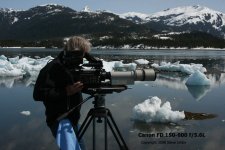
Wildlife is one of my core genres of production with Red One. Like James, my long zoom for that is a Canon FD 150-600 f5.6L. Mine is stock, except for a Century PL mount conversion. Its much smaller and lighter than the fully re-housed versions of the 150-600. Mine weighs just 9 pounds. I pack mine in via backpack then mount it on the camera when I get on location. Then if I need to hike reasonable distances to other locations with the lens on the camera, the whole rig weighs about 26 pounds - a manageable load to walk with. I also use a mountain bike pulling a small cargo trailer for transporting all my gear into remote places.

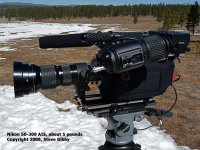
Another zoom I use a lot for wildlife is a Nikon 50-300 f4.5 AIS. It is very crisp, and weighs just 5 pounds.

Filtering on the Century PL modified 150-600 is via screw-on filters on the back end of the mount. Filtering on the 50-300 is via screw-on filters on the front of the lens barrel.

Between these two zoom I have plenty of focal length reach on RED One for for the wildlife and sports I shoot. Both lenses produce excellent footage on Red.

The full manual operation of these long zooms while tracking wildlife or sports takes practice, but when mastered its quite smooth. All focusing is eye focusing done by the operator.

I have some long primes I occasionally use on my Reds for wildlife and sports. If the subject matter is very far away and can be located easily, the primes can be used. But the zooms are usually much more effective for wildlife and sports production, because as James has mentioned it allows you to pull back to find your subject matter, then push in to the framing you want for the shot. Picking up a camera when using a prime and walking to each framing is almost always either unsafe or impractical when shooting wildlife and sports.

I have also used multiple B4 lenses extensively on Red One via the Red B4 adaptor. The B4 adaptor softens footage slightly. Using B4 lenses limits you to 2k resolution on Red. Using Graeme's .78 figure in debayering R3D files, 2k debayers out to around 1.56k. In my opinion that is fine for SD and 720p finishes, but frequently a little soft for 1080p finishes. On Red, 4k debayers out to around 3.12k, and 3k debayers out to around 2.34k. Both Red 4k and 3k resample and scale beautifully down to 1080p, thus I use those resolutions for almost all my wildlife and sports production with Red. Also, 4k and 3k stock footage are much more future-proof for use as stock footage.

Looking forward to Epic and Scarlet, I'll definitely use my 150-600 and 50-300 on Epic X and FF35 Epic. If Red produces long focal length Red Electronic Lens zooms, I'll definitely get those for use on wildlife and sports. IMO ideal focal lengths for for long RED Electronic zooms would be a 15x (maybe 24-360mm), and a long focal length 6x (maybe 100-600mm).

In Scarlet, I'll also be using a Scarlet fixed lens version for wildlife and sports work. I expect the fixed 8x to be very good. Red said early on (subject to change) that they would also be producing a 2x extender for the front of the fixed 8x lens, along with a wide converter. The 2x on the 8x would give me 16x reach for wildlife and sports production - very cool.

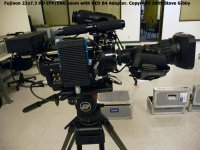
I've attached pics of the 150-600, 50-300, and a Fujinon 22x on my Red Cameras.

Hope this info helps you Dave...
 

Attachments

  • Nikon-50-300-web.jpg
    Nikon-50-300-web.jpg
    92.8 KB · Views: 0
  • Canon-150-600-Alaska-1.jpg
    Canon-150-600-Alaska-1.jpg
    92.5 KB · Views: 0
  • Gibby-22x-web.jpg
    Gibby-22x-web.jpg
    91.9 KB · Views: 0
Thanks very much for the replies. Very helpful.

Quote <I'm curious to know how do you handle focus on the long end of the zoom when animals move in your direction. Do you have a focus puller or is it done by the operator? If the latter is the case, you should need have the extra depth of field of a 2/3 chips to help you out.>

I guess the issue is for us is focus which is why we mostly shoot 3k as it offers good 1920 x 1080 and also is a little more forgiving for holding focus. We have been using a Chrozsiel FF unit on the Cooke and the Leica and Canon telephotos just using their manual focus rings. We don't use focus pullers for this type of work. We hope to continue to use Red one and Epic when its available for our work and probably will use Scarlet more as the longer range zooms are more readily available.
 
Dave,

For our Red wildlife work, whether is being shot in 4k, 3k, or 2k, all focusing is via the shooter, using 1:1 image magnification when time allows. We use 35mm still lenses exclusively. For mobility we don't use matte boxes or follow focus units. All filtering is via screw-on filters. All focusing is by hand racking the lens barrel.

The huge majority of wildlife shots is in decent light, thus apertures range from 5.6 to 11. At these apertures, even in 4k, DOF is deep enough for experienced shooters to easily do eye focus racking. In 3k its often even easier. We eye focus all the way down to 2.8 apertures with certain of our lenses in lower light.

We shoot the large majority of our footage in 4k HD (Quad HD). When we need to overcrank for slow motion sequences, we shoot 3k.

With practice, racking focus by eye on animals moving toward/or away from us, even in 4k, isn't a problem.

Using Red One in a hybrid style for the genres of adventure travel, wildlife, alternative sports, and nature, we shoot all our productions as described above. By choice I don't even own a matte box or follow focus :)

There is no single "right way" to use and accessorize a Red One camera - but rather multiple right ways depending what you shoot.
 
dave,

No question RED wins hands down on res and frame rate, but that only matters if you are regularly getting the subject in the frame.

It is a tough compromise to make. 42x lens with stabliser on say a panny 3000 is very versatile optical combination, compared to a 10:1.
Around 5x tighter than the 10:1?

We have been spoilt by the 22x and 42x lenses!

If the Panny could do 120fps would you use 2/3 inch?

Part of the theoretical solution would be higher pixel density sensor on epic so B4 lenses would cover 3k pixels. But there is still a trade off in optical quality using the B4 adaptor.

As the large format cameras get smaller (or remote heads) I could see a time when two epic remote heads are mounted on the one head, one with a wide zoom the other long zoom.

Over time 120fps will probably become available in the 2/3 inch cameras too... probably about the same time as 250fps will be available on Epic :)


Mike Brennan
 
Or, as you suggest, one could use the Scarlet 2/3. I assume that will have a native 1920 rez that will translate to HDTV better than 2K.

Scarlet 2/3" shoots native 3k resolution at 120fps continuous and 150fps burst according to the previously published specs. Should be a very good match for B4 lenses with an optically corrected mount and give much better resolution than the S35 models shooting at 2k.

I am more of a casual shooter/hobbyist these days, but I plan to use an old Angenieux 12-240 T5.6 16mm lens in PL mount on a Scarlet 2/3" interchangeable model for long nature shots, birds and such. Roughly equivalent FOV to the Canon 600mm at 4k on S35. Makes for a very compact and lightweight field package for day hikes.
 
Scarlet 2/3" shoots native 3k resolution at 120fps continuous and 150fps burst according to the previously published specs. Should be a very good match for B4 lenses with an optically corrected mount and give much better resolution than the S35 models shooting at 2k.

We were shooting yesterday with Red on a crane getting some really good high sped POV shots with short depth of field to cut in to a pre shot sequence. I don't think we could have achieved this with a 2/3 camera.

However, I agree with David, Scarlet when it is available will have its place. The buzz seems to be about 120fps (and 150 burst) plus the ability to use the HJ40 lens which guys here like.

For our money we hope to have both 2/3 and S35 cameras and use them to where each will work best. Im not sure if one or other will win out, both have their place.

The other question is about Panasonic 2700 at 60fps which is currently in vogue for wildlife. Our tests show that Red 3K at 50 fps out performs the 2700 easily on resolution and is nearly equal for practical purposes for frame rate. At 2K Red offers similar in resolution but exceeds frame rate by 40fps.

Do any users here have reservations about Red 2K high speed footage against the panasonic 2700 ?
 
Many wildlife productions are now inter-cutting high end 2/3" 1080p footage with Red 4k and 3k which has been resampled and scaled down to 1080p.

I was one of the executive producers recently for a blue chip Alaska wildlife documentary that aired multiple times last year on National Geographic Channel, nationally and internationally. For aerial footage and from-boat footage we used a Sony HDC1500 shooting 1080p/60fps using a 4:4:4 profile upgrade. The HDC1500 was housed in a CineFlex V14 gimbal, usually with a Fujinon HA 42x9.7 zoom. We also used a Fujinon wide angle for certain shots sequences (flying along glaciers, low to water, etc.).

All underwater footage was shot using Red One in 4k using cine lenses, plus certain land-based footage was shot with Red using a variety of 35mm still and cine lenses.

Beyond all that, we also used a Sony F900R with a Fujinon HA22x7.3 and HA13x4.5 for certain wildlife and creative shots.

After color correction, and scaling in the case of the Red 4k and 3k footage, all the footage from the above mentioned cameras edited together quite well.

The B4 HD 2/3" zooms I've used on my Red cameras since late August 2007 are:
Canon HJ40, and Fujinon HA42 (both versions), HA22x7.3, HA16x, and HA13x4.5. My assessment of the Red 2k results and pluses/minuses are in my previous post.

David, I hear ya on the Angie 12-240. Its a good lens and a good solution for long focal length shooting with the Scarlet 2/3" interchangeable. On the downside is that it is a straight manual lens. I'm sure it will work out well for you.

My initial strategy for long focal length wildlife production with Epic and Scarlet will be as I outlined in my last two posts. I believe the fixed lens Scarlet with a good 2x extender (thus 16x) will satisfy a lot of my mid focal length zoom needs for real mobile production. I also think that my Canon FD 150-600 zoom and and Nikon 50-300 AIS zoom will initially solve my mid to long zoom 5k and 4k wildlife needs with Epic X and FF35 Epic.

As I noted in my previous post, IMO the Red Electronic Lenses are the real "sleeper" in the mix. If Red can combine reasonable size/weight 35mm still lens technology and available features like AF and IS into a range of wide, mid, and long focal length zooms, with the added capability for smooth powered zooming, with either internal or external lens motors, then in my mind that will be the Holy Grail for mobile hybrid and non-hardlined EFP production of a wide range of genres - including wildlife.

Interesting times ahead gents...
 
David, I hear ya on the Angie 12-240. Its a good lens and a good solution for long focal length shooting with the Scarlet 2/3" interchangeable. On the downside is that it is a straight manual lens.

Yeah I wouldn't mind having a nice servo zoom, but I too shoot a zoom as more of a variable prime. Cost is a major factor on my limited budget.
 
Yeah I wouldn't mind having a nice servo zoom, but I too shoot a zoom as more of a variable prime. Cost is a major factor on my limited budget.

You may be able to adapt a B4 2/3" servo zoom scavenged from a B4 lens to your 12-240. I did that last year with my Nikon 35-300 AIS, custom-adapting an old Fujinon servo zoom unit to the lens, then powering it from Red One via a hirose to 12v auxiliary cable plugged into the bottom 12v bus on the smart side of Red. The results were encouraging. I'm sure Red Team has heard the input loud and clear that a new selection of 35mm covering zooms combined with the servo zoom operability of a B4 2/3" HD EFP/ENG zoom would have massive sales potential. Like you, I'm way familiar with all the arguments about why such lenses are impossible to make - with most of that coming from the cine lens crowd. However I believe when such lenses are actually made, they will be created using modified, adapted, and improved 35mm still lens technology.
 
You may be able to adapt a B4 2/3" servo zoom scavenged from a B4 lens to your 12-240. I did that last year with my Nikon 35-300 AIS, custom-adapting an old Fujinon servo zoom unit to the lens, then powering it from Red One via a hirose to 12v auxiliary cable plugged into the bottom 12v bus on the smart side of Red. The results were encouraging. I'm sure Red Team has heard the input loud and clear that a new selection of 35mm covering zooms combined with the servo zoom operability of a B4 2/3" HD EFP/ENG zoom would have massive sales potential. Like you, I'm way familiar with all the arguments about why such lenses are impossible to make - with most of that coming from the cine lens crowd. However I believe when such lenses are actually made, they will be from modified, adapted, and improved 35mm still lens technology.

I've been scoping out a couple of used cine servo rigs that set up on a 15mm rail support. Could use one of these with both the Angie and the Cooke 9-50, but it is not as clean a rig as the servo-on-lens solution.
 
I've been scoping out a couple of used cine servo rigs that set up on a 15mm rail support. Could use one of these with both the Angie and the Cooke 9-50, but it is not as clean a rig as the servo-on-lens solution.

David, keep your eyes peeled for an arri right hand grip with a built in zoom controller. They come up on ebay, and at the usual places pretty often. They usually go for 300-900 bucks, and work great.
 

Attachments

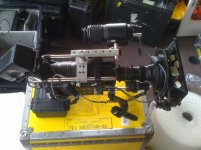
  • IMG_0040.jpg
    IMG_0040.jpg
    91.1 KB · Views: 0
Yeah I wouldn't mind having a nice servo zoom, but I too shoot a zoom as more of a variable prime. Cost is a major factor on my limited budget.

Hi David,

Saw this on ebay. Looks like a fairly clean example of a 20.1 The older CP (Cinema Products) servo motors were very stout and it would not be hard to round up a control handle for it. The mount on this one is a CP-16 but is easy to change out. These lenses were built like the old 12-120 and 9.5-95 so any decent lens tech can work on them.

http://cgi.ebay.com/Angenieux-3-5-1...ViewItemQQptZFilm_Cameras?hash=item25587a1959

Thanks for the info Chuck. I already have a 12-240 and a Cooke 9-50 in Arri B mount. The CP servo rig or something like it would be a nice addition though.
 
David, keep your eyes peeled for an arri right hand grip with a built in zoom controller. They come up on ebay, and at the usual places pretty often. They usually go for 300-900 bucks, and work great.

Yeah, something like that is what I had in mind. I could use one rig like that on both lenses. Thanks for the tip.

PS: Nice looking setup by the way.
 
Back
Top