Welcome to our community

Be a part of something great, join today!

  • Hey all, just changed over the backend after 15 years I figured time to give it a bit of an update, its probably gonna be a bit weird for most of you and i am sure there is a few bugs to work out but it should kinda work the same as before... hopefully :)

Robert Richardson lighting style: how to?

Metering is a religion for a lot of people - lots of emotional responses for what one would think would be a very dry subject. All you really need to know is that incident meters read the amount of light falling on the dome of the meter and reflected meters read the amount of light reflected or transmitted by the subject -- so to dumb it down, with incident meters you are reading the brightness of the light and with spot meters, the brightness of the object.
 
Sometimes I use the back of my hand as a meter. Seriously. You can get to the point where you can measure an f stop based on the reflective quality of your own skin.

It's taken years but I'm very often "spot" on. :)
 
Sometimes I use the back of my hand as a meter. Seriously. You can get to the point where you can measure an f stop based on the reflective quality of your own skin.

It's taken years but I'm very often "spot" on. :)

Yes, David, the hand is a decent quick reference alternative to the grey card. The palm of your hand (it varies less in tone throughout the year) placed one stop above meter. But that is average, the power of spot metering ( when monitors aren't available) lies in providing subject values that can then be very accurately PLACED. Of course, no meter is going to make up for a lack of sensitivity in the artist.
 
I think to some extent, some of this debate is partly due to the nature of shooting narrative versus stills, efx plates, etc. Most applications in photography use spot meters, whereas incident meters seem to be limited to narrative production. Because narrative involves shooting a series of shots for a sequence, besides exposing accurately set-up by set-up, you are also exposing for a general consistency as a sequence so that density and printing lights (in film) or noise (in digital) is consistent overall. Obviously you can do this with any type of meter, but I think that since incident metering tends to be more about setting light levels of the space / scene regardless of the content of the room or the actual subject in the shot, it tends to force you to think on those terms, the general light levels that will make a series of set-ups consistent, as opposed to the actual exposure of each shot based on the reflectivity of the subject. But as I said, you can make any meter behave the way you need it to, more or less, and there are narrative DP's who rely more on spot meter readings. But I would say that incident meter reading is a lot more common among narrative cinematographers that it is among still photographers, for example.

It may also be a result of working with negative film, with its tremendous exposure latitude -- in the past, still photographers often had to deal with the more restrictive range of slide film, and video shooters with the narrower range of broadcast video cameras. So in their cases, you had to be a lot more precise with your exposures, whereas the narrative cinematographer using an incident meter was less worried about exposure precision as opposed to consistency of light levels between set-ups.
 
This makes no sense whatsoever. None.

No? If you were to dictate that all Caucasian skin should meter to a reflectance of X, and adjusted all of your exposures of Caucasian skin to be exactly the same, can you not see that subtle differences in tone and color could be lost? I don't see how they couldn't.

I have seen photographers employ this kind of method shooting portraits for people of color deal with multiple complaints for exactly this reason. African Americans in particular can be very sensitive to the color rendition of their skin tone. if you under expose them by even a half stop prints can come back with the complaint "I'm not that dark."

Unless of course you don't know how to interpret different faces, and simply take a reading and apply.

That is exactly what I was pointing out. The idea was not to be too clinically precise when applying the numbers. You have to use your eyes and good sense too. Once you start to stray from the meter and apply judgement, then the numbers become less relevant.

However, If you're implying that the zone system subverts innovation and all that that connotes, you couldn't be farther from the truth.

Nope, I didn't mean to imply that at all. I'm no Ansel Adams, but I think you are selling me short. I was merely pointing out a specific error and you have extrapolated that to a generalized assumption. I don't begrudge anyone their use of spot metering. It is a useful tool that I will admit to not fully exploiting myself.

Alexander I hope I didn't come across as under-estimating you in that way. It was all meant to be light hearted.
 
Last edited:
Scott, nothing will be "lost" if you know how to use the meter (among other things). Nothing at all. Your exposure methods would have to be pretty awry to lose any nuance in skin tone, no matter what the complexion. Lighting is another thing altogether.

"African American " skin tones: If one finds they are having trouble when using a meter, I can't imagine what one gets up to without one. Interpretation is usually at fault, not metering.

You can't have it both ways, you can't criticize "precision" and at the same time demand it.

And the idea is not to be "clinically" precise, the idea is to be precise. As precise as your aesthetic can bare.

I'm not criticizing precision. I for the most part am content to incident meter for faces and you apparently prefer to spot meter. Wonderful. Good for you.

Everyone's skin will reflect differently under the same lighting conditions. If someone is adjusting their exposure and light levels so that each face reflects the same, then they are actively reducing the apparent variations in tone. Of that I am quite certain.

Either I am not communicating well or you are scrapping for an argument so I'm not going to waste anyone's time by engaging with you further on the subject.
 
Last edited:
Alexander I hope I didn't come across as under-estimating you in that way. It was all meant to be light hearted.

Nope. No problems here.

I don't think anyone here really thinks that anyone is going to actually meter a group of individuals, say caucasians, and try to precisely match their exposure to f/4.0 (or whatever) no matter what they look like thus making them all look exactly the same.

I do take your point that you need to pay attention or else risk homogenizing people ... and I hope that my response, which is essentially that I precisely account for individuals not groups, addressed that.

Bill ... I think your tone is a bit too combative. Sure there are errors here, but no one is writing a technical manual or textbook on the topic either. I think there is room for understanding without being pedantic.

And frankly Mr. Anderson ... being pedantic is my job! Get off my lawn... or something like that. ;)
 
Well I will take your word on that. I'm just contemplating the process of determining what zone this week's alien should be exposed in, and it gives me a chuckle.

Sorry for running off topic.

Like I said before, I kind of like metering stuff. I always have - and not just light meters. When I was in school I liked taking measurements - loved physics lab the most, especially after we started measuring stuff with lasers.

Now thanks to an inquiring actor I have the added "benefit" of imagining that I'm a crew member on some star ship taking readings.

Of course given the sets you'll usually find me on, I'm actually a crew member on a star ship taking readings ... and so the circle is complete: My "reality" is most people's science fiction.
 
"Pedantic" Seriously? It didn't seem that bad to me, particularly in a thread of this nature. Come on Alexander, pointing out or wishing to discuss these "errors", as you put it, is not to suggest that we are writing a "technical manual or text book". Is it? My point, and it seems yours also, is simply to point out when a fundamental misunderstanding about metering is used as the basis for all kinds of wild conjectures.

This WS sonnet springs to mind, in part:

and right perfection wrongfully disgraced,
and strength by limping sway disabled,
and art made tongue-tied by authority,
and folly doctor-like controlling skill,
and simple truth miscalled simplicity,....

Maybe that's pedantic of me.

Anyway, after thirty or more years of making images, I rarely use a meter, I don't imagine a more intuitive approach exists, and yet here I am .....
 
One thing that is very interesting to me about this "style" is the fact that things do get "blown out".

I am hearing that with the extra bits EPIC has more room in the highlights than the MX chip.

I know that "clipping" has become a dirty word in digital, but letting things blowout on film was common.

I know that a white pixel can never be recovered, but has anyone pushed digital in camera to achieve pleasnt, intended look, even with blown highlights?
Examples?
Save it for post?

David
 
I believe the Epic is a very good digital candidate for this style, since its highlights "roll off" a bit more organically, film like. And with the control one has over exposure, with monitors and scopes and all, this should be quite doable. And film has a pretty good DR.

Would one have to compensate for the lack of, or nature of, halation in the sensor Vs film emulsion? Filters?
 
I have a thought on this.

The bounce is as important as the source.

Agreed. That is particularly true of Alexander's first example. Gorgeous.

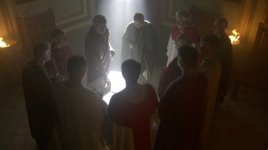
inglourious-basterds-hickox-hammersmark.jpg
 
I routinely blow stuff out on digital. Forgive the shitty DVD screen grabs, but you get the idea.
 

Attachments

  • ishot-1.jpg
    ishot-1.jpg
    33.6 KB · Views: 0
  • ishot-2.jpg
    ishot-2.jpg
    80.1 KB · Views: 0
  • ishot-3.jpg
    ishot-3.jpg
    81.1 KB · Views: 0
Would one have to compensate for the lack of, or nature of, halation in the sensor Vs film emulsion? Filters?

Film doesn't halate too much (except for the old 3-strip Technicolor process, since the blue record couldn't have an anti-halation backing because the red record was bipacked behind it) and some lenses halate more than others... but something like a 1/8 Black Frost might be useful on a digital camera if you want a tiny bit of halation.
 
One trick I've done with digital cameras when I want a hot backlight to hit a table top or floor and bounce back up into the room is to use an ND grad at the bottom of frame to bring down the table or floor a bit, so I keep the ambient bounce into the shadows but control the intensity of the hot spot.
 
Back
Top