Welcome to our community

Be a part of something great, join today!

  • Hey all, just changed over the backend after 15 years I figured time to give it a bit of an update, its probably gonna be a bit weird for most of you and i am sure there is a few bugs to work out but it should kinda work the same as before... hopefully :)

RED ONE Jello effect

Status
Not open for further replies.
Buhot,

Here we are again...on another active RED User thread I recently explained to you the relationship between frame rates and shutter speeds in fast pans, and provided multiple links to examples of how those frame rate/shutter speed combinations provide smooth fast pans with RED One.

That thread is the "Stuttering image while panning" thread in the RED Discussion forum. Link:
http://205.234.135.241/forum/showthread.php?t=28219
(My posts 113 and 118 on Page 12, and my post 131 later in the thread, explain thoroughly frame rates/shutter speeds for fast action pans)

On this thread my good friend Graeme has explained the same things I did on the other thread - and yet it seems like the info is new to you. If you're still trying to do fast pans of wildlife with a frame rate of 25fps and 180 degree shutter - well I'm not surprised you're still having stutter problems in your pans.

To help you out here is a list I've compiled of fast pan action clips I shot with RED which are part of my extensive RED stock footage library represented by Artbeats. I've included below all shot settings I used for each clip. The shot info I listed below is accurate, so when you click on the links, disregard the frame rates listed on the web site for each clip - for the most part they are wrong, and the person who posted up the clips to the site will correct the indicated frame rates shortly. If you double click on the thumbnail photo for the clips it will open and run a QuickTime version of the clip. Some of these clips are straight 4k/29.97, and others are 3k overcranked and 2k overcranked.

What all the clips have in common is this: none of them were shot at frame rates lower than 29.97, all of them were shot slightly above 180 degree shutter (but nowhere near 360 shutter), all of them are fast action pans, some were shot at regular frame rates (29.97) and others are overcranked for low motion playback, all of them retain a cinematic look, and all of them play back very smooth.

I think you need to quit blaming the RED camera for your stuttering pans and pay close attention to your frame rates and shutter speeds in relation to the frame rates - exactly what I explained on the previous thread, Graeme explained on this thread, and my examples below illustrate for you.

Don't worry my friend, you'll get all this figured out...and then your fast action pans will be smooth :)


RED camera fast pans without stutter examples

Smooth fast pan example #1:
http://www.artbeats.com/footage/search?fh44=1&page=2
Bottom of page, personal watercraft, clip # SG-FH100-49
Shot setting in camera: 3k, project frame rate 23.98, Varispeed frame rate 48fps, shutter speed 125th second

Smooth fast pan example #2:
http://www.artbeats.com/footage/search?fh44=1&page=4
Top of page, personal watercraft, clip # SG-FH100-31
Shot setting in camera: 3k, project frame rate 23.98, Varispeed frame rate 48fps, shutter speed 125th second

Smooth fast pan example #3:
http://www.artbeats.com/footage/search?fh44=1&page=9
Top of page, wave moving, clip # SG-FH101-34
Shot setting in camera: Quad HD, project frame rate 29.97, shutter speed 96th second

Smooth fast pan examples #4 and #5:
http://www.artbeats.com/footage/search?fh44=1&page=24
Bottom of page, wave moving, clip # SG-FH103-84 and SG-FH103-85
Shot setting in camera: 2k, project frame rate 29.97, Varispeed frame rate 72fps, shutter speed 196th second

Smooth fast pan examples #6 and #7:
http://www.artbeats.com/footage/search?fh44=1&page=25
Bottom of page, pelicans flying, clip # SG-FH104-03 and SG-FH104-04
Shot setting in camera: 2k, project frame rate 29.97, Varispeed frame rate 72fps, shutter speed 196th second

Smooth fast pan examples #8 through #16:
http://www.artbeats.com/footage/search?fh44=1&page=26
Top of page, pelicans flying, clips # SG-FH104-05 through SG-FH104-13
Shot setting in camera: 2k, project frame rate 29.97, Varispeed frame rate 72fps, shutter speed 196th second, and some 3k, project frame rate 29.97, Varispeed frame rate 48fps, shutter 125th second

Smooth fast pan example #17:
http://www.artbeats.com/footage/search?fh44=1&page=28
Top of page, pelicans flying, clip # SG-FH101-39
Shot setting in camera: Quad HD, project frame rate 29.97, shutter speed 96th second

Smooth fast pan examples #18 through #21:
http://www.artbeats.com/footage/search?fh44=1&page=28
Top of page, sailboard, clips # SG-FH104-41 through SG-FH104-44
Shot setting in camera: 3k, project frame rate 23.98, Varispeed frame rate 48fps, shutter speed 125th second

Smooth fast pan example #22:
http://www.artbeats.com/footage/search?fh44=1&page=21
Bottom of page, pelicans flying, clip # SG-FH103-36
Shot setting in camera: Quad HD, project frame rate 29.97, shutter speed 96th second

Smooth fast pan examples #23 and #24:
http://www.artbeats.com/footage/search?fh44=1&page=21
Bottom of page, birds at pond, clips # SG-FH103-37 through SG-FH103-38
Shot setting in camera: 3k, project frame rate 23.98, Varispeed frame rate 48fps, shutter speed 125th second
 
Buhot,

You should use a Red RAM drive if you are moving about a lot!

Red Ram = No dropped frames!

Dave
 
Buhot,

You should use a Red RAM drive if you are moving about a lot!

Red Ram = No dropped frames!

Dave

The RED Ram drive eliminates dropped frames if you work in serious shaking situations - if you shoot a lot of extreme shaking situations and have the funds to buy the RED Ram, by all means do so. But then again, I shoot a ton of high-action adventure travel, sports, and nature footage with RED One - and I don't even own a RED Ram drive. Almost all my footage, a lot from boats, helicopters, trains, cars, music close to amps, etc. has been shot using my RED Drives mounted on ET Shock Mounts, and attached to the camera using ET V-Dock and Speedy Clamps. I've rarely had any dropped frames.

But dropped frames aren't Buhot's problem - it is stuttering in fast pans caused by his camera setups, as I illustrated in my last post.
 
Gibby... being slow minded

Gibby... being slow minded

is quite some bit of my problem here, as well as in the many other fields I'm in... I'm afraid that contempt will not help, my friend. The fact is the threads you pointed out to me in your former posts were all slow-mo shots when movement was involved, as far as I remember, and that I have feared for some time that it was not only a matter of aesthetics. I'm quite happy, as I said, to be proved wrong. I'll check on the recent threads you mentioned.


Well, I'm not blaming anyone... Just saying Graeme's recent explanation (for which I thanked him) is crystal clear, not even requiring your own. I'm not really saying that I had not figured it out myself at all, really... Just had to be quite sure that I had fully understood the issue. Choosing a time base for an entire, long-run project is quite a bit of a decision... I still don't fully understand why higher shutter speeds will improve smoothness, but I shall live with it.

Not blaming anyone... I'm saying instead that I know now for certain that the red one camera suffers limitations when used in wildlife applications. 48 fps combined with higher shutter speeds requires more light, won't work in 4K, etc. So what ? Being aware of the limitations in any gear is part of the solution already. I'll adapt, and as many others, shall wait for Epic-X
 
Thx Steve!

Those examples are great. I think they apply to a lot of what i'll be shooting. Can I ask you - Were all those clips shot from land? Were the PWC's shot from the water?

thx so much
 
I still don't fully understand why higher shutter speeds will improve smoothness, but I shall live with it.

Some things to consider regarding shutter speeds, frame rates, etc..

Higher frame rates give smoother motion due to more frames or visual information per second. It also effects the slowest possible shutter speed. Shooting 50fps means that your shutter can't be "open" any longer than 1/50th of a second. Actually a bit less than that due to the shutter actuation or read reset cycle.

Faster shutter speeds reduce the exposure time of each frame. So you get less motion blur and a sharper image. However, less motion blur can lead to obvious frame stutter or visible jumps within the motion, especially when shooting slower than 60fps.

On the RED One, the CMOS read reset cycle occurs at the same speed, regardless of frame rate and shutter speed. Approximately 9ms, if I recall. This is independent of shutter speed and frame rate. So as you increase your shutter speed (decrease exposure time), you will actually increase the visibility of the skew or jell-o effect. There is actually no more or less rolling shutter skew present, but with less motion blur and prior exposure of an image to compensate what is present during the reset cycle, you see more visible skew.
 
is quite some bit of my problem here, as well as in the many other fields I'm in... I'm afraid that contempt will not help, my friend. The fact is the threads you pointed out to me in your former posts were all slow-mo shots when movement was involved, as far as I remember, and that I have feared for some time that it was not only a matter of aesthetics. I'm quite happy, as I said, to be proved wrong. I'll check on the recent threads you mentioned.

I expressed no contempt in my post – frustration yes, but contempt no. Coming into this thread with “If Gibby or anyone can prove me wrong on that, I’d be very, very happy.” was frustrating to me – I already proved you wrong on the previous thread. On that previous thread I took a lot of time out from my normal production work to answer your questions, something I don’t have to do, but chose to in order to help you, and I explained very accurately the relationship between frame rates and shutter speeds when filming high-motion subjects, like animals and sports. If my good friend Graeme or anyone else knowledgeable about shooting fast motion subjects were to read my previous posts on that thread, they would agree with my suggestions there. In fact, several others on the thread did just that – agreed with my posts. That those shots were slo-mo has nothing to do with it. They were only slo-mo because I setup a project frame rate, then used Varispeed to “overcrank” them up to a higher frame rate, to make them play back in slo-mo. For instance, in a 3k project, if I set up a project frame rate of 23.98, then use Varispeed to setup 48 fps, when I play back the clips they will play back at a 50% slo-mo. But the motion of objects is smooth because the frame rate (48fps) and shutter speed combination lends itself to smooth motion acquisition in the first place. If I played those same 48 fps clips back on a timeline setup to play 48 fps, they would be smooth playing at their real speed.

On my Post #22 of this thread, I gave you many different frame rate footage examples – 29.97, 48, 72. Examples #3, #17, and #22 are all fast action pans shot with a simple project frame rate of 29.97, and those QuickTime clips playback in 29.97 – no slo-mo involved. Notice that there is no stutter in those 29.97 pans. Naturally the other 48 fps and 72 fps clips play back smoothly. Also notice that on none of these clips did I use a 180 degree shutter – my shutter speed was a bit above 180 degrees. What do these clips illustrate? At frame rates of 29.97 and above, combined with shutter speeds slightly above 180 degrees you can achieve glass-smooth pans of fast motion subjects with RED One – or basically any other camera for that matter.

If you have been shooting 25 fps and 180 degree shutter I’m not surprised you’re seeing stutter in your fast pans – and I explained that for you in the last thread. Try this – setup your RED One in Quad HD, 29.97, shutter 96th second and go out and shoot the same fast pan subject matter – and you’ll find an absence of stutter just like you see in my examples I posted in my Post #22 of this thread. After that, setup your camera in 3k, 50 fps, shutter 120th second, and go out and shoot the same fast pan subject matter. You’ll find your pans to be free of stutter – again because the frame rate/shutter speed combination won’t create stutter. Thos same 50 fps clips will play back at 50 fps on a 50 fps timeline, or be glass-smooth 50% slo-mo if played back on a 25 fps timeline.

Well, I'm not blaming anyone... Just saying Graeme's recent explanation (for which I thanked him) is crystal clear, not even requiring your own. I'm not really saying that I had not figured it out myself at all, really... Just had to be quite sure that I had fully understood the issue. Choosing a time base for an entire, long-run project is quite a bit of a decision... I still don't fully understand why higher shutter speeds will improve smoothness, but I shall live with it.

Graeme is a very close friend of mine, and unbelievably knowledgeable about coding, how cameras incorporate and use algorithms, etc. But I’m one of the guys who is the in-the-field, practical user of the camera systems. For over 30 years I’ve been filming high motion subject matter – animals, sports objects, etc. Graeme’s advice to you was no different than mine on the previous thread – because me and him are both longtime professionals at doing what we do, and in this case I put to use what Grame has helped to design – the RED One camera and REDCODE. The decision on a time base frame rate is something everyone who shoots needs to make. The factors in that decision are:

1) What is the delivery medium for my work, and then what are the projection requirements or Producer’s Guidelines in the case of television?
2) Keeping #1 in mind, and I have to shoot fast motion pans, what combination of frame rate and shutter speed will eliminate stutter and give me a smooth presentation of motion?


Not blaming anyone... I'm saying instead that I know now for certain that the red one camera suffers limitations when used in wildlife applications. 48 fps combined with higher shutter speeds requires more light, won't work in 4K, etc. So what ? Being aware of the limitations in any gear is part of the solution already. I'll adapt, and as many others, shall wait for Epic-X

The RED One camera will shoot up to 30 fps in 4k, up to 60 fps in 3k, and up to 120 fps in 2k. I don’t see many “limitations” for wildlife shooting. I shoot vast amounts of wildlife for international and national television programs – and Red One has been my main camera for wildlife shooting since August 2007. There are tons of other professional wildlife shooters who have moved over to RED One for their work – and don’t feel “limited”. Why? For their fast motion pans they follow the exact (or similar) frame rate/shutter speed combinations I illustrated for you – and they get smooth, stutter-free playback of their footage. If you’d like an example, go to the Shot on RED forum, and search for a very close friend and associate of mine’s (Kennan Ward) thread titled “Four months in Alaska wilderness”.

I recently finished my work as an Executive Producer on an Alaska wildlife documentary (“Icy Killers”), which aired internationally on National Geographic Channel. Almost all footage in the program was shot at 60 fps. Some slow motion, stationary subjects, underwater, and scenics were shot at 23.98. The reason we shot 60 fps is because we had so many high motion subjects, fast pans, fast moving shots from helicopters and boats, etc, that we wanted the smoothest presentation of the motion possible – and we achieved that.

If you need to shoot fast motion subjects in 4k with RED, then I’d suggest 29.97. If you need frame rates above 29.97, then shoot 3k and maybe frame rates between 50 fps and 60 fps. RED 3k resamples down to 1080p beautifully, whether your delivery medium is large screen or television. If you absolutely need frame rates above 60 fps, and your delivery is television, then 2k is the next option.

I’ve found RED One to be a wonderfully capable camera for a wide range of subject matter and genres - including fast motion wildlife and sports. Epic will take fast motion subject shooting that to a whole different level though – with its much higher frame rates. I expect the Epic models, with their smaller size, range of mount and lens options, and high frame rates, to be superb wildlife and sports cameras.

Good luck to you Buhot…
 
Thx Steve!

Those examples are great. I think they apply to a lot of what i'll be shooting. Can I ask you - Were all those clips shot from land? Were the PWC's shot from the water?

thx so much

Glad those clips helped you...

They were all shot from land. Lenses used those clips were Canon FD 150-600 f5.6L with Century PL mount conversion (pelicans, waves), and Nikon 50-300 f4.5 AIS (sailboard, pond birds). All 30 of my lenses I use on RED are 35mm stills lenses (2 Canon, 28 Nikon). For lightness and mobility, I use no matte boxes or follow focus units. All filtering is via screw on filters, all focusing is via eye, and all exposing is via zebras and histogram.

In those shots the tripod used was the Miller Arrow 55 head, with Miller Solo 1505 spreaderless carbon fiber legs. That combo weighs only 13.8 pounds, but has excellent head action as you can see from the fast pan action following in those shots.
 
Gibby...

Gibby...

.. you speak loud, at times...

No one (especially not me) doubts that you are a prominent professional, with many friends just as good as you are, with an extensive field experience, a great technical input on this board... and a resumé anyone here does bear in mind by now.

I'm perfectly aware of what you already wrote and seem to care to write again every now and then. I have checked on your shots. Splendid. However, suppose what works for you is not relevant, given situations/subjects/shots and resolution needed/countries you just have no idea of, being not totally omniscient...

Now, please just let other people - far more obscure - ask their own questions, for whatever purpose they wish/may find too long a story to explain, without looking down at them the way you do.

You don't see limitations. Some other people may see some «*limited limitations*», if you red savant will allow, because they don't shoot what you shoot the way you shoot it for the people/money you shoot it for, however good, splendid, stellar it may be. And actually is. Period.

For instance, people that have moved to Red with a video background will find limitations, every time they'll have to shoot fast moving wild subjects in dim light and with no possibility for additional lighting. 1/60s, shutter speed over 1/100, 320 asa... Avoiding stutter with a film-like gear has a cost.

So what ? Heard of any gear without limitations ? Of any benefit without a cost ? The red one camera speaks for itself... No need for the heavy artillery here. I own a red one, I'm happy using it, I was thinking of advising one on another project. I'm a bit disappointed... no big deal. I'll have to wait for Epic-X, and I'm happy to wait for it. And I'm grateful that Red is in line with the initial promise : obsolescence made obsolete.
 
Open Gate

Open Gate

With open gate shooting at 24fps you're effectively seeing 48fps.

I was wondering why you call "skip frame" mode "open gate", where does the term "open gate" come from?

Thanks in advance for the time to answer this...
 
Buhot,

I don't look down on anyone - in fact though I do a lot of high-level professional work with large crews, I also shoot all my stock footage completely by myself (no other crew), and I consistently champion here and elsewhere the causes and needs of small, independent filmmakers. I remember my roots. I help a lot of people here, and almost all of them thank me for taking the time to help them.

I've posted clearly how me and every other professional wildlife and sports shooter I know and work with achieve our results. If you feel the need to reject it, fine reject it. But if you'd take the time to to setup your RED One the way I described and shoot fast moving content with those setups - you will get exactly the smooth playback me and everyone else I work with does.

Those who followed the links to my example shots invariably came back to the thread posting that they see how well my setups worked. The proof is in the testing - and my setups have been tested not just by me, by scores of other wildlife and sports shooters.

You see that "California and worldwide" in my info block below my avatar? I've been really fortunate to work in 65 countries in my career, so when I give you advice its not just filtered through California or USA experience, but extensive international experience too.

To be sure, there are some workarounds and additional things that users of RED in wildlife and sports shooting need to be aware of. Its a manual camera, but the actual technology of the camera should be quite familiar to digital stills photographers and to a lesser extent TV/video camera users. There is no "rocket science" involved with using RED One though. Like any other high-tech gadget there are a lot of features we know are there, but anyone can still operate the camera simply and effectively with a small amount of instruction and practice.

If there is one "weak" area with RED One for use in wildlife and sports, it is lenses. Traditional EFP camera wildlife and sports shooters are used to broad focal ranges and powered servo-zoom units on their EFP/ENG zooms. On RED, 4k and 3k shooters only have the option of S35 cine lenses or 35mm stills lenses. I think the new RED Electronic Lenses for use on Epic will be lightweight, have broad focal length ranges (eventually), and the longer versions of them could turn out to be just what wildlife and sports shooters need. We'll see...

When I take time out from my normal production work, I essentially lose money because that same time could be spent on my projects. I don't have to contribute here - but I usually choose to.

Please leave reference to me and my name out of your future posts. I've given you all the advice I intend to.
 
Open Gate.

Open Gate.

I was wondering why you call "skip frame" mode "open gate", where does the term "open gate" come from?.

Film camera analogy. With film passing through the gate, you will normally observe a 24 fps cadence through the optical viewfinder.

But with the gate open you have the opportunity of a clear view of the scene. i.e. no 24 fps cadence..

The "Open Gate" mode of RED ONE also allows a clearer view, as the sensor data displayed in the EVF is twice the fps of the recorded image.


Where exactly was the "skip frame" reference?
 
Stuttering is a different issue to skew. So let's tackle stuttering: It's directly related to the fps you shoot. If you shoot 24fps and pan fast you will get stutter. It's not something unique to RED, but directly related to the fps. Shoot fps on any other camera and the stuttering is there.

24fps only really "works" due to a combo of factors - controlled camera moves, putting the background out of focus and keeping edge contrast low (as in no electronic edge enhancement) which makes it easier for RED and Film to not stutter at 24fps (due to large sensor and no electronic enhancement) than a smaller sensor video camera. Make all things equal though, and you're back to stutter.

Graeme

Brilliant info Graeme! Thanks!
 
24 of 48

24 of 48

Where exactly was the "skip frame" reference?

So the sensor and EVF run at 48fps, and every other frame is saved, so its like skip printing in an optical printer?

That is you skip saving every other frame the sensor shoots, so 180 degrees rolling shutter at 48fps "open gate" has the time of 90 degrees non "open gate"?
 
I think what's happening here with Buhot is what could potentially happen to anyone with a video background that upgrades to a R1. Many times they try to shoot with RED in situations that they are only familiar shooting with video. You have to understand that the RED is a "DIGITAL CINEMA" camera... not a video camera. You can certainly set it to look more like video; but I think most of the people shooting with the camera are trying to achieve a more cinematic look.

Buhot, the stutter you're experiencing is not a shortcoming of RED, but a matter of cinematic physics. If you shot high-speed moving objects on film with a 180 degree shutter at 1/25th second, they would also get the stutter. The object you are shooting is traveling farther on each frame than the camera can keep up with.

Here's an example and these numbers may not be accurate... they're for demonstration purposes only:

Let's say you have a red ball sitting on the floor. Your RED One is set up at 24fps with 1/48 shutter. You are recording the ball and decide to pan quickly from left to right for a duration of 1 second. When you play back your shot on your 30" monitor, the ball stutters during the pan. Bummer. If you play back your shot frame by frame, you will see that the ball moves 2 inches every time you advance to the next frame. Now if you change your camera to shoot 48fps and do the shot again, the ball only jumps 1 inch between frames. You will see that the playback is smoother, but may still stutter a little. So now you shoot at 96fps and the playback is smooth, because the ball is only jumping 1/2 inch between frames.

To apply that to your situation, you are used to shooting video at 25fps INTERLACED, which is actually 50 images per second. Now you're taking the RED into the same situation and shooting at 25fps PROGRESSIVE (which is 25 actual images per second) and expecting the ball to not jump, even though you're sampling the image 1/2 as many times as before. This phenomenon is common with ALL cameras, not just the RED. When the EPIC comes out it will do the same thing. If you shot this on an Arri 435 with the same settings it would do the same thing.

In order to shoot fast-moving subjects without stutter, you have to shoot at higher speeds. If you are shooting in low-light conditions, you have a few options. You can either get faster lenses (costs more money), add more light to the situation (many times not possible), or crank up the gain on the camera (may compromise the quality of the shot). But you still have to shoot at higher speeds. When the newer RED sensors come out, they will be more light sensitive and possibly solve the issue for you.

Does that make sense?
 
Tyler,

That's a good summary of the situation...and that's the essence of what myself, Graeme, Jeff Kilgroe and others have explained before. RED One can be used to make some amazing images of high speed wildlife and sports action - but the user needs to understand the strengths and caveats of using the camera. Extreme low light shooting of fast motion with RED One in natural light setting will require you to boost the ISO. A lot of this is shot in 4k and 3k with a predominance of long focal length 35mm stills lenses (mostly zooms) - for affordability, S35 coverage, and physical weight (mobility) of the lens. About the fastest long 35mm stills lens in a prime is f4 and in a long zoom is f4.5 or f5.6. These lenses aren't generally at their best wide open. Their "sweet spot" is usually somewhere between f5.6 and f11. To get to those iris levels in low light we use no ND filtering, and often take the ISO to 500 or even occasionally 800.

BTW - me and my crews shoot hybrid style, in equipment and techniques. We use 35mm stills lenses, no matte boxes (screw-on filters), no follow focus units, focus by eye using 1:1 magnification or simply rack on the fly if need be, and expose by zebras and histogram. We shoot RED in a cinema style in the sense that it is a manual camera, but our lenses and the way we use them are drawn from the SLR stills industry, and the way we expose RED is a combination of TV/video industry (zebras) and the DSLR industry (histogram). We don't approach RED as a "film" camera, but as you can see, we approach it and use it as a "hybrid" camera - with accessories and techniques predominantly from the 35mm stills and to a lesser extent the TV/Video industry (EVF, etc.). Our goal is cinematic footage, tweaked a bit to allow for the performance parameters of the fast motion subject matter. Our footage doesn't look like video - it looks like filmic, organic RED footage.

The sensitivity of the new Mysterium X sensor (and Monstro) should seriously help in wildlife and sports shooting. A clean, noiseless 800 ISO would be amazing for what we shoot. The higher frame rates of Epic will also be great for certain shooting situations.

What we really need for optimal S35 and FF35 sports and wildlife shooting is lighter weight, broad focal length zoom lenses with the functionality of EFP/ENG zooms - with servozoom capability. This basically is the 3-Way Zoom I've posted about over the years. It would have gears, so it could be used as a cine lens if needed, but with a servo-zoom unit added on it would have the functionality of an EFP/ENG zoom. Then with or without the servozoom it could have the electronic functionality of a 35mm stills lens. Such a lens, for size and mobility considerations, would be based on 35mm stills technology to a certain extent, but have much better motors, no breathing, accept screw-on filters if needed, and have very good optics. My hope is that some of the lenses in the new line of RED Electronic Lenses will be what I just described in this paragraph. If not, its inevitable that someone else will make them eventually. Cine traditionalists may scoff at such a lens - but they wouldn't necessarily be the market for it. The market would be the hybrid shooters seeking to maximize the capabilities and utility of the DSMC cameras - people who shoot hybrid, non-hardlined EFP, and stills.

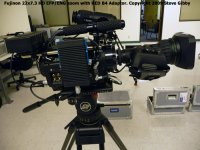
Sure you can go to a straight EFP setup of RED - which I've tested out at length. This is a B4 adaptor, B4 HD 2/3" EFP/ENG zoom, and hirose to 12v cable to power cable to power the lens servozoom. With this you gain faster lenses, with broad focal lengths for their size/weight - but you are then limited to shooting 2k, and many project finishes call for higher resolutions, then resampling down for editing and delivery. The reality is that the bulk of wildlife and sports shooting needs to be shot in 3k and 4k - thus the adaption of lightweight (thus mobile), affordable 35mm stills lenses to the task. Cine lenses are way too big and heavy (thus immobile) for their focal lengths to be of used in most wildlife and sports shooting - and they are also way too expensive. Again - thus the adaption of 35mm stills lenses.

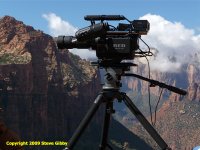
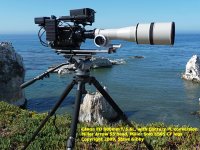
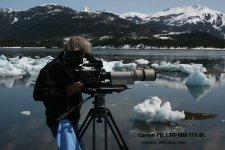
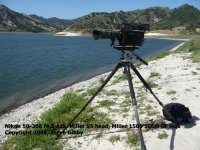
Attached are pics of a few of my 35mm stills lens setups for shooting wildlife and sports, along with one B4 setup photo.

With Epic, Scarlet, and the new RED Electronic Lenses, I think we have some very interesting times ahead...:thumbup1:
 

Attachments

  • Nikon-80-200-AF.jpg
    Nikon-80-200-AF.jpg
    91.6 KB · Views: 0
  • Canon FD 800 web, 1.jpg
    Canon FD 800 web, 1.jpg
    92.1 KB · Views: 0
  • Canon-150-600-Alaska-1.jpg
    Canon-150-600-Alaska-1.jpg
    92.5 KB · Views: 0
  • Nikon-50-300-for-web,-2.jpg
    Nikon-50-300-for-web,-2.jpg
    91.6 KB · Views: 0
  • Gibby-22x-web.jpg
    Gibby-22x-web.jpg
    91.9 KB · Views: 0
You know, Gibby, since you are concerned about taking time away from your extensive production schedule to write these posts, you might try saving some time by using less words, particularly commentary about yourself which doesn't add anything -- who your friends are, how many countries you work in and so on. Unless I am mistaken, you have mentioned these facts before.

Your experiences are not universal and do not apply to all situations. Your close personal friend Graeme (is that how you spell it?) is able to make his point very well without including a catalog of his magnificence.

No hard feelings, of course, I'm just sayin'...
 
You know Rob, you and me have been down this road a few times before - with you feeling the need to bring personal criticism of me into a thread, rather than any constructive input into the subject matter of the thread. In those instances moderators stepped in and asked you to 1) post constructive input for the thread and 2) refrain from posting personal criticisms.

Here's an example thread:
http://205.234.135.241/forum/showthread.php?t=35734&page=2

You don't seem to have learned from those recent situations where you tried the same tactic and had to be warned by moderators, because here you are trying the same sarcastic, personal attack strategy. I have no personal bone to pick with you and I have never used those tactics on you or anyone else. I'm asking you to cease this behavior, and yes, I have referred it to Jarred and moderators.

Lets be professional here on RED User and give constructive input to the threads, which benefits us all. Personal attacks laced with sarcasm have no place here - and you've been warned about that tactic. I could care less what you opinion is of me or my background is - I've been here on RED User from the very beginning, moderating (early on), and I've consistently posted constructive information to help people understand RED One, and ways to use the camera.
 
And I think we're done.
 
Status
Not open for further replies.
Back
Top