Welcome to our community

Be a part of something great, join today!

  • Hey all, just changed over the backend after 15 years I figured time to give it a bit of an update, its probably gonna be a bit weird for most of you and i am sure there is a few bugs to work out but it should kinda work the same as before... hopefully :)

RED MX latitude for day exteriors

Bryce Lansing

Well-known member
Joined
Jul 1, 2009
Messages
47
Reaction score
0
Points
0
I'm shooting a few low budget student thesis films this year, both are mainly day exterior scenes, and neither can afford film. I had heard that the MX sensor has very good latitude, and it may be within the budget. I've heard mixed numbers, 11 stops, 12 stops, 13.5 stops.. But I wanted to hear from anyone who's done day exteriors with the sensor.. How well does it handle shadows and highlights?

Our only other options are my HVX200a, or a 7d, which have both given me only about 8 stops at most, with very abrupt highlight blowouts. I'm trying to talk them into going for the RED MX, never having used it, but assuming it'll handle shadows and highlights noticeably better than an HVX or 7d.

Also, if we can't afford an MX, but can afford a RED ONE, would it be worth the extra money? Is the RED ONE's latitude/DR noticeably better than the HVX/7d?
 
I can't speak for the MX, but even the original Red One beats HVX or 7D for dynamic range hands down. More importantly the raw image means that you have great flexibility in post for balancing day exteriors.
 
I have not done any numerical testing yet, and I have not worked with the HVX or 7d. But I did finish a shoot last week in northern California with my newly MX'ed Red that pushed the envelope on latitude. The shot was from inside a small car heading directly into the sun. Sun was high enough where the sun visor just blocked it from the lens (Zeiss 18mm). I was able to hold detail in the very bright, clear sky, in the glare on the asphalt pavement, and into a large shaded area where there were pedestrians standing. The only portion of the scene that was blown out was a portion of the (black) dashboard that the sun reflected off. Otherwise, the scene looked great. I hope to do a numerical assessment of the latitude sometime soon. Several colleagues are curious.

Good luck with your films and funding!

Mike

Oh, ya better register and use your real name here...
 
Check out the published M-X reel... there are several shots in there that give you an indication just how good the new sensor is in sunlight/shade.

Jim
 
From a latitude perspective, RED M-X wins. A side by side test would quickly reveal this. But to be honest, the best way to analyze this is to shoot and then process the clips, trying to get the most out of each image and then compare. The reason being that with the RED, you may decide to protect some highlights and then manipulate the image later on, and since you now have two additional stops at the bottom end, this allows a lot more flexibility without as much penalty in terms of noise. So, someone skilled with processing RED footage could work wonders with an image where you protect your highlights and then go into the shadow areas later to expand.

Having said that, I love when optics/imaging are handled properly on set. So if you can use filters to control the image, you will be blown away how much you can get out of this RED M-X sensor. Using standard grads, or painted, custom grads when necessary to knock down highlights and really controlling your image will result in great footage. It's the art in cinematography. Using dulling spray, flags, whatever you can do to treat these "problem areas" right there on set will allow you to nail exposure, and give post a lot of room to play if need be. It will also result in the most cinematic looking images. Before all of these post solutions were available, you had to get it right on set. The theory now should be, get it right on set and then have a world of opportunity in post to do whatever you want.

Of course, practicality plays a role here too, and your project may not have the time or budget to always get it right. But, that's another issue altogether and might be out of your control.
 
If you go only day. i dont think you need MX. RED ONE beatifully holds day (just dont blow hilights on a suny days, and use some reflection).
By the way you can change cameras for difrent time (day or night). Good planing saves a lot of cash.
DR is noticebly better , but it is not only DR, but also color, posisibility to do it your self (not sinealta style), and the houle way you shoot--- not run and gun , but at least some thouts, good optics, planing, and a role ...
sorry for my english too tierd to check spellyng (after 50 something day of shooting)
PS. belive in red. its the best, that can get in our hands( its the best part)
PPS. If you have a chance shoot a test with both cameras (MXed and not). Tight budget is not a limitaton it is still a POSSIBILLITY.
 
Last edited:
Does anyone know where I can find the cheapest MX package is in the LA area?
 
OMFG, MX rips 7D and HVX a new one. It's not even funny. And the HVX only looks good with a lens adapter, which means you have to rate it at like 80 iso. The Red One pre-MX was great for sure, but those 2 extra stops are really something else.

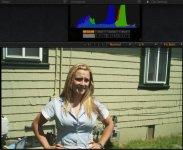
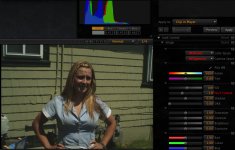
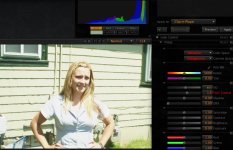
Check out this frame grab in Redcine-X. Bright midday sun, no budget for a giant overhead silk. Note the histogram -- everything between the goalposts. And you can see when I adjust the FLUT slider, the detail in the white of the shirt is there, as is the detail in the grass in the shadow below her left arm.

Definitely make sure you have at least one reflector, though. Indispensable.
 

Attachments

  • 1.jpg
    1.jpg
    96.6 KB · Views: 0
  • 2.jpg
    2.jpg
    95.5 KB · Views: 0
  • 3.jpg
    3.jpg
    85.6 KB · Views: 0
Last edited:
OMFG, MX rips 7D and HVX a new one. It's not even funny. And the HVX only looks good with a lens adapter, which means you have to rate it at like 80 iso. The Red One pre-MX was great for sure, but those 2 extra stops are really something else.

And it should. It is a real digital cinema camera.
 
I've shot all the cameras you are considering.

I would choose a 7D over a RED One for low light applications, where sensitivity is the main issue, and for very small spaces where you could not otherwise place a camera with a S35 imager. (House finale) Oh, and crash cam. the 7D is a great crash camera. Throw some cheap SLR glass on it and crash away.

The RED One trumps the 7D hands down in every other situation.

There are no circumstances I can think of where photographically the 7D is better than a RED One MX, although sometimes it fits in spaces the RED doesn't.

I would only shoot the HVX200 if it was the ONLY choice I was given. I sort of hate that camera. It gets worse with a DoF adapter on it... although I rated it 100 or 160 depending on its setup. This goes for the HVX200A, the HPX170 and to a lesser extent the HPX500.

If you are really considering some other camera, I recommend an EX1R, with a Letus adapter and a AJA KiPro or Convergent Designs NanoFlash. (I recommend those two devices so often, AJA and Convergent designs really ought to pay me.)

If you really want ENG work styles and can use 2/3"/16mm style DoF, then I'd point at the Sony PMW350K.

Otherwise go for a RED package. For your purposes it sounds like you would be happiest with either a RED One or a RED One MX.
 
If you are on a tight budget get EX1 + redrock M2e (latest adapter) - it's really pretty good, especially with Nanoflash - the in-cam Ex codec does not like focus pulls and can fail with giant macroblocks. I estimate our kit to be about 200 ASA - 300 ASA, with the Ex1 at f7 or so.

Spinning adapters are better tools with less problems - The Me2 gives identical results to a Letus Ultimatte (actually, a little better) for 1/3rd price. If you are careful about setup and dust, the above becomes a dependable system that simply delivers predictably. It has teh advantage of being fast, as you can control light via the Ex1 iris without using NDs

That said, it is a piece of crap compared to a Red (non Mx) and a Red with MX is the best camera you can buy at any price for anything - its only downsides are weight (about same as cam + adapter) size (about same, again) and price (about 2.5 X EX1 plus adapter).

Line-skippers are such heart-breaking time-wasters they are not really worth it I.M.O. except as semi-disposable crash-cams, "crevice cams" etc. (Albeit skew is bad, so heavy motion is to be avoided).

Keep in mind that a solid tool will SAVE you money - Time is money on set and crap tools slow you down. Get the best. Few people, if any, ever regret spending a wee bit extra on better cam rentals.
 
Last edited:
http://reduser.net/forum/showthread.php?p=624398#post624398

A high latitude feature used in some cameras to look out for, is called dual slope or multi-slope (one called autobrite which maybe gain on individual pixels). I have one here, and it seems to get the results sometimes, but is flaky. If it is done well, it should work, but one of the problems are color constancy, the color balance changes as the brightness changes (should be calculable from a manufacturers point of view) Omron claimed to have a 27 stop sensor with color constancy. Having said this, I am not aware of which, if any, class sensors use it, a good sensor can achieve a good degree of altitude without it.
 
Our only other options are my HVX200a, or a 7d, which have both given me only about 8 stops at most, with very abrupt highlight blowouts.

As far as i know, both cameras have an adjustment for gamma curve (i haven't used 7D). In harsh sunlight, these cameras should be set to as "flat" (yes, i know it's the wrong word) gamma as possible, which brings up shadows and compresses highlights, and exposed for highlight protection.

Of course, as said, Red blows both out the water, but even HPX 200 is able to produce somewhat decent results this way.
 
Does anyone know where I can find the cheapest MX package is in the LA area?

Going cheapest in LA may not be the best thing to do. I had a nightmare with a camera I got from Indie Rents (camera locking up, wrong build, loose camera mount, scratched OPLF, camera looked beat up). Lots of students here in town who try to get the cheapest, and I have noticed that the one thing seems to be missing from their education is how to care for equipment. My suggestion is to go to reputible and reliable rental house if you value your time and images.
 

If I follow your post right (it is very late here, 1am) you are using multiple frames to clean up the image, as used in astronomical photography. The Omron car camera sensor uses this as part of a technique to film by star light.

The technique is more advanced than this. One set of pixels can theoretically be set at a shutter speed 12bits lower than the other set, and 'theoretically' achieve 24 stops of latitude (though I would aim for 16 stops+, as 4096th of 1/48th a second shutter is pretty fast and I imagine no value overlap could result in issues with color information in an individual pixel). You could do one whole frame fast and one slow, but as there is no overlap, movement might be an issue.
 
I have just shot a feature film with the new M-X sensor on Anamorphic lenses, the majority of which was day exterior in pine forest. My advice would be to keep the ISO at 800 (use lots of ND filters) to keep your stop down around 2.8, 4 and take extra care in planning your shots in relation to the sun.
If your careful and you make sure that your background has just as much sun or shade on it as your foreground, you'll find balancing your exposure much easier. Avoid shooting actors in shade with a sunny background and your golden.
Use the Red, stop worrying about the latitude and start thinking about how your going to balance your exposure because either way, whether your shooting film or digital, balancing exposure for day exteriors is a challenge.
 
The MX sensor is actually better than the Canon at low light.

For crash cam, go for the t2i. Exact same image quality as the 7D, but lighter and cheaper.

I'd agree there - and also vastly higher (visibly so) dynamic range at higher ISOs.

Graeme
 
Back
Top