Welcome to our community

Be a part of something great, join today!

  • Hey all, just changed over the backend after 15 years I figured time to give it a bit of an update, its probably gonna be a bit weird for most of you and i am sure there is a few bugs to work out but it should kinda work the same as before... hopefully :)

Reading exposure; Feature request to EPIC

Lauri Kettunen

Well-known member
Joined
Aug 6, 2007
Messages
1,063
Reaction score
0
Points
36
Location
Finland
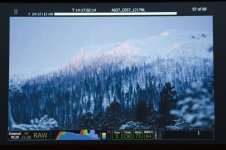
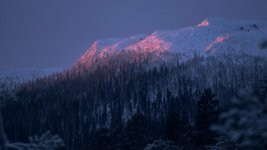
Took recently the shot below and attched is also a view of the camera display.

What puzzled me with this shot is that the 'barber pole' shows that there's no clipping. (Stuart has confirmed that if the upper most red light of the barber pole is off, there's no clippping.) But still, the reds on the mountain have rather little tones as if they were clipped a bit. Heavy grading does not solve the issue.

I've noticed before that in similar kind of conditions something unexpected happens with the metering, and thus experience suggest to "under"exposure. This is to say, what ever the meteres say in raw mode, it's a good idea to come down a bit.

I suspect that the reds of this image are not clipped. But, instead, the show is out of the linear region and thus I'm not able to roll back as I would like to.

Consequently a feature request to EPIC: whatever FLUT/Color science/wonderful assiatnce for exposure you come up with, please include also a mode which shows the upper limit of the linear region (of raw image). This is a necessity for everybody ETTR.

At last, please document clearly what the meters actually show. This is where I find Red One has bit failed to be professional as the documenation forces the user to guess and experiment what is actually going on. Or is it me who is failing to understand the technical principles.
 

Attachments

  • Kivakkatunturi1.jpg
    Kivakkatunturi1.jpg
    38.6 KB · Views: 0
  • Histograms.jpg
    Histograms.jpg
    63 KB · Views: 0
I'm glad you posted this, Lauri, because I think this is particularly true of shooting landscapes, at least that is my experience, that objects seem clipped in the file that didn't appear clipped in the LCD. For these types of shots, I monitor the RAW and the REDSPACE and split the difference in the highlights but, as you say, this is not very scientific, and the results feel somewhat uneven. It doesn't seem to be true of medium shots and close-ups, where I seem to be able to stop down from the RAW, to expose for the most important object in the frame, and get good results consistently.
 
Well - there is a stoplight on the right indicating that at least 2 percent of the image is clipped in the red channel. Its pretty clear.

For what its worth, the image looks completely fine to me. I not seeing any lack of detail in those rosy pink highlights. They look great to me. And for what its worth, you've exposed so far to the right, compared to the final look that you were going for that you've completely eliminated any safety margin that you might have.
 
Well - there is a stoplight on the right indicating that at least 2 percent of the image is clipped in the red channel. Its pretty clear

Andrew, thank you for your comments but perhaps I did not manage to make my point properly as you missed the key point.

In this kind of situations there is no time to set the white balance. The light is there for a short moment and one has to rush to get the camera on to captyure the unique moment. Consequently, there is no time to set the white balance and tilt.

Now, the trafic lights depend on the chosen WB and tilt and by chaning them the red light disappears. Thus, the trafic lights give the cameraman only a little if any useful information of the exposure in situations where the WB itself makes little sense as different parts of the image have different color temperature. However, the barber's pole should be a reliable indication of clipping and this seems to be true. Although the red light is on, the red channel does not clip in this image as the barber's pole indicate. In fact, the image is well below cliiping. When I have a chance, I'll post the raw view instead of the rec709 and you will see that nothing on the monitor indicates any kind of clipping.

But now, my point is, the camera does not indicate when one is beyond the linear region of the sensor. And when so between the upper limit of the linear regions and the point when the signal clips there's a region where information gets compressed (precisely the same way as audio signals are compressed with compressors). This means, in post one is not able to roll back as one should, but instead some of the possible dynamics were lost while shooting. In this image the reds are compressed.

For this reason, I'm suggesting that in Epic/Scarlet the monitor clearly indicated where the linear region ends. The reason to ask this is that I've learnt by experience that when I'm shooting snow fields in December and January when the sun is just below or above the horizon --and the light rays "travel" a very long path in the atmosphere and consequently become heavily filtered-- the metering of Red One is misleading. One has to underexposure a lot.

I suspect, but may well be wrong, that the color science covers 99% and more of the possible conditions. But some cases like this example just happen to fall out from the assumptions behind Graeme's color science. All these FLUT/Color science/whatever is just wonderful. I'm just saying that in some cases need metering that tells precisely what is going on on the sensor. For as long as linearity is retained nothing is lost and everything is saved and one is able to work out the right colors in post. It sounds like Meryem have similar kind of experience.
 
Back
Top