Welcome to our community

Be a part of something great, join today!

  • Hey all, just changed over the backend after 15 years I figured time to give it a bit of an update, its probably gonna be a bit weird for most of you and i am sure there is a few bugs to work out but it should kinda work the same as before... hopefully :)

Question on correct Articulating Arm usage.

Ron Smith

Member
Joined
Mar 20, 2011
Messages
22
Reaction score
0
Points
0
When I use an articulating arm like a noga with a monitor it is very easy for the monitor to loosen because it is screwed into the 1/4 20" thread or 3/8" thread and when I accidentally spin it the arm itself acts like its own wrench and loosens the arm from the thread.

How do you prevent this from happening? I just want to prevent any monitor damage.
 
The best non-permanent way is to get a wrench on the mount point and tighten it a bit more tightly than the arm torque can loosen.

Alternatively attach it to a Manfrotto Nanoclamp with the above trick, or Loctite threadlocker, and you can mount it anywhere the nanoclamp can clamp.
 
Thanks Eric!

If I was using one of these...

http://store.zacuto.com/20-to-3-8-16-gold-adapter.html
http://www.filmtools.com/filmtools-quarter-f-3-8-m-adapter.html

Would a pipe wrench be the right tool to lock the arm into the thread so that the arm torque cannot loosen it?

It looks like the 1/4 20 to 3/8 16 adapter is already ridged for that purpose.


There best non-permanent way is to get a wrench on the mount point and tighten it a bit more tightly than the arm torque can loosen.

Alternatively attach it to a Manfrotto Nanoclamp with the above trick, or Loctite threadlocker, and you can mount it anywhere the nanoclamp can clamp.
 
Any tool that will grip it tight enough would work - even a pair of pliers or a large Leatherman/Gerber pliers using the circular ridged cut out:

eg:
http://static.ddmcdn.com/gif/pliers-1.jpg
http://www.photo-dictionary.com/photofiles/list/754/1173pliers.jpg

Remember most of the mounting holes are only aluminium. A pipe wrench can exert a lot of force - enough to easily strip the threads of a mounting hole if you're not careful. It only needs to be a bit tighter than the torque from the arm.
Overtightening also makes it almost impossible to remove if you ever have to in future.
 
If you mount the 1/4" screw sideways ( like on one of the arms of a cage) you can put the weight of the arm pushing on the direction the screw spins. If the 1/4" screw is bottomed out it can't loosen.
 
Unless the Noga arm is to be a permanent fixture, I would have some reservation about attaching with loctite or overtightening.

When a fitting is frequently removed for shipping and transporting, unless a quick dismount device is added, there will always be that nagging doubt as to whether "this time" something may break. Sooner or later the correct tool will be forgotten or go over the side. Then the ratnose plies or multigrips will come out and things may get torn up.

A stripped thread on a cage is not going to be wrist-slashing time and there's plently of spare holes on modern cages have been provided by thoughtful designers. Besides, if a few holes become rent and the anodising scarred, won't it now look like a well used rig that pays its dues? ( Sorry about that ) Stainless steel helicoil repairs work exceedingly well. Helicoils are routinely fitted from new to some alloy structures for thread longevity.

There is a product vended by a US outfit, 16.9 INC which is a miniature wedgeplate for Noga Arms and the like. B&H have them fitted to some Noga Arms as a complete kit. They are not cheap.

They take a little practice in getting used to as they do not quite work like the tripod speed mounts they look like. The latch mechanism is not arm-and-auto-release-on-insertion in its function. The lever has to be held open manually. They do work and they do work well.


As for correct use, my use of the Noga arm is for a touch monitor on a P+S Technik SI2K camera-recorder body where it anchors to the top handle. My personal preference is to normally deploy the arm only in a near to half-folded state and move the monitor around inside of the limits that arrangement imposes. This practice reduces the outboard load on the anchor point which can become rather wrought when people become all enthusiastic and vigorously stab at the touch screen controller.

If the Noga arm must be always fully extended for reach, then it may be time to provide another anchor point.

There is also a matter of choice of the correct Noga arm for your particular job. They come in several sizes and arrangements. I replaced the standard longer arm with a shorter one. I found that an arm with shorter segments provided the same utility for me as the longer version. It no longer tended to loosen at the anchor point and folded away into the travel case for short commutes.

What suits me may not suit someone else.


EDIT: Here is a picture of the quick release gadget :-

http://16x9inc.com/shop/cart.php?m=product_detail&p=32
 
Last edited:
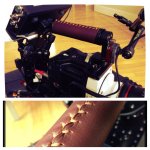
Roger the 16x9 quick release. I have a bunch of them. At first I didn't want to spend the $$ on them, but now I am "Shup up and take my money!". They are one of the best things I've purchased.

The 16x9 quick release + the Wooden NATO handle which is also awesome make for a 3 minute build on my Phantom instead of a 15-20 minute.
 

Attachments

  • 254615_10151290152959810_1371337834_n.jpg
    254615_10151290152959810_1371337834_n.jpg
    90.2 KB · Views: 0
Roger the 16x9 quick release. I have a bunch of them. At first I didn't want to spend the $$ on them, but now I am "Shup up and take my money!". They are one of the best things I've purchased.

The 16x9 quick release + the Wooden NATO handle which is also awesome make for a 3 minute build on my Phantom instead of a 15-20 minute.

+1, these things rock!
 
Back
Top