Welcome to our community

Be a part of something great, join today!

  • Hey all, just changed over the backend after 15 years I figured time to give it a bit of an update, its probably gonna be a bit weird for most of you and i am sure there is a few bugs to work out but it should kinda work the same as before... hopefully :)

Power Mac computing wall?

Wayne Morellini

Well-known member
Joined
Jan 3, 2008
Messages
6,157
Reaction score
0
Points
0
Would building a computing wall out of 200 or so Power Mac's stacked up be useful?

Thanks.

Re-edit: A comedy thread that people took too seriously again.
 
If you're talking PowerPC based Power Macs, then no... If talking Intel based Mac Pro, then perhaps yes, but still probably no...
 
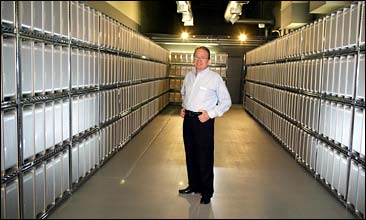
We had a room full of 500 Mac G5s at Lowry to do image processing around the clock on various projects, using custom software and parallel processing to do very complex work on film restoration:

lowry.digital.jpg


I believe this was subsequently dismantled around following most of the company's move to Mumbai in late 2012. I think there are alternate ways of deploying supercomputers today that might be more effective. A lot depends on the available operating systems and writing specific software to take advantage of parallel processing. I know in this case, they were not running Mac OSX -- this was all Linux.
 
Since we can currently fit 72 cores / 144 threads into half-depth blades of < 1U rack space.... Or 1U rack full depth rack space buys us the same number of cores/threads with dual 12GB GPUs, there is no reason to build walls of towers. The Mac Pro cylinder has a lot going for it in terms of density and connectivity for these purposes, but I think an update is warranted here. If Apple can put dual CPU with updated GPUs and the ability to build an interconnect fabric on 40Gbps Thunderbolt 3..
 
If you were Apple ... would you try and Release a new Mac Pro Q3 2016 based on AMD Polaris + 14nm Xeon ... or wait until Q3 2017, when :
- Intel is on 10nm (which will probably be Intel's leading platform for 4 years), and
- AMD rolls out Vega (which will will be HBM2, proves they are going to survive, and have stellar performance compared to what is available today)

With Microsoft now in the Linux camp, ARM betting on TSMC 7nm (==Intel 10nm) to help them break into enterprise systems, and Apple looking to spend $3B to build its own cloud infrastructure .... I wonder what computing systems Apple will use?

AJ


AMDGPU.jpg
 
Intel won't go 10nm for Xeon CPUs until at least 2019... They have only released a select few 14nm Xeons with the bulk of that lineup launching late this year in the E5 camp. E7's won't go 14nm for another year. Apple will definitely launch a new Mac Pro with this iteration and gain +2 generations on GPU hardware along with the 14nm CPUs, DDR4 RAM and Thunderbolt 3. We may not see a new iteration after that until Thunderbolt 4 comes along and possibly the 10nm shrink, so very late 2018 at the earliest, IMO. There will be an iteration of Xeon and GPUs in between there, but as far as the CPU and RAM will be considered, the gains will be very minimal and Apple may continue their trend of the last 5+ years with the Mac Pro of skipping the inconsequential updates.

Ultimately, I expect to see a convergence of ARM and x86 architectures too. I've been privy to some development on that front and if the stars properly align (as in, it's a somewhat big "if"), that could be coming sooner than people might think.

I do think we'll see a Skylake / 14nm Xeon Mac Pro with Polaris GPUs and TB3 this year, probably announced at WWDC and shipping not too long after - August~September, maybe? Although most would prefer Apple move to nVidia GPUs. I know that nVidia would do a far better job at supporting the system with proper drivers. AMD/ Apple did an extra shitty job with GPU drivers and support on the current Mac Pro cylinder.
 
We had a room full of 500 Mac G5s at Lowry to do image processing around the clock on various projects, using custom software and parallel processing to do very complex work on film restoration:

lowry.digital.jpg


I believe this was subsequently dismantled around following most of the company's move to Mumbai in late 2012. I think there are alternate ways of deploying supercomputers today that might be more effective. A lot depends on the available operating systems and writing specific software to take advantage of parallel processing. I know in this case, they were not running Mac OSX -- this was all Linux.


Was the deployment based on XGrid?
 
Ultimately, I expect to see a convergence of ARM and x86 architectures too. I've been privy to some development on that front and if the stars properly align (as in, it's a somewhat big "if"), that could be coming sooner than people might think.

Anything related to heterogeneous computing?
 
I would have enjoyed seeing the applications of quantum computing in it prime. Perhaps next life.
 
What sort of applications would you hope to see?

I think it will be some time before we are able to effectively 'program' quantum computers.
My guess is that we will end up using machine learning systems to help us bridge the gap due to the counterintuition involved in coding them.
And even if a super-duper programmable quantum computer existed today - this would not translate into anything general purpose (ie usable) for many many years.

Before that point however - I think we WILL have nudged towards the minimum Energy consumptions required for single bits of atomic computing. If there is an absolute minimum of energy required to 'flip a bit', and this is proportional to the amount of Useful work a computing device is performing (for a non quantum computer) then this is the ultimate barier to 'what we can do' for a specified amount of power.

https://en.m.wikipedia.org/wiki/Landauer's_principle

Until the DOE gets its hands on a Fusion rector (2035 ish?), the power budget for a supercomputer will be in the region of 20 megawatts.
The DOE have the trying to tempt companies to develope more efficient commercial CPU/GPUs.
And DARPA have bee pouring in research money into reaching the Minimum energy for hardware devices.

In the short term the DOE will get supercomputers that are 10 times faster with current leading edge technology (ie SUMMIT super by end of 2017).

In the longer term, the R&D has created individual Proof of Concept demonstrations of specific superconducting components that near or equal Landaure's minimum proposed energy. These use 1/1000 -> 1/10000 the energy of the current best in class components.

DARPAs been be funding heavily ... even teen startups :-)
http://www.nextplatform.com/2015/07/22/supercomputer-chip-startup-scores-funding-darpa-contract/

It is DAPRA Who I think will have the first supercomputer with functions superconducting Parts that near the Landauer limit.
I would guess [DOE] 300PF by 2018, [DOE] 1 Exaflop by 2022 (2 year late!) and [DARPA] 100 Exaflops 2030 using all the magical components from their superconducting labs!

... but the question still remains ... what would you want to do with all that computational power?!

AJ
 
Back
Top