Welcome to our community

Be a part of something great, join today!

  • Hey all, just changed over the backend after 15 years I figured time to give it a bit of an update, its probably gonna be a bit weird for most of you and i am sure there is a few bugs to work out but it should kinda work the same as before... hopefully :)

Positives of 2/3rds

Erik Vanlenten

Well-known member
Joined
Jan 19, 2011
Messages
207
Reaction score
4
Points
18
Location
Atlanta GA
Website
www.erikvanlenten.com
Hello,

This is my 1st post and I am so excited to be a part of this community, GO RED!

I would love to hear from some people about the upsides of the 2/3rds sensor. I have the opportunity to work with a panasonic 2/3rds sensor everyday and I love it. (although I am super excited to get my Scarlet:)

So what do ya'll think?
 
this thread contains some similar thoughts... http://reduser.net/forum/showthread.php?t=38645

it really depends on what you're comparing it to. there's no such thing as a positive without a negative. compared to smaller sensors, it gives you greater options for a more shallow depth of field and lower light conditions. compared to a larger sensor, it natively has a deeper depth of field, which can be desirable for stereo3d work, in combination with its small size. those are the main things i'm thinking off the top of my head.

like i said, it all depends on what we're comparing to, and if we're simply talking about the sensor size or if we're talking about the scarlet 2/3 itself.
 
There is no right or wrong sensor size, as Paul suggests, they all have their pluses and minuses. The main advantage of 2/3" over S35 or FF35, in my opinion, is mainly that it is (of course) smaller and thus it allows the camera to be smaller and the optics to be smaller. There are a number of small handholdable f/2.0 zoom lenses for 2/3" ENG cameras for example with zoom ratios over 10X, but hardly any for Super-35 cine with those sorts of zoom ratios, in those sorts of sizes.

Other than that, there is the increase in depth of field, about 2.5-stops more on average compared to Super-35... that can be an advantage in some cases, an annoyance in others. In other words, if you shot at an f/2.0 on a 2/3" camera, it would look like shooting at f/4.0-5.6 split in Super-35. Now is that a good or bad thing? Well, it may be a good thing if shooting close-ups in low-light at f/2.0 but wanting to hold focus better. It may be better suited for 3D photography, where some deeper-focus is often preferred. It may make telephoto shooting easier to focus. On the other hand, if you want the look of f/2.0 in 35mm photography, it's hard to get that on a 2/3" camera.
 
As David pointed out, PLUS the GLASS itself for 2/3" is also a LOT MORE AFFORDABLE and AVAILABLE than for S35
 
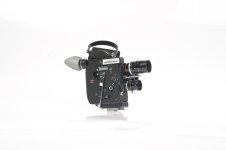
It would be cool if you could get a turret mount for it.
 

Attachments

  • bolex_turret.jpg
    bolex_turret.jpg
    40.9 KB · Views: 0
I think the 2/3" will be a go to for documentary work of all kinds. Run and gun on FF can be tedious, 2/3" is a perfect middle ground. Possibility for some DoF, but deep enough to keep your wide shots in focus ;)
 
It would be cool if you could get a turret mount for it.

Yeah, a turret mount with the mini-primes would be excellent. No need to open the sensor up to dust in the field, but you'd still have three distinct focal lengths that are all faster than a comparable zoom. And speed is important with small sensors.
 
The scarlet interchangeable reminds me of a bolex or an old 16mm camera. Excited to see what people can do with it.

High quality 16mm film camera lenses should serve very well for Scarlet. That is what I plan to use, including some that used to ride the nose of a Bolex. The Bolex analogy ( or digitalogy:w00t:) is very appropriate I think.
I am very fond of the 16mm/2/3" sized formats for general purpose production use. 35mm is the all the rage right now, but for a go anywhere do anything compact personal motion production camera, I think Scarlet is hard to beat.
 
The scarlet 8x will be a work horse for many people, and the 3d capabilities are mind blowing. I can't wait to see all the Scarlet's at NAB, wondering if the interchangeable will be cheaper with one lens than the fixed 6000-7000 price range?
 
Paillard_Bolex_16mm_lens.jpg


Replace with red mini primes
 
1. Physically smaller, lighter lenses.
2. Generally less expensive lenses.
3. Possibility for fast, long zooms unlike what is available for S35 or FF35.
4. Usable depth of field at low F-stops.
5. Availability of some really great ENG-style servo zooms.
 
How big is the sensor of the Canon 7D in relation to the Scarlet? (I tried to google it but I couldn't find any clear results)
 
How big is the sensor of the Canon 7D in relation to the Scarlet? (I tried to google it but I couldn't find any clear results)


Well the 7D has an APS-C sensor which is much closer to 35mm and the scarlet which is more like s16mm sized.
112608_sensor_sizes.jpg
 
Well the 7D has an APS-C sensor which is much closer to 35mm and the scarlet which is more like s16mm sized.

Scarlet is 10.1mm x 5.35mm 1.89:1 digital cinema format. For HD it conforms closely to the 2/3" reference standard of 9.6mm x 5.4mm. More like standard 16mm film than S16mm.

attachment.php
 
That's much clearer, thanks. I'm fairly familiar with the 7D but I don't know a whole lot about sensors. I know there's some people who aren't thrilled about the 2/3" sensor on the Scarlet but this thread has eased my worries a little bit.
 
Back
Top