Welcome to our community

Be a part of something great, join today!

  • Hey all, just changed over the backend after 15 years I figured time to give it a bit of an update, its probably gonna be a bit weird for most of you and i am sure there is a few bugs to work out but it should kinda work the same as before... hopefully :)

Panavision 70mm

leonel escobar

Active member
Joined
Dec 31, 2013
Messages
25
Reaction score
0
Points
1
Location
Boston, MA
Do you need anamorphic lenses to shoot Panavision 70mm? After watching Quentin Tarantino's The Hateful Eight the bokeh appeared to be circular rather than oval shape.
 
Regular 5-perf 65mm Super Panavision (originally Todd-AO 65) as was used on movies like "2001", "Lawrence of Arabia", "Sound of Music", "Patton", "Ryan's Daughter", "Far and Away", "Hamlet" etc. uses spherical lenses and the native aspect ratio is 2.20 : 1.

Panavision and MGM developed an anamorphic 65mm format originally called MGM Camera 65 and then later Ultra Panavision that uses a mild 1.25X anamorphic squeeze to fit a 2.76 : 1 image onto the 2.20 : 1 negative. Only nine movies were shot in the format, not including the use of the camera for some stunt shots in "How the West Was Won", which was mainly shot in 3-strip Cinerama.

Raintree County (1957) – credited as MGM Camera 65.
Ben-Hur (1959) – credited as MGM Camera 65.
Mutiny on the Bounty (1962)
It's a Mad, Mad, Mad, Mad World (1963)
The Fall of the Roman Empire (1964)
The Greatest Story Ever Told (1965)
The Hallelujah Trail (1965)
Battle of the Bulge (1965)
Khartoum (1966)

And now "The Hateful Eight".

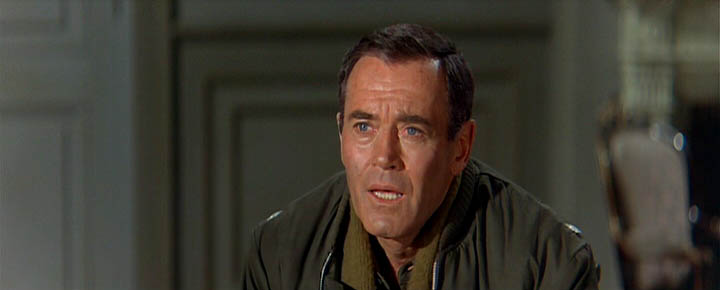
The 1.25X anamorphic bokeh is pretty mild but it's there if you look - for example, in this frame from "Battle of the Bulge":
botb1.jpg


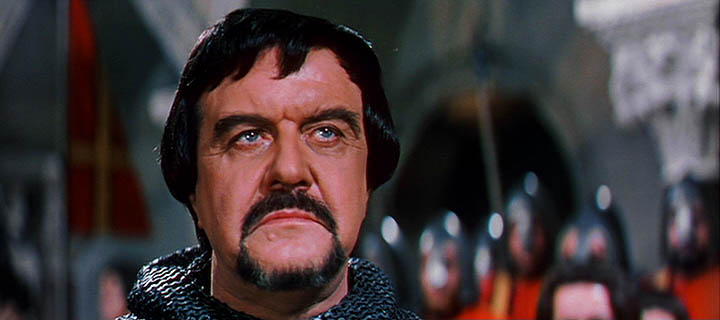
Technirama (8-perf 35mm VistaVision-type negative with a 1.5X anamorphic squeeze) has a similar mild anamorphic bokeh compared to the classic 2X squeeze of CinemaScope. For example, look at this frame from "El Cid":
elcid1.jpg


Same goes for the 1.3X squeeze of the Hawk anamorphics used recently on such movies like "Blackhat".

Only the print stock is 70mm, the negative is 65mm and the sprockets line-up with the 70mm print stock, which has the extra 5mm on the outer edges, originally to make room for 6 tracks of magnetic sound.
 
The widescreen revolution was kicked off in 1952 in Hollywood by the success of Cinerama as demonstrated in the travelogue feature "This is Cinerama" -- it was independently made and only viewable in a few theaters around the country converted to show it -- three 6-perf 35mm images side-by-side to create a 2.66 : 1 image on a huge, deeply curved screen, with seven tracks of sound. This was in a day and age when most movies were 1.37 Academy b&w with mono sound. "This is Cinerama" was #1 at the box office for some weeks, which really caught the attention of the Hollywood studios.

MGM developed Ultra Panavision with Panavision partly to create a 65mm format that could be released in 3-projector Cinerama theaters without using the Cinerama process. But soon after Ultra Panavision was introduced, Pacific Theaters bought the Cinerama Corporation and phased out three-projector Cinerama in favor of 70mm prints, spherical and anamorphic. So the Cinerama Theater in Hollywood, which has three projection booths to show Cinerama, when it finally opened, it showed "It's a Mad, Mad, Mad, Mad World" in 70mm instead. It wasn't until just a few years ago when a restored 3-panel print of "How the West Was Won" got struck that the Cinerama Theater actually showed a Cinerama movie in real Cinerama.
 
Its a shame The Hateful 8 wasn't able to keep their deal with Arc light to show it there, instead got bullied by Disney out of it.
 
2-perf Techniscope used spherical lenses. 4-perf 35mm Full Aperture is 1.33 : 1, so a frame that is half that in height is 2.66 : 1 Full Aperture -- Techniscope only used the Academy width though so the image was 2.35 : 1. It was blown-up and squeezed in an optical printer to create a 4-perf 35mm anamorphic copy for making CinemaScope prints.

David O. Russell made "The Fighter" and "American Hustle" in 2-perf.

In terms of how the image looks, however, cropping 3-perf or 4-perf to 2.40 doesn't look that different from shooting 2-perf.
 
My Fair Lady is another spherical 65mm production, and that's a really beautiful film (and won 8 Oscars including one for DP Harry Stradling). I'm a much bigger fan of spherical 65mm Super Panavision just because I think it looks sharper and clearer than anamorphic UltraPanavision, but that's me. I concede that there's a particular look of those old anamorphic lenses that definitely have a vintage flair.

In terms of how the image looks, however, cropping 3-perf or 4-perf to 2.40 doesn't look that different from shooting 2-perf.
My problem with 2-perf is that the image height is almost as tiny as Super 16mm (.373mm vs. .292mm), so grain starts to become an issue as well as image steadiness. Dirt is a much bigger issue in 16mm and 2-perf as well, and gate dirt is a much bigger problem hinging on how much of the frame you're using. I also think 35mm 3-perf cameras are easy to find in good shape, particularly for rental. I'm a much bigger fan of shooting in Super 35mm 3-perf and providing the ability to recompose in post if necessary. I also think 3-perf helps provide an easier way to transition to a 16x9 full-frame version, which is almost always required for video deliverables (in addition to the 2.40 letterbox version).

I'm curious to see if any under-$10M indies will shoot in Super 35mm, because then the budget becomes much more of an issue. I know both Kodak and Fotokem are bending over backwards to make both the stock and the developing much more affordable than it used to be, and god knows, film cameras are dirt-cheap to rent these days.
 
In general, I think that spherical 65mm is not only a better system optically (and depth of field is already shallow enough without the added twist of anamorphics) but mainly, 2.20 : 1 is a lot easier to compose for than 2.76 : 1, which is extremely wide. But there is a certain "cool" factor about such an unusual format.

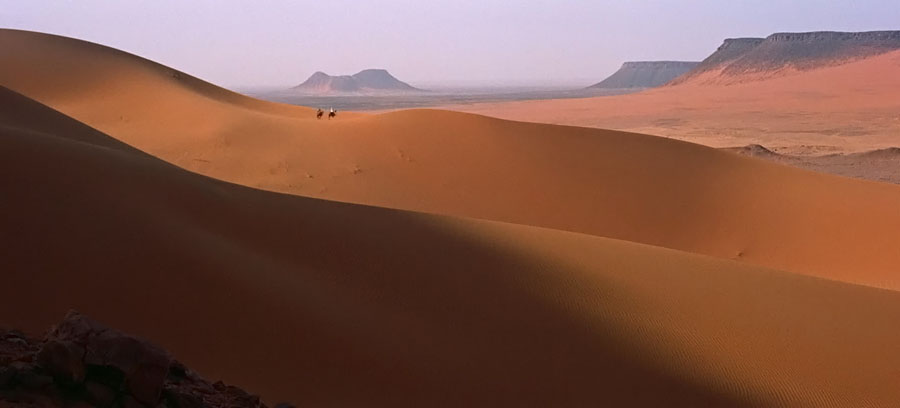
It's hard to beat the elegant widescreen shape of 2.20 : 1 65mm spherical:
loa6.jpg
 
Last edited:
2-perf Techniscope used spherical lenses. 4-perf 35mm Full Aperture is 1.33 : 1, so a frame that is half that in height is 2.66 : 1 Full Aperture -- Techniscope only used the Academy width though so the image was 2.35 : 1. It was blown-up and squeezed in an optical printer to create a 4-perf 35mm anamorphic copy for making CinemaScope prints.

David O. Russell made "The Fighter" and "American Hustle" in 2-perf.

In terms of how the image looks, however, cropping 3-perf or 4-perf to 2.40 doesn't look that different from shooting 2-perf.
Thanks, I get it now, the 2 perf goes through a anamorphic lens to go onto a 35 mm print. And when they did 70mm prints of 2 perf, I guess all they did was project between the smaller 2 perf spherical to the much larger 70mm(or Vista Vision prints?) print which is also spherical. To me, I like 2 perf from a retro perspective, since it really shows the grain and its almost twice as cheap as normal 35mm.
 
It's hard to beat the elegant widescreen shape of 2.20 : 1 65mm spherical...
Yeah, I agree. I often make the argument that I'm skeptical as to whether movies made prior to 1980 really have 4K of resolution, but I can't argue about 65mm spherical shows like Lawrence of Arabia or 2001. Those are beautiful, pin-sharp movies for any generation.

But man, some of the anamorphic stuff I've seen is woefully soft. Especially stuff from the 1950s.

Thanks, I get it now, the 2 perf goes through a anamorphic lens to go onto a 35 mm print. And when they did 70mm prints of 2 perf, I guess all they did was project between the smaller 2 perf spherical to the much larger 70mm(or Vista Vision prints?) print which is also spherical. To me, I like 2 perf from a retro perspective, since it really shows the grain and its almost twice as cheap as normal 35mm.
I think the cost savings is a distraction. In truth, you have to go through a digital intermediate pass, so bear in mind you're spending $100,000 to get a print in the end. If you only go with a digital DCP release, then it's no more costly than any camera. When you add up the real costs for a feature, I think film stock is very, very low on the list; the above-the-line expenses are far more critical.

Doing 2-perf Techniscope back in the day (like American Graffiti and quite a few Sergio Leone films) required another optical blow-up stage which resulted in lots of grain build up and density shifts. It was not an ideal medium, using an optical printer to convert to anamorphic. It's basically camera negative to IP to interneg to IP and then IN again. Those additional optical stages are not healthy, but it would save money if you were shooting tons and tons of material. But I think 3-perf is far more flexible for post and gives you another perf for more stability, plus the additional vertical room for recompositions.

The two things a 70mm release print would give you are a) huge light behind the film for projection, and b) enough area for a 6-track surround soundtrack. Bear in mind you're just blowing up an image that's .373" x .864", which is teeny-tiny. I think using more area for Super 35mm 3-perf makes a lot more sense, but it would hinge on doing a digital intermediate. Your options for a pure film release are very, very limited in 2016. And -- Tarantino notwithstanding -- I don't think a 70mm print release makes sense for 99.999% of most film releases.

2-perf-by%20MaxSmith.jpg
 
Back in the 1960's Techniscope blow-ups to anamorphic looked pretty good because of how Technicolor did the blow-ups back then -- they went from 2-perf camera negative through an optical printer with an anamorphic lens directly to the 4-perf 35mm b&w matrix stock, from which the dye transfer prints were made. So no IP/IN step and one generation saved, it was what Technicolor called "direct to matrix". (I don't think any Techniscope movies were released in 70mm, especially since that wasn't a dye transfer process.)

Plus Technicolor offered a discount for the whole deal. But then in the early 1970's they dismantled their dye transfer printing machines and Techniscope died out at the same time. Once producers had to spend the money on an IP/IN optical printer step with increased grain problems, the process no longer looked appealing. Plus another coincidence was the early 1970's was the time of the new quiet self-blimped cameras like the Panaflex and the Arri-BL, which were not made with 2-perf options. So 2-perf shooters were stuck with older Mitchells, Eclair CM3's, and Arri-2C's that had been converted to 2-perf.

The name Techniscope was resurrected in the early 1980's when John Alcott was about to shoot "Greystoke" for Hugh Hudson and didn't want to shoot on anamorphic lenses but wanted a 2.40 image for blow-up to 70mm. Remembering the Techniscope format, he thought he would shoot in 4-perf 35mm but expose a 2.40 image out into the soundtrack area. He called it "Super Techniscope" and the image was printed directly from camera negative to 70mm print stock (in an optical printer) for a few theaters (as was done later for "Howard's End" and "Remains of the Day" -- gorgeous 70mm prints). Since "Techniscope" was a name connected with Technicolor Labs, eventually the more generic term "Super-35" became more common.

The idea of shooting 4-perf 35mm Full Aperture for 2.40 was not new -- in the late 1950's there was a process called "SuperScope" that involved shooting 4-perf 35mm Academy and cropping this to 2.00 : 1 and blowing it up onto a CinemaScope print with black side mattes. The process died out because it was easier to just compose Academy for cropping to 1.85. But some attempt was made to improve SuperScope by using the Full Aperture width and composing for cropping to 2.35 -- the idea was called "SuperScope-235" but it is unclear if any movie actually got made in the process.
 
Last edited:
Thanks so much for the detailed read! Very interesting stuff to me, especially with the new digital models coming to market in 65 and vista vision sizes it's refreshing to grasp the historical significance
 
Certainly James Cameron also had an extremely influential hand in re-popularizing Super35 (pre-DI) in the late 1980s with films like The Abyss and into the 90s with Terminator 2, True Lies and Titanic… Once DI post processes took hold by the mid-2000s, negating having to deal with an optical printer taking its generational toll on the image, Super35 became quite attractive for its flexibility for multi format releases...
 
David, is it a coincidence or not that all the information you possess happens to be super-duper interesting? ;-) One thing I don't get: why exactly could you not order a sound camera with 2-perf? How hard could it be for Arri or Panavision to modify the gates?

Christopher, I read somewhere (I might have the URL somewhere) that James Cameron liked to make sure his negatives were "rich" - I translate that to overexposed by maybe 2/3 of a stop. He preferred this to double-printing the IP (which minimised graininess but obviously cost more). This reduces sharpness a bit but also gives a cleaner image. David can probably tell us about that as well!
 
There are 2-perf movements now for Panaflexes and Arricams, just not in the 1970's, 80's, and 90's. Techniscope was considered a dying format when the Panaflex and Arri-BL arrived in the early 1970's so no one made 2-perf movements for them until the format was revived in the 2000's with the rise of D.I.'s. It's not a question of just modifying the gates, you needed a new pulldown movement.

I'm not sure about double-printing an IP reducing sharpness. I know that Cameron liked a thick negative and he even timed the movie on the brighter side so that the dupe negative from the IP was also denser than normal.
 
Certainly James Cameron also had an extremely influential hand in re-popularizing Super35 (pre-DI) in the late 1980s with films like The Abyss and into the 90s with Terminator 2, True Lies and Titanic… Once DI post processes took hold by the mid-2000s, negating having to deal with an optical printer taking its generational toll on the image, Super35 became quite attractive for its flexibility for multi format releases...
Jim Cameron was frustrated by the amount of image lost in pan/scans for TV (particularly 1.33 standard-def TV), and didn't like the loss of resolution with 2.40 letterbox. Super 35 was his idea to provide more image area so every shot could be optimized for TV. The flaw with his reasoning is that many of the effects for his films -- particularly Aliens, Terminator 2, The Abyss, True Lies, Titanic, and so on -- were composed only with 2.40 in mind, so there was often no effects finished to the edge of the aperture plate. The live action shots were fine, but the other 1/3 of the movie all had to be blown-up and repositioned quite a bit.

Everything changed around 2002-2007 when DI took over and optical printers fell by the wayside.

...I read somewhere (I might have the URL somewhere) that James Cameron liked to make sure his negatives were "rich" - I translate that to overexposed by maybe 2/3 of a stop. He preferred this to double-printing the IP (which minimised graininess but obviously cost more). This reduces sharpness a bit but also gives a cleaner image. David can probably tell us about that as well!
Going for a thick negative is a preference quite a few DPs have made over the years, particularly when they know they're going to go through a digital or VFX stage. I've always told my clients to over expose by about 1/3 to 1/2 a stop on film.

I've never heard of double-printing an IP. I do know that in Technicolor printing, they'd do a final B&W-only stage to increase the apparent sharpness due to alignment issues with the YCM negatives. What is true is that the IP stock is really, really slow (like ISO 5) and has to be run fairly slow on the printer. This is also very, very expensive film, roughly $2/foot when I last checked, so you're looking at about $3500-$4000 per 20-minute roll. Prints are cheap; internegs and IPs are not.

One thing a lot of people aren't considering with Hateful 8 and 70mm: the film release is color timed differently than the wider digital release. I would bet that there were a lot of things in the film print they just had to let go, and Richardson was able to zero in on the digital version with a lot more time and scrutiny.
 
I saw a framing chart for the cameras used on "Terminator 2" and basically it implied that effects shots would be finished out to 2.00 : 1. Whether they did that or not, I don't know but of course a 2.00 : 1 shot would still need to be panned and scanned for 4x3 TV.
 
The Blu Ray for The Hateful Eight has been announce for March 31. No word yet about the supplements for the 2 discs, but since so much has been made in the press about the rare use of 65mm I am so hoping that they include a comprehensive documentary about large-format cinema and the filmmaker's hard fought struggle to shoot The Hateful Eight on a format not used in 50 years.
 
Now if we could just get a butterfly (split screen) with the 70MM film print on one side and a 4K DCP on the other... (using a hard mask on side by side projectors). How much of the Hateful 8's texture/feel/sense of era comes from use of film vs lens choice/production design/color palette/pacing/etc? How different would the color timing look between photochemical for release print vs DI to P3 DCP? Would be fun to set it up at Cine-Gear for people to experience with their own eyes...

Cheers - #19
 
Now if we could just get a butterfly (split screen) with the 70MM film print on one side and a 4K DCP on the other... (using a hard mask on side by side projectors). How much of the Hateful 8's texture/feel/sense of era comes from use of film vs lens choice/production design/color palette/pacing/etc? How different would the color timing look between photochemical for release print vs DI to P3 DCP? Would be fun to set it up at Cine-Gear for people to experience with their own eyes...

Cheers - #19

+1 would absolutely love to see something like that! There are so many questions that could be answered if someone actually did this!!!!
 
Back
Top