Welcome to our community

Be a part of something great, join today!

  • Hey all, just changed over the backend after 15 years I figured time to give it a bit of an update, its probably gonna be a bit weird for most of you and i am sure there is a few bugs to work out but it should kinda work the same as before... hopefully :)

New project...

Instead of AR or VR we're going to have Reality . . . where you actually go outside and experience stuff ;-)

Just kidding. Whatever JJ is up to I'm sure it will be awesome! If it was easy - everyone would be doing it already

+1...

Yup "Reality"... The rendering is really awesome and the stereo is so well resolved LOL...

It's with programmers you have to occasionally tell them that the bright shinny orb in the sky... is called "The SUN".

+1 on what you also said @ Zeb B... That's what my Ph.D supervisor said to me many years ago; "If it was that easy it would have been done already".

On a different note...

Hopefully "Everybody" has read the relevant parts of the patent literature and the Patent Examiners are doing the best job that they are able to do... (Cough, cough)... [As a 20+ year expert in VR and stereo and photogrammetry I personally don't think there is ANY commercial future in notional everyday VR tech , (and we solved some of the most tricky problems and show stoppers associated with the technology). There are obviously very important niche applications, but I have to admit I am somewhat dismayed and pessimistic that somehow VR came back into "Fashion" :-) :-( ].

I'm pretty sure Jim "Labs" are doing something of a much broader and long lasting appeal and utility and something that is truly PRACTICAL... (LOL). So a little bit like what I was whiffling on about, if you render real imagery in a synthetic environment then you turn AR on it's head to something that is infinitely more useful. I think it's more about things that are useful, practical and genuinely change they way people do things rather than VR or or so called holographic gizmos. If you think about it if you have total Georeferenced imagery of a high precision with accurate position and orientation data then the way you search for stock footage stills and media content is completely changed. In other words Jim Et Al. could be what I-tunes is to music is Jim's "New thang" is to visual media. So for example if you need to look for imagery of let's say the Alhambra in Spain you go to a GIS/Google Earth "Type" database and interface that has spatially and georeferenced material created by various shooters / media content producers that can sell direct... As that's how we search for "Stock media". Maybe ... I have no idea LOL... Seems like it would fit the user base for RED cameras and products quite well for those that are outside of the main steam "Film/movie industry" And stimulate people to get off their proverbial butts and get out there and shoot stuff, or encourage people to travel further afield to "Fill in the blanks" for sites and situations and environments that have little or scant or un-original imagery. Such a "Database" would also encourage healthy competition between various "Shooters"/ media content professionals whether they be well seasoned and well known or whether they are young and hungry and eager to make their mark. [Assuming that something like this does not already exist?]. A really interesting thematic, spatial and semantic search engine would have to be built for such a "Database"... (That would fall into the category of "Mind numbing" and "Big").
 
"People don't know what they want until they see it"
 
"But I see what you want in my head" - A future inventor.

Thanks for VI.
 
1/ Liquid lenses incorporated into compact camera.

2/ What is a big bug bear in working with 4K motion picture images?
Cost, size, complexity and functionality of equipment merely viewing 4K motion images.
Jim is capable of making a tablet size 8k, 120fps monitor, recorder, player and editor tailored for motion pictures.
Basically putting the processing tech, that gives Red cameras the highest horsepower, into a edit box.


Mike Brennan
 
+100

The tablet thing us a bit of an issue though. There is newer storage technology that could record uncompressed8k in a small tablet device,/phone but the processing for an edit box might mean a big hot table. but stick around, I don't have any solutions on the market, but there are others out there. Parallella maker has announced he is going to use RISC-V CPU architecture in future, and once others start using this in mass arrays products, it should make things easier. Reading about this architecture, there are things I'm not comfortable with, but it puts the reduced instruction set back in RISC, and is an optimised RISC from decades of industry experience. Companies like ARM are involved from memory. Not saying it is a most optimised array solution, but programmability at greater density compared to ARM helps a lot. A future Nvidia arm (or other, they are running another architecture beneath their arm frin end to emulate the Arm, which would be interesting to see if it might be front end capable, running a full cuda GPU array. Be interested to see what the Red Phone camera design uses. This performance design stuff is complex, but Red had access to an array technology, which is probably less optimised than an inflexible ASIC design, but I have been exploring how to best an ASIC design in power consumption (=heat production) from an old proposal of mine to replace analogue electronics and ASIC with programmable circuites, I'll stop.there, I forget how much I made public. Commercial in Confidence and Trade Secret to whoever might be monitoring or reading my edit feed. However, I'm investigating how tontrokace AsIc's, though Asic's van be improved with similar technique. But then again, I've been exploring method tears ago for desktop programmable ASIC. The days of. a lot of things is numbered. So wait Michael, your dream is possible even post 8k, just needs somebody to get up with the talent. Just a lot of people that design these things just think they are talented.
 
I have always loved the craziness behind holograms starting with someone telling me you can break one into several pieces and still pretty much see the entire image. That is an incredible amount of information captured on what is essentially a piece of photographic film. I even went so far as to build a laser drive circuit lovingly mounted into a circa 1970 RCA video camera body with "woody" sides to make my own holograms for my final art project in college.

If you could create enough resolution to dynamically create the interference pattern that would emulate an exposed holographic plate and throw some coherent laser light at it, you could probably make an amazing holographic projection without the need of a bulky headset. I have seen some amazing full color plates that looked so insanely real that I was having a hard time believing that it wasn't actually there. Turn that into something that moves and can be interacted with and you have a true mixed reality experience.

I remember seeing a hologram of a microscope when I was a kid at a science museum. It blew my mind when I looked into the holographic eyepiece and there was a small chip you could see just as if you were looking into the real thing. I remember unconsciously grabbing for the focus knob to get a better look at the writing on the chip before remembering it wasn't really a physical object.

Whatever it is Mr. J., I'm sure it is going to blow my mind just like the first time I ran across a picture of this crazy silver object with a red eye (pretty sure at the time I thought it was alien technology) and a story about a digital cinema camera that was going to replace film.
 
Soooo... how soon is "soon" for new info? :smiley: Seems like this thread has been going around itself trying to figuring out what the project is. Is there any date to look forward to for a reveal?
 
Some years back, NHK invented some holographic motion film. But look at the digital cinema sensor design, that uses silver. It works by registering the hits on the grains. But the real resolution is very high.

Now, in reality, companies only need to record 9 point + grid of views on chip to calculate in between views reasonably. A lot less data. But I'm working on something interesting, just got to record this one before I forget, just spent a number of hours under a sleeping tablet struggling to write some revolutionary circuit technology from today. So I don't know howbIll go tomorrow writing about whatbI thought around 3 or 4 am last night going through several or a dozen alternative lens design solutions to a problem.
 
Chris, don't worry about it. It will come when it comes. Obviously the thread is a bit of a pre pre announcement, so something October-December or maybe even next year. :(
 
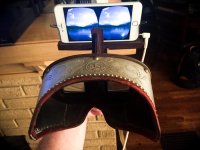
While we are waiting, here is a 1904 VR headset for the iPhone 6+ haha. It's almost as if it was made for it ;D
IMG_3918.jpg
 
I might consider it a form of time travel haha. This is a stereoscope from 1904 which is the original version of a view master. It happens to work without modification as a Google cardboard device.

When it originally came out they thought it was going to be the entertainment of the future until moving pictures killed it. I can't help but draw an analogy to VR. I am certain that the alchemist that is Mr. J. will show is the equivalent of the philosophers stone ;D
 
It could be jumping out of a plane with no parachute. But, I still think it's BITCOIN.
 
What we are working on is truly significant. It will change the way we all do things for sure. It will not save the planet, cure cancer or give one immortality. I wish we could do any of those things.

The RED One did not save the world. But it changed the imaging world forever. This new project will affect everyone in a major way. That is about all we can do...

I appreciate everyone's support and belief that we are no longer a scam. And at some point we will be calling for deposits on something you know nothing about. :-)

Jim

I just bought Racing Extinction and watched it last night. [Fantastic/fantastic job/beautiful!!! (Great to see the Colorado/Denver connection) ].

The overall vibe or feeling I was left with from watching Racing Extinction and in regard to Mr Jannard (Jim) and his, and RED's expertise is digital archiving.

There is a massive and important need for high density bombproof and idiot proof and management proof digital archiving systems. The kind of system that manages itself and yet in theory could be put on a shelf for a 100 years and still be readable. Given that most of the "Shooters" on RED / with RED are not going to have "Hardcopy" output of their works stored in refrigerative film storage vaults, there is a REAL need for serious digital archiving capability that does not "Mess up" or become corrupted over time and yet is cost effective, solid state and bomb proof. The most successful archiving systems have used automated and scheduled triple redundancy parity checks on data, whether that is using robots loading "tapes" (doing parity and data checks) or very fancy magneto optical juke boxes (for their time) that "self check" or whether you bootstrap your data to financial banking storage systems or mail your data to be stored under a Swiss mountain somewhere... (all rather archaic strategies and technologies but have never the less have proven their worth in the past) ; but today something different is needed and especially with the advent of 8K that's a gargantuan amount of data to archive. So... If there is a better solution sign me up and I know a lot of government agencies and non-profits and conservation and cultural heritage agencies that would be keen to buy into that (big time); as you can't go back and re-shoot this stuff. As can be seen in the "Racing Extinction" (documentary) some of those images HAVE to endure as the animal/species is gone for ever. [There are countless examples of non-disposable imagery that must endure (no matter what)].

On the other hand I have this vibe that Jim will be building a small fleet of really Kick ass "Drones/quad copters" with a high payload and range capability just to "Hassle" poachers... :-) [Given his knowledge and skills (especially for modern manufacturing processes and composites) that would be very doable].
 
You are right Eric. I here people in LA LA land (capitals my auto spell correctors sense of humor, not mine) recording to hard drives, then transferring footage to newer storage regularly without a bit by bit debuffered verifies, a good way to pick up compensating errors eventually. Others probably think the hard drive will keep for a very long time, not realising that hard drives and flash loose data integrity eventually.

For non film related technical purposes I once came up with a sceme to keep data integrity for thousands, even millions of years, and recently was looking at a cheap method for high density data archiving, and a bit of fire proofing, that could be used in house.

But there is a big problem in getting the electronics to last that long. Even rare earth magnets will be loosing strength by 100 years, and many chips and circuits will be corrupt. An optical circuit system might be able to preserve a mechanism for a long time, but other parts will have to be replaced, such as drivers to move heads and media, unless you had a stable optical recording block that had a standard interface understood and used over the millennium, but combined with a computer, user interface, and projector and laser etcher, you could maybe get something stable enough, but then are getting into the territory of the librarian archive in the movie The Time Machine. But that is possible, I've got a design suitable for the laser part. But even glass is a liquid.the scientist have found. Over time it flows and that means deforms. There are note advanced methods but they are in the scientific realms, and I'm not sure if they vsnnaboid quantum leaching.
 
Wayne, if you can't etch onto glass, why not etch onto metal? E.g. steel or aluminium or titanium? Maybe not as dense as Blu-Rays but still, we're talking about very long-term archiving. Or holographic storage, so that even if one part of the device decayed, the information would still be there?
 
Give the man a prize. Exactly Karim, you can still use glass butnI don't know how it would be in a thousand years, which doesn't matter to most people.

The issue with metals and alloys is which to use that won't get corroded, tranfirmed or in other ways fouled. How many will also move like a liquid.

I was talking about glass in optic circuits to maintain long term function. But maybe some crystal structure substances does not flow and could be used instead. But about glass being a liquid, I wish I had the original research to hetnan idea of how long it may take, millions of years maybe. But the issue is it is likely shorter on data recording scales. If Red wanted to, they could fund us to develop a long term archival system for massive data.

Now, am interesting illustration of how the environment gets to structures unexpectedly. I opened up my ice tray for the first time on months, and even though the grudge has bernnon its coldest and in winter, the ice was mal-formed, not melted at the base. Where ever it flowed, or just the air took away water molecules I don't know. Even in permanment sub zero temperatures snow will erode away from interation with dry air, requiring snow falls for replenishment.
 
Back
Top