Welcome to our community

Be a part of something great, join today!

  • Hey all, just changed over the backend after 15 years I figured time to give it a bit of an update, its probably gonna be a bit weird for most of you and i am sure there is a few bugs to work out but it should kinda work the same as before... hopefully :)

New MacPro predictions? Hopes? Fears?

I was just about to buy the latest Shure microphone .. looked at the specs, added it to my basket .. then realised that it did NOT use the latest USB-C style connector ... and changed my mind.

Ummm... USB is USB. Just use the right cable, no adapter needed. That looks like the new MV51 mic, which seems to have a female micro-B USB connector on the rear. In that case, you just need a USB-C to micro-B cable, like this one.
 
You guys do know if the device has a USB socket on it you can get a usbx to USBC cable. Other devices you can get an longer extension cable convertor that takes the cludegy covertor point away. Solves some issues. Just buy new memory sticks and an old USB hub to use old sticks at home.

Ummm... USB is USB. Just use the right cable, no adapter needed. That looks like the new MV51 mic, which seems to have a female micro-B USB connector on the rear. In that case, you just need a USB-C to micro-B cable, like this one.

You do realise I just said this. But then again, I treat what others write as important even if I don't agree with it, because people wrote it.
 
Election schmlection.
Everyone knows the fate of humanity rests on Apple releasing a new Mac Pro.
 
Thanks Wayne & Jeff.

Given the choice - I will be trying to limit my choice of new devices to wireless / ones that utilise a USB-C connector.

I don't Also want to have slow-lightning connector (USB-2) to something else connectors ... the the microchips are also likely to be locked into USB-2 speeds.
Apple have only (AFAIK) enabled high-speed (USB-3) Lightning in the IpadPro.

Now that there is a reversible connector that is (arguably) superior to Lightning - perhaps it is time for Apple to ALSO ditch lightning in favor of USB-C?

AndroidPIT-usb-c-lighning-comparison-3-w782.JPG


AJ
 
Random thought on dependencies for a new iMac/Pro:

The Force-Touch Effect

Apple have not been successful in getting a 'ForceTouch' mechanism to work in iPads, and it was not included in the iPhone SE.

The result is that for software writers - they optimise their interfaces around the common denominator.
They don't want to have TWO manuals, TWO workflows, and functional videos that frustrate people because their software doesn't suport the chosen Apple hardware.


Touch Bar Keyboard

Apple Delayed the construction of the 2016 MacBook Pro as it had insufficient 'retina' Touch bars - ostensibly due to very low yields.

Apple have now tapped a factory in Taiwan (Wistron) to bolster their supplier in Singapore - with the shortfall expected to catch up in the next few months.


2017 iMac/Pro

Could it be that the reason that there might Not be a 2016 release is that Apple want to avoid the 'force-touch-effect' - and ensure that all MacOs devices support TouchBar going forward.

But this will require Apple to ship external keyboards with an embedded Touchbar (perhaps even with wireless charging).
And if Apple did this, it would likely cause a huge number existing iMac users to order a stand-alone keyboard - massively exacerbating the supply and demand situation and frustrate many a user.

I am guessing that Apple had to release MBPs first - and their circulation will allow developers (who are currently dipping their toes in) to start finessing their software offerings.

AND that the reason that RESOLVE and FINAL CUT X (surely - everyone's favorite editor?) have put so much effort into having a TOUCH BAR oriented interface, is because Apple have given a them a Heads up that an External keyboard for iMac/Pro is on the cards.

... anyone want to 'heh, heh, heh' this? :-)


AJ
 
Last edited:
:)
.
 
Apple should invesr in QDCA for home, intelligence simulation and Super Server use.

Apple should invesr in QDCA for home, intelligence simulation and Super Server use.

Jeff, Antony, and others, an interesting read:

I meant to say Apple should invest in Magnetic, or other, Quantum Dot Cellular Automata. As it is extreme low power, virtually nothing, you can make room sized supper computers, and even 3D circuits. I was working towards atom sized circuits or something (hard to remember). At the moment it is a bit slow (another thing I was trying to do is replace the clocking scheme used to stabilise the circuit, this would lead to great speed ups). At the moment it is like a very long pipeline scheme, where you can send new bit after new bit along the same line concurrently, this means many serial parallel data at one time. So it has a little bit of an advantage there. However, being so cool to operate it can be packed more densely and in most areas formerly taken up by cooling mechanisms, power supplies and free space. We might be talking about a computer case containing thousands - tens of thousands of times more precessing density then Xeon or Phi.

Hybrid technologies can be used to reduce bottle necks for drastic speedups in areas, such as high performance sections. Literally, a piece of line can contain x bits by length, so good for memory/storage. However, using substrate capacitance you can execute a higher performance memory in parallel to the lower power and slower, line scheme. I also have been working towards other magnetic processing concepts.

You may say so what, most applications are not that parallel. I agree, my more conventional scheme can parallel tens of thousands or more processors, but you get to the point that less and less of larger and larger arrays can be used, but one thing that does require this is server farms. Imagine a small warehouse condensed into a large room, for a fraction the price. Inter server communications become intra communications that can be made as fast, or faster than various inter server communications. Imagine reducing costs by 100x + and operating costs in terms of power and maintenance by somewhere between 10-1000x+ depending on the functional implementation that can be worked out. Dead processing areas (arrays of processing areas and virtual servers in each circuit) canbe bi-passed, so such a system can be up with low maintenance for very long periods of time. If the technology can last for a number of decades, then most of the functionality can be made to last for most of the period without opening it up. Virtual management.

It makes sense to produce a fpga that is closely the size and performance of custom circuits. In this way you can make a 3D block of FPGA, and make higher performance custom circuits. I think of the circuits as like real optical interference based circuits, but in the binary. What we have now in QDCA, is like the simple linear optics optical processing circuits that are many times less then interference based circuits. I wanted to make small processing sections, hybrid at first, based in this sort of optical circuit, but have recently come up with something better and easier to do. There is a trick to this optical processing to do it simply, but I could hybridize it (I just realised another new extension to this scheme).

Another application for this technology as either fpga or custom, is intelligence simulation. Put simply, people can buy a computer box and have the QDCA to form an intelligence that can help them organise their life and correspond with them. This moves towards robotic intelligence as this is worked out. It starts like Siri or other, and as more things are worked out it becomes more high level reasoning, researching, organising. You ask it to organise a list of tasks from lawn mowing contracting being careful even the kook of the lawn and the usual like avoiding the flower bed, to shopping and dealing with the shopping or tax department. The computer can talk to real people or another system at the other end. Eventually the computers can organise and perform the tasks themselves. In the case of lawn maintenance not only can the other contractor's computer perform it, but your computer can do it. This is a progression, and a possible open source progression. This is another use of slow mass processing. So, billions of units of QDCA can be sold each year for different uses, at the start we are talking about tens of billions. Many years ago, I identified 80% of practical applications required only a slow processor. I even looked into practical processors operating at kilohertz when needed. I was looking at doing a 1000 hr battery life laptop now with revolutionary screen technology beyond anything else, and the ability to out process the Mac Pro, or battery life going far longer. So, most processing similarly can fit in the QDCA framework, even games. Virtual reality is actually a slow processing task. I did some calculations a while ago to figure out how big of a computer block I would need to simulate the entire world surface by 2035 or something (this is a coarse simulation, not atomic, and where I get the 9600dpi figure) however, that might have to wait longer. The solution is not what people think. It is not about dreaming, it is about figuring out what, and how something, is possible.

My head is so full of memory skeletons of dozens of processing alternatives I had been working on, each better than what we have now.

Basically it is the super server computer. There is maybe more money in this then Apple is presently making, as slow compared to true optical computing or quantum computers, but that speed is not needed for many server applications. But basically people don't think like this, they can often not see what does or can exist in front of them if it is beyond their knowledge. They back the wrong horses.
 
I forgot. With the QDCA, intelligence simulation, eventually after the research is done in decades to come, you will be able to talk to your computer as an individual about things.
 
Edit.
3 year old on my phone, open tab = gibberish.
Even he is angry about no Mac Pro!
 
Last edited:
Nic dgf SD?
 
Air, I, book what?

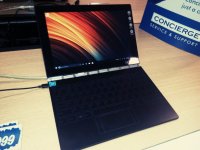
Look carefully at this. That is a hinge and self lit flat keyboard, feels cool to touch. And they say Apple is stylish.
 

Attachments

  • IMG_20161123_193344.jpg
    IMG_20161123_193344.jpg
    70.1 KB · Views: 0
That's more like it, with style. Keep it coming Alex.


https://www.msi.com/laptop/gt83vr-6rf-titan-sli.html#hero-overview

Wow

xsplit_block02.jpg


Whoops, isn't that a picture of the laptop? Anyway, that's what this laptop is like in my head.

But what is this in the background, better looking than the Pro:

N17_enth.png


Doesn't anybody make a laptop wedged like this that can take a standard GPU card in the back?
 
By the way, on MSI notebooks you can change video cards.(like ram or processor) (as far as I can remember )
 
Yes, their is a notebook video card standard in the old days, mainly NVIDIA cards. You could ask about which notebooks at the shop and a arrogant no nothing could tell you it didn't exist. Boy I don't miss those types messing things up. I don't know how advanced it is today, butbIm curiouse about desktop cards. A wedge shape with venting, like they are doing here, is what I was looking at trying myself.
 
They seem to show a mini tower in the background above, but I can't find it on their site.
 
Thanks Brian. That is more like it, if only they had desktop GPU's on those MXM cards, or a bigger version with desktop cards. This is what a workstation should look like but 4 times the volume maybe with more bay and card options. Could you.imagine a Phi version of this that had normal processing function.

Is something like this much of an option over a Mac Pro, or boxx?
 
Is there a narrow main board standard I can use to make a narrow square cube case?
 
Back
Top