Welcome to our community

Be a part of something great, join today!

  • Hey all, just changed over the backend after 15 years I figured time to give it a bit of an update, its probably gonna be a bit weird for most of you and i am sure there is a few bugs to work out but it should kinda work the same as before... hopefully :)

New 15" MacBook Pro Performance

Latest test results:
Running on the new 15" MacBookPro and Tbolt expansion via Sonnet:
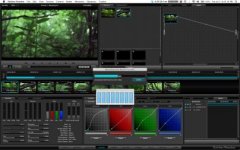
We ran Express Dailies by ColorFront and were able to process AVID DNxHD36 (1080p) from EPIC 5K files at 30 frames per second.
Sonnet connected the Rocket and the SAS raid we were reading/writing off of.
The most amazing part of this data is that the Tbolt connection represents the equivalent of a 4x lane in a MacPro tower.
That shows the power of the MacBookPro when working in conjunction with the power of Express Dailies software and thunderbolt.

FYI: on a 12core tower maxed out with ram we have been able to achieve 23fps at 1/2 quality without a Rocket to 1080p DNxHD36.

The world is changing...and though others disagree, my personal faith in Apple pushing the boundaries of hardware horsepower is the best it's been in 2 years.
m
Nice, can't wait to Test my MBP
 
Latest test results:
Running on the new 15" MacBookPro and Tbolt expansion via Sonnet:
We ran Express Dailies by ColorFront and were able to process AVID DNxHD36 (1080p) from EPIC 5K files at 30 frames per second.
Sonnet connected the Rocket and the SAS raid we were reading/writing off of.
The most amazing part of this data is that the Tbolt connection represents the equivalent of a 4x lane in a MacPro tower.
That shows the power of the MacBookPro when working in conjunction with the power of Express Dailies software and thunderbolt.

FYI: on a 12core tower maxed out with ram we have been able to achieve 23fps at 1/2 quality without a Rocket to 1080p DNxHD36.

The world is changing...and though others disagree, my personal faith in Apple pushing the boundaries of hardware horsepower is the best it's been in 2 years.
m

Wow... maybe I don't really need a separate TB enclosure for both the RR and Raid card!
 
Michael, just to clarify, what quality debayer were you doing for the transcodes on the MacBook Pro?


Remember: when using the Rocket, there is no qualitative control. The Rocket takes over and gives everyone the same debayer. This is one of the nice things about the Rocket: you automatically get a full debayer.
 
Michael,

how well do you think the new mbp will perform without the rrocket?

thanks
 
Remember: when using the Rocket, there is no qualitative control. The Rocket takes over and gives everyone the same debayer. This is one of the nice things about the Rocket: you automatically get a full debayer.

Right. But weren't your tests done without a Red Rocket? I'm just trying to figure out what debayer settings you used to get the transcode times you listed in your original post.
 
Right. But weren't your tests done without a Red Rocket? I'm just trying to figure out what debayer settings you used to get the transcode times you listed in your original post.

The MBP numbers are with a Rocket. The Mac Pro (as in, the massive tower) numbers are without.

But I'm also curious to know what framerates you can get on that MBP without a rocket.
 
Michael,

Was the MBP a 2.6 or 2.7?
Whichever one you tested, in your opinion, does the 2.7 bring enough to the table to make it a no-brainer?
If the answer is tied to the processing of specific applications - how would you break that out?

If you went for the larger SSD, did you research performance between the two first ?

Really appreciate you sharing your experiences - I'm sure I'm speaking for many when I ask how much more you can share about the dailies package you are testing.
Quite curious.

The system we are testing with is the new Lily Pad Case (http://www.lightiron.com/enterprise) which is a custom-built dailies system packed inside a modified DIT Rouge system. As part of the hardware and software package we offer to OUTPOST Enterprise members, the difference between a 2.6 and 2.7 is small. But the overall power within the 15" MacBookPro is remarkably close to a MacPro tower, making it almost as powerful as a Lily Pad or OUTPOST cart, only with less overall storage.

The rendering benchmarks we do are NOT off the SSD, rather an internal or external SAS raid that enables better performance after downloading, which also better emulates the steps one would take in the field (eg: download & checksum, copy, color, then render).
The results we are getting are considered "best case scenario," but with the systems we build, there is no reason everyone can't have one and also experience the same performance results.
m
 
I posted this in the HP RED Tower thread, but I thought it would be having some relevance in this thread too:

I read the Anandtech review of the new retina Macbook Pro, and of course half of it is incomprehensible for me, but I read some interesting things at these pages:

http://www.anandtech.com/show/6023/t...splay-review/6
http://www.anandtech.com/show/6023/t...splay-review/7

That clearly show that Apple took a very pro-active role in getting these graphics to work on the software side. For anyone that says that Apple only cares about the consumer, should read these pages.
 
My understanding from the Anandtech review was that the rMBP was struggling to push the pixels necessary for even basic user interface behavior. Scrolling and other things were clocked at well under 30FPS.

Can someone wiser than me chime in on whether the retina display might hog the system trying to do other GPU tasks, such as debayering?
 
When I first tried one out in the apple store I noticed that as well and was pretty skeptical about the computer. That is an issue and I think apple kind of failed here and I really hope they can fix it with Mountain Liion. However I believe the CPU is responsible for debayering and this computer is wicked fast and will playback 5k content smoothly at 1/8th res in PPro.


My understanding from the Anandtech review was that the rMBP was struggling to push the pixels necessary for even basic user interface behavior. Scrolling and other things were clocked at well under 30FPS.

Can someone wiser than me chime in on whether the retina display might hog the system trying to do other GPU tasks, such as debayering?
 
Retina Display really is a game-changer ...

Retina Display really is a game-changer ...

When I first tried one out in the apple store I noticed that as well and was pretty skeptical about the computer. That is an issue and I think apple kind of failed here and I really hope they can fix it with Mountain Liion. However I believe the CPU is responsible for debayering and this computer is wicked fast and will playback 5k content smoothly at 1/8th res in PPro.

Not exactly sure what you're testing or how ... as Michael said in his first post, the RetDisp MBP really is a game-changer ... and it's not just about the new screen (even though it truly is a sight to behold) it's also about the engineering under the hood ... CPU and the two GPUs - one with CUDA cores! ... we've been testing the 8GB RetDisp with Redcine X, Express Dailies, Resolve 9, CS6 apps, FCP X and Avid and all perform better than expected.

Have also booted Mountain Lion on the RetDisp and it runs just fine.

We haven't tested data throughput with SAS drives like Mike has, but testing with Thunderbolt RAID, Fiber Channel RAID, SSDs and USB 3 single drives gives great throughput speeds ...we're doing dailies on an EPIC feature as speak, using both a MacPro Tower with 2 GTX 580s and a RedRocket and then comparing it against the RetDisp MBP ... sure the MacPro Tower is faster (obviously), but people will be pleasantly surprised with the performance of the RetDisp MBP ... and we haven't even got optimized code yet.

Please be respectful of the incredible engineering that has gone into this new Apple product ... it marks the beginning of a new phase in the relentless wave of Moore's Law driven innovation. Assuming Apple applies some of this engineering excellence to the next generation of MacPro Towers due out in 2013 we'll witness a quantum shift in computing power and functionality.

In the meantime, enjoy the RetDisp MBP ... it really is the game-changer Michael says it is.

Cheers,
Neil
 
Neil while the computer is impressibly fast and the IO is amazing, the display is NOT as responsive as the previous generation. The Graphics card is driving 4x as many pixels and apparently its not quite up to the task as I get slow FPS when resizing windows etc.
 
I am building a DIT system very similar to that Michael. MacBook Pro, 16TB of Thunderbolt storage, dual usb 3.0 red readers, and all inside of a pelican case. Mine however does not have any outside ports, so that it stays waterproof.
 
Me thinks that Apple will fix that basic GUI slow down with updates.
Its not the first time they've had to do that :)
 
I would think that debating the merits of a computer, which is a tool, is valid in this context. In these cases respect isn't given ipso facto, right?

To Dean's point, are the GPU and CPU taxed just by simply drawing the screen itself and its 4000 pixels? Does that mean less processor cycles for doing things like rendering and debayering? Is there a resolution to run the screen that taxes the GPU least? I'm thinking about when we used to run Mac OS 7 in thousands of colors as opposed to millions. Something like that.

Maybe a software fix isn't enough, and more powerful processors are the next bottleneck to open up. These are just faster Core i7's, right?
 
Back
Top