Welcome to our community

Be a part of something great, join today!

  • Hey all, just changed over the backend after 15 years I figured time to give it a bit of an update, its probably gonna be a bit weird for most of you and i am sure there is a few bugs to work out but it should kinda work the same as before... hopefully :)

My perfect module

Pawel Achtel

Banned
Joined
Oct 12, 2007
Messages
3,648
Reaction score
0
Points
0
Location
Tasmania
Website
www.achtel.com
Ok, I'll take Jarred's invitation and describe my perfect module, the GPIO module.

The module allows remote control. But, not wireless and not any type of remote control. It is more suitable for underwater and many other remote applications such as helicopter, crane, etc...

The module has a bunch of addressable GPIO ports. Just about any function can be assigned and wired to a microswitch (digital input) or a 5k Pot (analogue Input). An adjustment of an analogue input shows the current value on the screen overlay temporarily when the value is changed. Functions such as REC, DELETE NG (yes!), Zoom 1:1, POWER ON/OFF, etc.. can be triggered using those GPIO ports.

How is it different to RedMote? It is a wired solution, it is assaignable, and requires 3rd party triggers and knobs to function.

How important is it for me to have one of those? $4-$5k is on the table.
 
remote

remote

For many many moons I have been asking for some kind of remote for the R1 or to simply publish the protocol so we could make our own.

Your version would be just as good and simpler to implement for the user. Ironically, all you are really needing is to parallel the switches/buttons already on the camera.

Another nice capability would be to turn the camera power on and off remotely.
 
Jarred I do not have a perfect module at this time, but I WOULD like the IO module to have the audio video ports angled either towards the back of the camera, or down. Please do not let them stick straight out.

Thanks!

Jay
 
One module I think is doable if it is specialised, is purely a wireless I/O module with a couple of good antennas on it.

This module's sole function is to transmit a variety of data, from the mundane right through to live video out (copied from viewfinder stream with or without guides etc) as a high speed bitstream transmitter, whose companion receiver (battery operable) can decode and re-route the incoming data to whichever output it belongs to. The receiver would have at least one HD-SDI out and some data output such as USB or LAN for non image related streaming.

HTH Red Team, have a wonderful New Year's Day!

Paul


This is a good one.

Jay
 
I would like to see a "Pro Audio Module" that has multiple I/O, pots, monitoring and control functions either on the module or a separate control surface that is tethered, or preferably wireless. Essentially a full blown audio mixer that can be mounted in-line with other camera modules on or off the camera. This would be great for ENG use and lots of non hardlined EFP productions, especially with smaller crews or limited space, single operator or remote operation scenarios.

I also second Pawel's request. A control module or full control functions on the camera accessible via USB or other easily interfaced connector. Need to control everything from power on/off to all other controllable functions, including lens functions for electronic lenses. Not only useful for underwater, but for any form of remote mounted, remote control scenario.

How about a mirrored-media module? Would be an ENG / EFP godsend... I don't know what the full story is behind that 128GB RED Mag shown in one or two of the renders, but a module that can hold two of those and provide either sequential recording for long record times or provide mirrored recording to create duplicate copies at the time of record would be awesome. Camera crew could shoot to one RED Mag and have their master copy while handing over copy #2 instantly to a broadcaster or news agency. Which also leads to one more question about REDCODE....

Any chance in the near future or with the upcoming cameras, that original REDCODE files can be encoded or stamped with a watermark or digital fingerprint of some kind so it can be verified what camera shot the footage?
 
I would like a variation on Jeff's request, but a little more straight forward. How about a module that features a unislot to take a wireless reciever.

This is a very useful item.

Jay
 
Secondary REDMag

Secondary REDMag

How about a mirrored-media module? Would be an ENG / EFP godsend... I don't know what the full story is behind that 128GB RED Mag shown in one or two of the renders, but a module that can hold two of those and provide either sequential recording for long record times or provide mirrored recording to create duplicate copies at the time of record would be awesome...

Great idea, Jeff.

I also brought this up a little while ago in the "Another Taste" thread:
http://www.reduser.net/forum/showthread.php?t=23905&page=16

I think the ability to have a second REDMag Module that could record simultaneously as a backup, would be great. BUT the more valuable feature, I believe, would be the ability to have the second REDMag recording in a different format. (not a different frame rate or anything that needs changes made at the sensor, of course).

This would be HUGE for Feature work, as well as many other types of productions that want to shoot in resolutions higher than HD for their Master, and still have instant lower-res versions available to view.

Imagine being on-set, and having "Rushes" come straight off the Camera on a separate REDMag in 1080p scaled RGB, while you have the 4K+ version available to backup and send to Editorial on another REDMag.

I'm not sure if the brain of an EPIC or Scarlet would be able to handle this additional processing, but perhaps a specialized module could have an onboard co-processor (mini-brain) if needed. It could be a bit pricey, but I think for certain projects, it would more than pay for itself in time saved.

Panasonic has an accessory for the AJ-HPX series of Cameras (P2) called the AJ-YAX800G Proxy Encode Card.

From the Panasonic website:

"It allows AJ-HPX Cameras to record MPEG4 proxy (low-resolution) data onto the P2 card or an SD/SDHC Memory Card along with full-resolution data. This can be used for quick viewing of dailies with timecode and it's low bit-rate provides easy transmission over wired and wireless networks. It's also perfect for enhancing news production and simplifying long format program editing, including documentaries and reality television. The three levels of proxy video available are 1.5 Mbps, 768 kbps and 196 kbps which contain AV data, time code, metadata, and other control information."


Not bad for $1200.

Similar to this concept, the second REDMag would allow the Camera operator to decide which quality/format is being additionally recorded, from a full-res identical backup or 1080p scaled RGB version, all the way down to a low res proxy used for sending across networks quickly without needing too much storage room.

I'm sure there is plenty of technical issues that I am not aware of in how the inner workings of EPIC of Scarlet operate, and this may just not be possible. But I figured it was definitely worth adding to the list here.

Even if it were just possible on EPIC, I think there would be pretty good demand for it. I'd be curious to hear what others think. Is this something you could use?
 
The mirrored-media/extended recording module would be a big time saver. I was thinking to add this request, but I thought I already exhausted my Santa vouchers and Jeff beat me to it. I second the idea. Essential? Not. But, so bloody nice to have :biggrin:
 
Any chance in the near future or with the upcoming cameras, that original REDCODE files can be encoded or stamped with a watermark or digital fingerprint of some kind so it can be verified what camera shot the footage?

This is already done... in RED ONE, and will be in the new cameras. Its just one of the many benefits of the o-so-great REDCODE format :)
 
I like where this thread is headed. Already some good ideas here.
icon14.gif
 
Let's see....


1.Handle

Design

As I see, current REDhandle is designed in DSLR style.
I suggest adding a ENG/EFP style designed handle, larger and thinner, where the grab is more natural for the fist and less force is needed to hold the camera - with the strap over a wrist.

This is especially useful with lighter setups, because between shots (on a fast shoot) you can hold the cam in one hand (like on a tray - facing up) with all the weight resting on your palm. With current solution you'd have to grab it by the handle - inducing more muscle strain. More muscle strain = more shakiness on longer hand held shots.

Customization

Rotating handle = necessity, IMO. 180 degree, with centre of rotation in the middle of the handle.
No wrenches or tighteners. Click-turn-done.


2. Rail system

I think that there is potential in developing RED module attachments and their customization, by developing another mounting solution. I got this idea thinking about the handle customization, where I would want it to be able to slide down the length of the camera (next to the camera body, not only under it), depending on the setup and weight distribution.

Solution 1
Machined "channels" on the surface of DSMC modules, spreading across the whole length of the camera. This way you could mount any new modules directly on the camera body without the need for rails, and slide them around, getting better weight balanced system with less overall volume.

Solution 2
Rotating rail system.

Two round thin modules around the camera body - ring type, on the front and the back of the system, which carry the rails. Depending on the setup you could rotate the rails around the camera (parallel to the body).

Example 1: No need for additional handle for side shooting if one handle could rotate on those rails
Example 2: Left handed shooters (also depending on the design of the handle)
...etc...


3. Multi-functionality

With all this cable clutter and gazillion new options and modules coming, maybe their functionality could be enhanced. Just thinking out loud....
-handle could double as a battery holder and little breakout box (inner exchangeable modules)
-rails - data or power inside
-REDriser - storage, breakout box, audio controls...etc...

4. Touchscreen module

I've rambled enough about this here :-)
- so to keep it short - faster access to functions and settings with fewer clicks.

5. Module shape

Current module shape is slightly concave. I guess this is mostly not important for cinema style shooting. ENG/EFP cameras today are slightly convex, with smoother edges. This is for a good reason.
It is more ergonomic, you can grab a camera in many different ways closer to the body - much more comfortable then hard edged camera, or a cinema setup with rails and all add-ons.

With all the features and weight, my dream camera would also be compact and practical and it seems logical that the best camera should use the features and advantages from all the worlds, not just cinema one.

Personally, with a device which involves tight human interaction, such as a camera, I'd go with "biotech" crossover style, which is nothing new to RED, judging by the mattebox design. :-)
 
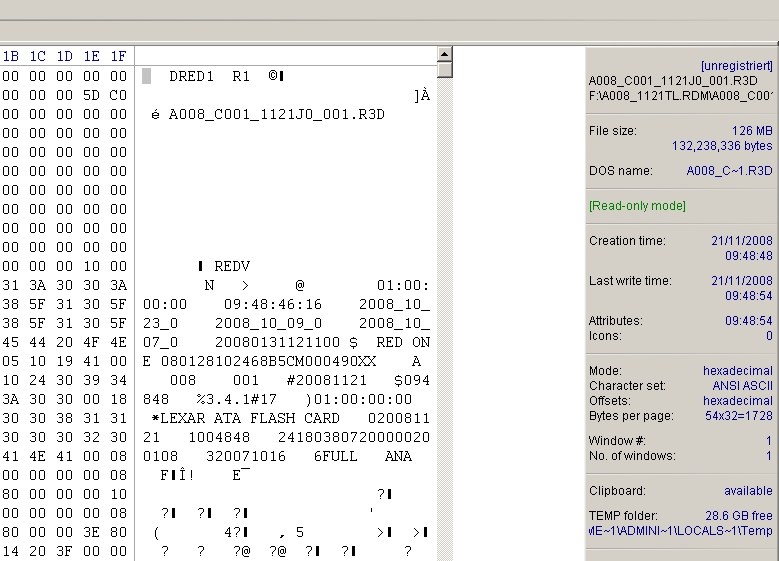
Any chance in the near future or with the upcoming cameras, that original REDCODE files can be encoded or stamped with a watermark or digital fingerprint of some kind so it can be verified what camera shot the footage?
As Jarred said, it's already in the footage, right down to individual frame numbers and camera serial number:

red_metadata_hexcode.jpg


HTH

Paul
 
That's all fine and great contained within the metadata... But is there something more that I'm unaware of? I'm looking for an actual impression or watermark encoded beyond metadata that can't be tampered with. Something along the lines of a digital fingerprint or digital DNA, unique to each camera. What keeps me from doing a search and replace with a hex editor to change the camera info?
 
Watermarking

Watermarking

That's all fine and great contained within the metadata... But is there something more that I'm unaware of? I'm looking for an actual impression or watermark encoded beyond metadata that can't be tampered with. Something along the lines of a digital fingerprint or digital DNA, unique to each camera. What keeps me from doing a search and replace with a hex editor to change the camera info?

This is an intresting question.

a) if someone is prepared to tamper with every frame of the original footage, then are they not prepared to deal with watermarking too.

b) How does watermarking survive a downconversion to a lower resolution format?

c) If a watermark is not visible, how is it of any use as a protection?


Bottom line, how do you see a watermark working, and what's it worth to you in terms of price, slower recordable fps, extra power consumption?

Just asking :-)
 
Good questions, Stewart. I'm probably not looking at it from the right angle. REDCODE is digital data, therefore highly malleable. Perhaps this is not something best solved with the recording format, but is more a task for the recording medium or archival services, etc..

I'm interested in watermarking for legal purposes, verification of ownership over disputed content in the ENG world, copyright disputes and for purposes of posterity for documentary and archival footage.

In response to the above questions:

a) Yes, being data, it's possible to tamper with anything. Depending on the type of watermarking it may be possible to limit the tampering though -- perhaps while it's possible to alter the mark, it may not be possible to replicate another camera's watermark. Maybe this is something that can be built from sensor profiling and noise characteristics. But then does it change with updates to the compression algorithms or each time black-shading or firmware updates occur?

Perhaps something within the wavelet compression that could use the camera PIN as a basis for wavelet constructs, or the order in which segments or data blocks are processed. Almost a form of encryption, but not with the goal of obscuring the data, but rather introducing the effect of undesirable image attributes or artifacts if the data is rearranged and modified to conform to a different base order or camera PIN.

b) I don't have an answer for this one, but then again, if the original source files are maintained, does the mark need to survive a conversion as long as the original R3D or acquisition file can be verified for authenticity?

c) The mark may not be directly visible, but perhaps something that can be extracted or identified through a utility and SDK functions.

Like I said, this is probably not something best solved via REDCODE. It was just one of those things that I could see useful if it can be included in some realistic manner. At what cost would it be worth it? I'm not willing to give up the resolution, fps, etc.. that we have now. Financial cost consideration would be fairly low too. Because there are external options to ownership verification now. I can submit copies of media as a digital archive to various archival services, court archives and government agencies, trademark offices, etc.. who will all submit my original media to a court of law, along with an official statement that they guarantee no one has had access to these copies or has modified them in any way.
 
Anyway, getting back on-topic here...

Jim posted a render showing both a dual CF module and RED MAG module. Which brings me back to my suggestion above for a module that could record two copies of media simultaneously. Thinking about it some more, that seems like it's not necessary. Given the modular nature, couldn't we just connect two RED MAG modules in-line and have a setting within the camera to use the media either sequentially, for hot-swap continuous recording, or simultaneously for duplicate copies made at record time? Perhaps the same can be done with CF and even a combination of CF / RED MAG / RED Drive, etc..

 
As long as we're doing a wish list, I saw 'wireless' mentioned, but not elaborated on.

1) A wireless broadcast of the video signal to be picked up by multiple monitors, for the DP, the Director, a Producer, etc. Little hand held monitor that can see what the camera sees from anywhere in the area would be fabulous.

2) Wireless module for the sound to enter the camera, so no tethered wires to trip over, no problem with wires pulling people, and ease of setting up in new spots. Will save time/money on set.
 
Yes, #2 would be great!

The real reason (in my opinion) that we haven't seen full-fledged cinema sound being recorded to a camera, even though the RED has good audio features, is simply because the added wires make most mobility impossible and add at least 5 minutes to each setup.

If there was a way to go wireless-ly from the sound man's station into the camera... you've just sped up editorial a huge amount, eliminated a couple of veeeery boring and tedious jobs in post-production, got rid of missing/mismatched audio clips... this would be great.

Ryan
 
Back
Top