Welcome to our community

Be a part of something great, join today!

  • Hey all, just changed over the backend after 15 years I figured time to give it a bit of an update, its probably gonna be a bit weird for most of you and i am sure there is a few bugs to work out but it should kinda work the same as before... hopefully :)

Molten Mental shooting

David Ellison

Well-known member
Joined
Apr 1, 2009
Messages
335
Reaction score
0
Points
0
Location
Manchester UK
Hi I'm going to be working on a project on Epic involving shooting at a small forge in Scotland. The process will involves shooting molten iron.
I'm obviously going to be shooting on long lenses as I need to keep clear but in terms of filters can anyone suggest any that would come in handy due to the extreme
contrasts involved or any other handy pieces of gear I might need?
I'm shooting two man crew (me and assist) on Canon L Primes

Best.
 
I saw "Molten Mental" and thought "that's a great name for a metal band!!" ;-)
 
Your first concern should be the particulate hot metal droplets that will be in the air - they will fuse to the glass on your lens and will be impossible to repair. I'll confess, it happened to me.
So first is a clear glass filter to protect your optics.
The choice to use longer lenses will make a difference - good start!

The next filters to consider are ND's. Before going down that road, some preliminary background info:

When metal is molten, the light is being emitted by the material. As it cools, that transitions to reflected light.

When the metal is at it's highest temperature, much of the light output is outside of our visual spectrum at shorter wavelengths. Our minds interpret that as white - a mix of all colors.
As the metal cools, the wavelengths lengthen and begin to fall through the visual spectrum - the color we see will shift from white to yellow, then red. At this point, the "color temp" of molten metal will be under 900K (versus about 1900K for a candle flame) The wavelengths then continue to fall off until it is no longer recognizable and we see the reflected light versus any transmitted light.

The brightness of some metals at a high temperature can easily exceed the minimum lens stop. If you want to see detail in the hottest molten pour, heavy ND brings you into a workable range. (At times, I have purchased welders glass instead of using standard ND's - but that was to capture what was happening in a molten pool while welding - might not be what you are after)

If you want to capture the maximum amount of detail in the area surrounding the molten metal, the trick is to hit it with as much light as possible. Seems counter-intuitive at first; you would still be using the ND's to drop down the luminance of the molten metal while bringing up the surrounding area with the lights - essentially balancing the two to bring them within a dynamic range you can capture…
 
Make sure you are protected first. I have used clear filters but they don't always work as sometimes the whole lens melts. If you had an old matte box you could offer it up as a sacrifice. Good to have a spotter or AC keeping an eye out for you as well. I shot at the old ford furnaces in Detroit, the part where the pour comes out is called the devils anus for good reason. Very gnarly and on occasion things go bad. But the imagery is often very beautiful. Good luck.
 

Attachments

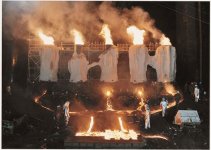
  • Blast furnaces.jpg
    Blast furnaces.jpg
    36.9 KB · Views: 0
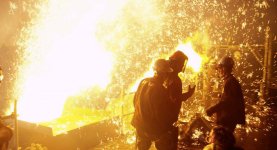
  • top of blast furnaces.jpg
    top of blast furnaces.jpg
    94.8 KB · Views: 0
Back
Top