Welcome to our community

Be a part of something great, join today!

  • Hey all, just changed over the backend after 15 years I figured time to give it a bit of an update, its probably gonna be a bit weird for most of you and i am sure there is a few bugs to work out but it should kinda work the same as before... hopefully :)

Mini Primes vs. Nikon Lenses

Lee Saxon

Well-known member
Joined
Jan 8, 2009
Messages
1,667
Reaction score
0
Points
0
Location
New Orleans
I've been trying to decide which MiniPrimes I need.

That the MiniPrimes are smaller and (probably) lighter doesn't matter to me.

My current thinking:

6mm - yes, only real wide angle option

8mm - no. I'll use the 6mm and take two steps forward for free

16mm - yes, it's t/1.5 whereas my Nikon 14-24 is only f/2.8

25mm - no, the Nikon 24mm f/1.4 (while twice the price) could be used on both my cameras, plus the S35 Scarlet if I ever manage to afford it

50mm - no, it's t/2.9 whereas my Nikon 50mm is f/1.4
 
Subject to change of course, Red has been saying the new mounts for Epic and Scarlet can be changed out by four bolts in about a minute, followed by a quick back focus adjustment involving the moveable sensor block. Changing lens and mount types quickly with Epic and Scarlet should be quite easy. I'm loving that concept...
 
Steve,

<off topic>Do you have a Nikon 50-300mm? If so, what are your comments about the sharpness and contrast? Does it hold focus thru out the entire zoom range? Thanks</off topic>
 
As far as i know, the miniprime focal lengths are not equivalent to s35 or ff35. There is a conversion factor somewhere on this site. Your Nikon's will be way cropped on the scarlet. at this point miniprimes and s16 lenses are the best option.
 
Get wide mini primes and a nice standard or Super 16mm zoom for the long end. The image shift of most stills lenses will be quite nasty on a 2/3 inch format sensor, especially an auto focus one. I don't relish in field lens mount changes, but you'll probably be able to adapt PL and Nikon to the Mini - Red mount. Perhaps Jarred would share the specs with us ? Diameter and FFD ??

Matt Uhry
www.mattuhry.com
 
As far as i know, the miniprime focal lengths are not equivalent to s35 or ff35. There is a conversion factor somewhere on this site. Your Nikon's will be way cropped on the scarlet. at this point miniprimes and s16 lenses are the best option.

Dude, a 50mm is a 50mm. If he puts hit 50mm f1.4 Nikkor on his 2/3" camera the picture will be the same as a 50mm miniprime, the difference being that the Nikkor will probably be softer(not meant for a tiny sensor) and that if you put the 50mm miniprime on your Nikon, it won't cover the larger sensor.

About the interchangeable lens mounts: I have no doubts it'll be quick and easily doable, something like how 35mm adapters have different lens mounts (I know I can change a Lets 35mm extreme lens mount in well under a minute with a single hex key), but it's still something I really would rather not have to do on a day-to-day basis every time you need a wider/longer lens.
 
Steve,

<off topic>Do you have a Nikon 50-300mm? If so, what are your comments about the sharpness and contrast? Does it hold focus thru out the entire zoom range? Thanks</off topic>

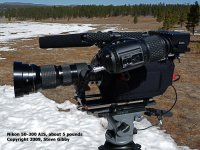
Michael, yes, one of the mid focal length Nikon zooms I regularly use for wildlife and sports shooting with Red is my Nikon 50-300 f4.5 AIS. The lens is plenty fast for daylight shooting, hold focus throughout a zoom extremely well, and has excellent sharpness and contrast. This lens was the core lens for wildlife still photographers in the late '80's and up into the mid '90's. The AIS version has a gold band around the end of the lens barrel. The improved coating of the AIS version differentiates it from the earlier AI version. Footage shot with it on Red One is sharp, good contrast, has a filmic quality to it, and is free from artifacts or weirdness. I've attached a photo of the 50-300 on one of my Red cameras. Every Red shooter I know who has bought a 50-300 AIS on my recommendation, has come back to thank me for the suggestion (Kennan Ward, Mike Waltze, etc.). If you look hard you can find one in very good condition for around $1,300

The notion that all 35mm stills zooms won't hold focus well throughout a zoom is very inaccurate, and usually fostered by those who haven't used a lot of different 35mm zooms on a Red camera. As myself, other Red shooters, and respected lens technicians like Chuck Colburn and Matt Duclos have confirmed on other threads, there are certain makes and models of 35mm stills zoom which hold focus quite well throughout a zoom - parfocal build lenses, etc. Among my 35mm still zoom lens kits, some of the ones which hold focus very well throughout a zoom are the Canon FD 150-600 f5.6L (stock push/pull/twist version), Nikon 50-300 f4.5 AIS, Nikon 80-200 f2.8 AF (push/pull version), Tokina 11-16 f2.8 (Nikon mount), Nikon 14-24 f2.8, and Nikon 17-35 f2.8. Just two weeks ago on a production I used a Canon 24-70 f2.8L zoom on someone else's Red with a Birger mount, and it held focus quite well throughout a zoom.

The above said, I do agree with Matt's comment that that some 35mm stills zooms prone to image shift would be a problem in the 2/3" format.

On other 35mm still lens threads here many others have reported various other Canon zooms which hold focus throughout a zoom.

Lee, if the genres you shoot call for primes, then I don't see a problem mixing Mini-Primes and Nikon primes, assuming the new Red mounts are as fast and easy to change as Red has been talking about. Since the lenses you mentioned are all primes I'm assuming you shoot genres where primes are the best choice. I shoot genres where most often zooms are the best choice, but I also have a lot of primes I can put in my kits my kits should I need them.
 

Attachments

  • Nikon-50-300-web.jpg
    Nikon-50-300-web.jpg
    92.8 KB · Views: 0
We won't know for sure until someone can get their hands on a miniRED prime and test this, but it may be possible to create a dumb miniRED mount to Canon mount adapter. This way you wouldn't have to change the Scarlet mount when switching from Canon to miniRED.

We've used the Fotodiox Nikon-Canon EOS dumb mounts and they work great for the most part.
 
As far as i know, the miniprime focal lengths are not equivalent to s35 or ff35. There is a conversion factor somewhere on this site. Your Nikon's will be way cropped on the scarlet.

Andrew, Juhan is right. Field of view remains the same if you put a 25mm FF35 Canon lens or a miniRED 25mm on the 2/3" Scarlet.

Larger format lenses at the same focal length will have the same field of view on a 2/3" sensor.
 
Nikons are likely to be soft compared to the miniprimes. Scarlet's pixels are a lot smaller than the average nikon's, so sharper lenses are necessary.
 
Get wide mini primes and a nice standard or Super 16mm zoom for the long end. The image shift of most stills lenses will be quite nasty on a 2/3 inch format sensor, especially an auto focus one. I don't relish in field lens mount changes, but you'll probably be able to adapt PL and Nikon to the Mini - Red mount. Perhaps Jarred would share the specs with us ? Diameter and FFD ??

Matt Uhry
www.mattuhry.com

I think this is a good approach too. Decent relatively fast used 16mm zooms can be bought relatively cheaply right now. They have more than enough coverage for 2/3", the more expensive S16 versions aren't necessary. I have collected a few myself.
I don't know how the Red min-pl style mount falls for size and flange depth, but I am hoping it may be possible to adapt c-mount lenses to mini-Red with a simple screw on flange plate, like Bolex did with the EBM. Not holding my breath on this one though.
 
As far as i know, the miniprime focal lengths are not equivalent to s35 or ff35. There is a conversion factor somewhere on this site. Your Nikon's will be way cropped on the scarlet. at this point miniprimes and s16 lenses are the best option.

There is a conversion factor of about 3.6x when comparing a 2/3" Scarlet image circle to a FF35 image circle. But all lenses are "named" in the same terms as far as mm, even if they cover a different image circle, so a 50mm is a 50mm.

A MiniPrime 50mm or a Nikon 50mm on a 2/3" Scarlet will both give me the same field of view as a ~180mm lens on a FF35 camera.

yes, but changing the mount to go from 6mm to 25 or 50 ? Not fun.

Yeah you got me there, I didn't think about that. Even if it's just four bolts and a focus adjustment, that's a pretty big hassle.
 
According to David Mullen:

"The reason we say that a "50 is a 50 is a 50" is because people start to confuse themselves when they only want to think about lenses in terms of conversion factors rather than simply learning what field of view different focal lengths give you on different formats.

In other words, if you take a 50mm lens off of a 35mm camera and put it on a 2/3" camera, it's still a 50mm lens, it just has a narrower view. It doesn't become some other focal length.

It's simpler to just think of the series of focal lengths you will be using as containing your wide to telephoto range. So you learn what your 8mm gives you versus your 28mm, etc. on your specific camera -- you don't have to make conversions to some format you aren't even shooting.

Of course, you may make conversions at first to know what lens to rent or buy, but honestly, it's not complicated. It's a 2.5X crop factor between Super-35 and 2/3", and remember that the typical range of focal lengths always get shorter for smaller formats to equal the same range of views of longer lenses on larger formats.

So you'd use a 20mm lens on a 2/3" camera when you wanted the same field of view as a 50mm lens on a Super-35 camera.

Let's say that your typical range used in Super-35 moviemaking is often 18mm to 100mm (and there's a Cooke zoom in that range.) Well, you'd need a 7.2mm to 40mm range on a 2/3" camera to get that same range of views.

So right off the bat, you just have to realize that your 6mm, 7mm, 8mm, 9mm lenses are wide-angles in 2/3", the 12mm, 16mm, 20mm lenses are the middle focal lengths, and beyond that start to become your telephoto lenses.

If you're trying to figure out the equivalent lenses to obtain the same field of view using a 2.5X crop factor, it would be:
S35 16mm = 6.4mm in 2/3"
S35 24mm = 9.6mm in 2/3"
S35 32mm = 12.8mm in 2/3"
S35 50mm = 20mm in 2/3"
S35 85mm = 34mm in 2/3"
S35 135mm = 54mm in 2/3"

But if you're asking how much more telephoto your S35 lenses will behave on a 2/3" camera, then your figures are about right. Just as long as you understand that your S35 lenses don't actually change into those longer focal lengths on a 2/3" camera, they just behave like those focal lengths would on a S35 camera."
 
Back
Top