Welcome to our community

Be a part of something great, join today!

  • Hey all, just changed over the backend after 15 years I figured time to give it a bit of an update, its probably gonna be a bit weird for most of you and i am sure there is a few bugs to work out but it should kinda work the same as before... hopefully :)

Manure

You should really go with the lowest common denominator and just keep the whole thing 2K.

Once Epic comes out, it will make more sense to finish at 4K.

Hi Tom,

Have you done any tests that confirm your advice?

Stephen
 
Hi Tom,

Have you done any tests that confirm your advice?

Stephen

Just going off what Graeme and others have said. If RED is actually a 3K camera or 3.2K camera, then it makes sense mathematically that Epic will roughly be a 4K camera. Or close enough to a make a 4K finish almost mandatory for a filmout on a major feature.

It is also possible that Red One's sensor upgrade in 2009 will up the resolution to 5K.
 
David,

Have you run into the "black sun" issue when shooting directly into lighting fixtures?

I had a problem with a reflection off of stainless steel. The highlight when purple, then black in the center.

Chris Bell

PS: This has been a fun read. Great images!
 
but I can tell you that all the symtoms of the data loss problems as described to me by David and his crew are identical to what happened to me once before when there was a power loss before the mag could be dismounted.

The other incident happened when we were using non-RED batteries, (before we knew any better), which do not communicate their status to the camera and easily allow you to run out of power without warning. This time, I think it's possible, especially with everyone on the crew working long hours with little rest, that someone could have inadvertently pulled the power before dismounting the media...Just my guess.

James Mathers
Cinematographer, Studio City, CA
Digital Cinema Society
President and Co-founder

One thing people need to understand is that when you press the record button to stop shooting - the camera take a second or two to write the QT reference files ("POST" is displayed in the LCD/EVF for a moment) -

When you press the "exit/undo" buttons to EJECT - the camera writes a .LOG file to the drive and this takes a few seconds before you see "same to remove" on the LCD/EVF and "no digimag" on the back of the camera.

While the camera is writing those file, it is obviously updating the FAT32 directory.

If you pull the drive (or loose power) while the directory is updating you are in a world of hurt.

Now, I know Stuart will not be happy that I am asking for this - but after this happened to me once - I sure would love the option to "un-check" (disengage) LOG FILE - just like I can "un-check" writing the QT files.

You can batch create QT files after the drive is removed very easily.

You should always emphasize to everyone on the camera crew - not to pull the drive until you see "safe to remove" or "no digimag". People get used to "calculating the delay" in their head and then yanking the drive - they need to have a visual confirmation that the drive has been unmounted.
 
Perhaps make it blink the control panel REC indicator light in orange as it's processing the "unmount" command (like when it's booting) and then have it go back to a steady green on the OK indicator light when it's done writing to the mag and it's safe to extract it.
 
Hey David, does Brad drive his Knight Rider Kit car to set?

Thanks for this thread, it's very informative on many levels.
 
You should always emphasize to everyone on the camera crew - not to pull the drive until you see "safe to remove" or "no digimag". People get used to "calculating the delay" in their head and then yanking the drive - they need to have a visual confirmation that the drive has been unmounted.

Mark is 200% correct. Always eject the drives/cards properly and you'll reduce the risk tremendously. It's the same on the PC/MAC side too.
 
I just wanted to say that these screen grabs look amazing so far.

davide
 
Seems like it would have been a good idea to put some sort of status indicator (LED) on the drive.

Constant RED - do not remove
Blinking RED - recording
Orange - preparing to eject
Green - safe to eject
 
Seems like it would have been a good idea to put some sort of status indicator (LED) on the drive.

Constant RED - do not remove
Blinking RED - recording
Orange - preparing to eject
Green - safe to eject

How about a 2-4 second delay before the disc is ejected?
 
Hi David,

I just found this thread. I'm awed by what you've been able to accomplish so far on this film and by your generous sharing of information.

THANKS!

Matt Uhry
www.mattuhry.com
 
Mark is 200% correct. Always eject the drives/cards properly and you'll reduce the risk tremendously. It's the same on the PC/MAC side too.

Also be careful not to leave a CF card in while mounting a drive or you will get really confused.
 
Week Five

Now we are on a Sunday thru Thursday schedule. Next week we only have three days left, plus any pick-up work to do later (I may be shooting some farm landscapes & car drive-bys for efx work later.)

Sunday and Monday were our last days shooting at Melody Ranch in Newhall. Clark Hunter, our production designer, built this great diner on Stage B, including a parking lot in front. My biggest problem was, when shooting scenes inside the diner, getting the background to look bright enough, since the diner is lined with windows. The diner was a lot easier to shoot for the night scenes, since it was well-dressed with hanging practical fixtures, augmented with a muslin ceiling that was lit from above with coop lights, adding a nice soft base light to everything.

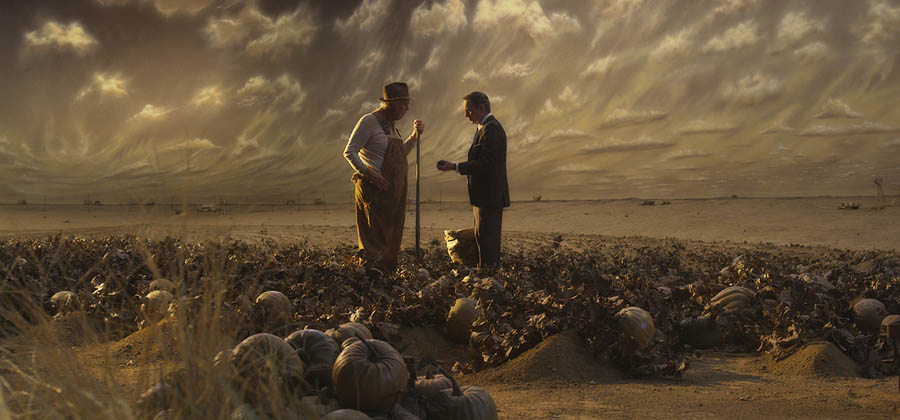
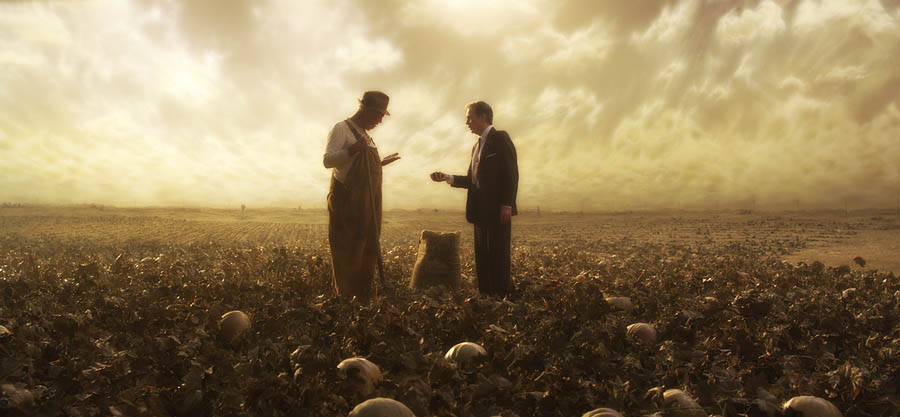
Last week, Clark and I were discussing how much we have learned about faking daytime landscapes inside a soundstage over the past five weeks. We decided to ask if we could reshoot the first scene of the movie, shot on Day One, of Billy Bob Thornton selling to a pumpkin farmer. It was part of a montage scene of different manure salesmen working different farms, but this was the longest scene and the first one, showing off the brown painted landscapes of the movie. Even though the last day at the Ranch was quite huge, we managed to add the reshoot of the scene; Clark improved upon his false perspective tricks, and I did a better job of creating the late afternoon look. The plants ended only about 20 feet beyond where the actors stood, and then the six foot wooden ramp leading to the backdrop began – Clark sprinkled peat moss from a bucket into tiny rows to create the illusion of distant crops. I added a light haze of smoke, something I didn’t do on Day One, plus I lit the sky backdrop brighter than before, though it took three 18K’s pointed into the brown sky backing to get it to overexpose.

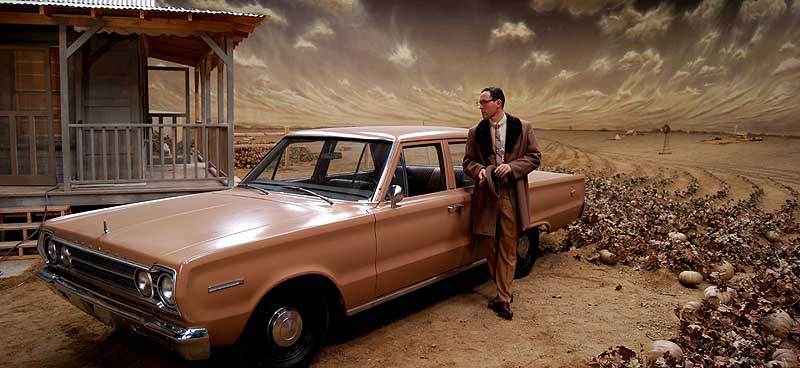
As a frame of reference, here is the Nikon snapshot I made on the test day a few days before Day One, when I only had part of my lighting package:

manure3.jpg


Here is the RED frame of the master shot of the scene from Day One’s shoot:

900manure1.jpg


Here is the RED frame of the reshot master on Day Twenty:

900manure2.jpg


Just keep in mind that I diffused these shots in Photoshop, and they are reduced, compressed, etc. Now the look of the movie is meant to be stylized and painterly, but it's nice to get handle on learning how to fake natural lighting effects on a stage.

On Tuesday we hit the road, shooting at the old Art Deco-style Bullocks Wilshire building (now a private law school) to play as an urban department store. The large interior was lit mainly with a single HMI lighting balloon. We then went down the block, past the now-demolished Ambassador Hotel (where I shot part of “D.E.B.S” a few years ago) to a small wooden bar to shoot a few scenes.

On Wednesday, we arrived at DC Stages in Downtown to shoot in some modified pre-existing sets (courtrooms, large hallways, offices, etc.) Since I used mostly HMI lighting at Melody Ranch, I decided to pre-rig these stages with my tungsten lights, discovering by now that the noise problem of shooting in 3200K balance on the RED was not as bad as some people have made it out to be. Plus I had too many sets that needed downward-pointing spots on architectural elements, and there really is no good HMI solution to that.

Thursday was my birthday and there was a nice big cake for me (and the crew) at lunchtime, which was nice. I also ran into the producers and advance prep people for HBO’s “Big Love”, now shooting their third season, a job offer I had to decline because of my commitment to the two Polish Brothers movies. They were at DC Stages scouting locations for an upcoming episode. I chatted briefly with Alan Caso, ASC, who is now shooting the series.

We shot some 16mm film footage for an educational film series, part of which plays on a wall in a later scene, plus is scattered throughout the movie. The plan is to rephotograph the image off of a screen, though we have the option of scanning the footage to digital as well. It was interesting to shoot film again, to look through an optical viewfinder to frame up a scene without having to turn on the camera. However, after the first scene was shot, the on-off trigger on the Arri-SR2 broke and we couldn’t turn on the camera. So much for the superior reliability of film equipment compared to the RED’s…

Turns out a small plastic piece inside the 25-year-old camera broke. By chance, our digital data wrangler, Eric, used to work as a camera tech and managed to repair it by pushing the internal microswitch to be permanently “on” so we could trigger the camera with a remote start-stop cable. But by the time it was fixed, we decided to shoot the rest of the 16mm scenes on Monday. Luckily we had already shot the one scene that we needed a 16mm print of to project during a scene on Monday. I guess one advantage of old film cameras is that the repairs tend to be low-tech and mechanical generally….

I used Kodak 7218 for the 16mm scenes, figuring the desaturated look of the movie, the digital color-correction planned, and the softening and fading from rephotographing the image off of a screen during projection sort of negated getting finicky about matching the look (grain-wise and color-wise) of older emulsions and formats, though I did point out to everyone that 16mm industrials made from the late 1930’s to early 1960’s, as ours were meant to represent, should reflect the changes in technology, with most of them being b&w, not color, except for the 1960’s era industrials. But since this movie is highly stylized, I don’t think it is important to get overly realistic about that aspect. Plus there was no time to shoot each 16mm sequence in different styles on different stocks. I lit the faux educational films in a classic hard light style, which was fun. I also am always amazed at how good actors look in that style.

We also shot a long scene in a lab / office set full of animals in cages, including a lion. That was interesting to say the least.

Well, three more days left!
 
Thanks as always, for your generosity in sharing all of this with us. What a difference there is between the Day 1 / Day 20 master shots!
 
Back
Top