Welcome to our community

Be a part of something great, join today!

  • Hey all, just changed over the backend after 15 years I figured time to give it a bit of an update, its probably gonna be a bit weird for most of you and i am sure there is a few bugs to work out but it should kinda work the same as before... hopefully :)

Magnetic ballasts with RED?

Providing all the kit is firing as it should be, the fps you can use should be divisible by twice the frequency.

25fps: 12.5/25/50/75/100 etc

24fps is slightly different, as on a film camera we would adjust the shutter, so i would adjust your RED SHUTTER, i.e the frequency from 1/50th = 180 degree shutter to 1/48th = 172.8 degree shutter. Now on 24fps you are good to go at 50Hz

This of coarse is reliant on the ballast being in good order and firing at regular cycles, this is where your flicker meter would help.

hope this helps.

:thumbsup:
 
Thanks for important info. So here in Sweden may my safe speed be 1/60 at 24 fps? 1/60 may be safer than 1/48 - am I right?
/Ronnie

Nope! If your power is 50Hz it has 2 parts to the cycle (up and down) so double 50 = 100. So to be flicker safe you need a shutter time that must divide into 100!!!! Like: 1/100th, 1/50th, 1/25th, 1/20th....

To be sure, set your red to display shutter in degrees and follow the 50Hz chart below.

FYI:
HMI50150.jpg


for 60 Hz:

HMI60150.jpg


Just a tip, when I shoot on location I always try to shoot a flicker safe speed! I have been burned by florescents deep in the background, or exit signs...!!!!

Best,
Rich
 
Thanks everyone for important info. So there are no totally safe speeds with magnetic ballasts?
Not even 24fps/172,8 or 25fps/180 in 4K or 50fps/180 in 3K?
Do I always have to shoot tests with the ballasts?
 
any ballast is capable of flicker, it's just electronic ballasts peak more often so there is less chance of flicker. Magnetic ballasts are more robust in my experience, it's one of the foibles of HMI. In theory the safe speeds we have given should be safe, as long as the kit is in good order, and there's the rub. So protect yourself, if it's a very important job and you're shooting off speed a lot go electronic, or take out a bit of insurance and get a flicker meter.
 
Nope! If your power is 50Hz it has 2 parts to the cycle (up and down) so double 50 = 100. So to be flicker safe you need a shutter time that must divide into 100!!!! Like: 1/100th, 1/50th, 1/25th, 1/20th....

To be sure, set your red to display shutter in degrees and follow the 50Hz chart below.


Rich

Please :Do you have bigger version of this chart so we could print it and keep it in hands
 
It is not practical to shoot tests all the time. Even if you do a generator could be off sync.... My lighting truck is all electronic these days to cover my behind.

Many times you can see the flicker easier in the waveform or histograms than by eye. You can learn to recognize it by practicing syncing to a CRT display. You will see the fluctuation in the meters. Or better yet, shoot a florescent light at an off speed.

The speed charts come from Cinematography Electronic's web site. Here is the link:

http://www.cinematographyelectronics.com/index_flickerfree.html

Prost,
Rich
 
I can mention that I never had any flicker problems on 25fps with my Arri camera with all kind of ballasts. Are the RED more sensitive for flicker?
(Maybe a stupid question)
/Ronnie
 
I can mention that I never had any flicker problems on 25fps with my Arri camera with all kind of ballasts. Are the RED more sensitive for flicker?
(Maybe a stupid question)
/Ronnie

Not a stupid question. In Sweeden 50Hz, 25fps and a 180 shutter you would be good with magnetic ballasts

I do not think the Red is more sensitive to flicker, its just very to change the settings and therefore get into trouble.
 
How Flicker Free Ballasts Work Part 1

How Flicker Free Ballasts Work Part 1

any ballast is capable of flicker, it's just electronic ballasts peak more often so there is less chance of flicker. Magnetic ballasts are more robust in my experience, it's one of the foibles of HMI.

I won’t address the issue of flicker and frame rate/shutter angles because it is well established elsewhere in this forum that there are safe windows that are “flicker free” as long as the power supply is stable. What I would like to do is correct some misinformation regarding electronic HMI ballasts. First, electronic HMI ballasts are not “flicker free” because they “peak more often so there is less chance of flicker.” Electronic HMI ballasts cycle at the same frequency as magnetic ballasts. The difference between them is that the light intensity of a HMI powered by a magnetic ballast follows the waveform of the supply power and increases gradually until it peaks and then decreases. Since there are two peaks per cycle (+ & - ), the light pulses twice every AC cycle or 120 times a second (see illustration below. ) This fluctuation in the light output is not visible to the eye but will be captured on film or video if the frequency (Hz) of the AC power is not precisely synchronized with the film frame rate or video scan rate. If the AC Frequency of the power were to vary, a frame of film or video scan, would receive more or less exposure depending upon the exact correspondence of the film/video exposure interval to the cycling power waveform because the light intensity is pulsating at twice the AC frequency.

HMIMagneticOutput.jpg

The sinusoidal 60Hz current of a magnetic ballast (left) creates a pulsating light output (right) ​

Electronic square wave ballasts eliminate the potential for flicker by squaring off the curves of the AC sine wave supplying the globe. Squared off, the changeover period between cycles is so brief that the light no longer pulsates but is virtually continuous (see illustration below.) Even if the AC Frequency of the power were to vary, a frame of film or video scan, would receive the same exposure because the light intensity is now not pulsating but nearly constant. In other words, electronic ballasts are “flicker free” because they square off the power sine wave which causes an increase in the duration of the peak level of light output so that the light is on more than it is off. Electronic HMI ballasts are also called “square wave” ballasts for this reason. The down side to electronic HMI ballasts is that because of their sophisticated electronics they are more expensive and more fragile than magnetic ballasts.

HMISquareWaveOutput.jpg

The refined square-wave signal of an electronic ballast (left) creates virtually even light output (right)(Illustrations courtesy of Harry Box​

I detect in Robert’s comment a whiff of nostalgia for the solidly reliable magnetic ballasts of yesteryear. I agree with him. There is a popular misconception reflected in Rich’s comment below that you should only use electronic ballasts with generators. Where that might be true with conventional generators without frequency governors, it is not true of the Crawford Studio Generators or even portable generators like the Honda EU series of inverter generators.

It is not practical to shoot tests all the time. Even if you do a generator could be off sync.... My lighting truck is all electronic these days to cover my behind.

Magnetic ballasts will operate reliably on the Honda EU series generators because Honda's sine-wave inverter technology provides much higher quality power than conventional (non-inverter) generators. With a waveform distortion factor of less than 2.5%, the power generated by Honda’s EU series of generators is quite often better than what you get out of the Crawford Studio Units. The power these machines generate is rock solid with a frequency variance of only hundredths of a cycle - which eliminates the need for costly crystal governors. The Honda EU series generators provide true sine wave power with low enough distortion, and frequency stability, to power HMI's with magnetic ballasts without problems. As long as you shoot at one of the many safe frame rates, magnetic ballasts are “flicker free.” Besides the extra bulk and weight of magnetic ballasts, the smaller magnetic ballasts (575-2500W) offer the distinct advantage of being less expensive and drawing less power (once they have come up to speed) than the commonly available non-PFC electronic equivalents.

In fact, according to recent research done by a Boston Gaffer I work with by the name of Guy Holt, if you don’t have access to the newest Power Factor Corrected (PFC) electronic ballasts, you are better served by using the older magnetic ballasts on an inverter generator (like the Honda EU6500is) over non-PFC electronic ballasts on conventional AVR generators (like the Honda EX5500 or ES6500.) I know this is contrary to the conventional wisdom, so I will explain his findings in more detail.

When electronic square wave HMI ballasts came on the market, they were at first thought to be the solution to all the problems inherent in running HMI lights on small portable generators. By eliminating the flicker problem associated with magnetic ballasts, they also eliminated the need for the expensive and ultimately unreliable AC governors required for flicker free filming with magnetic HMI ballasts and portable gas generators. Since they are not frequency dependent, it was thought at first that electronic square wave ballasts would operate HMIs more reliably on small portable generators – even those without frequency governors.

For this reason, as soon as electronic square wave ballasts appeared on the market, many lighting rental houses replaced the more expensive crystal governed portable generators with less expensive non-synchronous portable generators. The theory was that an electronic square wave ballast would operate reliably on a non governed generator and allow filming at any frame rate, where as a magnetic HMI ballast operating on an unreliably AC governed generator allowed filming only at permitted frame rates. In practice, electronic square wave ballasts turned out to be a mixed blessing. But, where I am out of space, I will have to explain why in my next post.

Eileen Ryan, Gaffer, Boston
 
Advantages to Magnetic Ballasts

Advantages to Magnetic Ballasts

In practice, electronic square wave ballasts turned out to be a mixed blessing. But, where I am out of space, I will have to explain why in my next post.

In practice, electronic square wave ballasts turned out to be a mixed blessing. Part of the problem with operating electronic HMI ballasts on portable gas generators in the past has to do with the purity of the power waveform they generate. With an applied voltage waveform distortion of upwards of 19.5%, conventional AVR generators (like the Honda EX5500 or ES6500) do not interact well with the leading power factor (current leads voltage) of the capacitive reactance created by electronic square wave HMI ballasts. The net result is harmonic currents are thrown back into the power stream, which results in a further degradation of the voltage waveform and ultimately to equipment failure or damage.

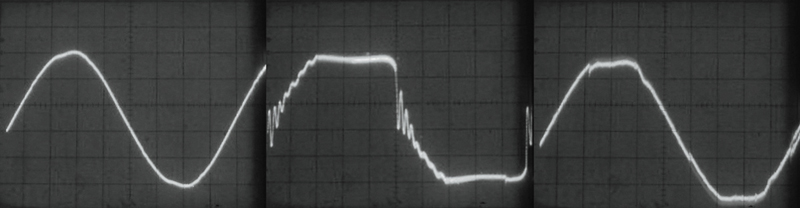
The oscilloscope shots of the power waveforms below is from an article Guy wrote for his company newsletter on the use of portable generators in motion picture lighting and is typical of what results from the operation of a 1200W HMI with non-power factor corrected ballast on grid power (left), on a conventional AVR generator (Honda EX5500) (middle), and inverter generator (Honda EU6500is)(right.) The adverse effects of the harmonic noise generated by non-PFC electronic ballasts and exhibited here in the middle shot, can take the form of overheating and failing equipment, circuit breaker trips, excessive current on the neutral wire, and instability of the generator’s voltage and frequency. Harmonic noise of this magnitude can also damage HD digital cinema production equipment, create ground loops, and possibly create radio frequency (RF) interference (for more details use this link.)

wwaveform_elec_ballast.jpg

As is evident in the oscilloscope shots below of a 1200W magnetic HMI ballasts on grid power (left), on power generated by a conventional AVR generator (middle), and power generated by an inverter generator (right), the lagging power factor caused by the inductive reactance of magnetic ballasts has by comparison only a moderately adverse effect on the power waveform. Outside of causing a voltage spike in the inverter power, magnetic ballasts actually show a positive effect on the already distorted power waveform of the Honda EX5500 conventional generator. For this reason magnetic ballasts work better on conventional generators with frequency governors than do non-PFC electronic square wave HMI ballasts.

wwaveform_mag_ballast.jpg

These oscilloscope shots show that if you don’t have access to the newest PFC electronic ballasts, the older magnetic ballasts are in fact cleaner running on portable gas generators than non-PFC electronic ballasts. And, where inverter generators like the Honda EU6500is do not require crystal governors to run at precisely 60Hz, you can operate magnetic HMI ballasts reliably on them. In addition, the smaller magnetic ballasts (575-2500W) offer the distinct advantage of being less expensive and draw less power (once they have come up to speed) than the commonly available non-PFC electronic equivalents (13.5A versus 19A for a 1.2kw.)

Of course there are downsides to using magnetic ballasts. One down side is that you are restricted to using only the safe frame rates and shutter angles. Another downside to magnetic ballasts is that you can’t load the generator to full capacity because you must leave “head room” for their higher front end striking load. When choosing HMIs to run off portable generators, bear in mind that magnetic ballasts draw more current during the striking phase and then they “settle down” and require less power to maintain the HMI Arc. By contrast, an electronic ballasts “ramps up”. That is, its’ current draw gradually builds until it “tops off.”

For example, even though a 2.5 magnetic ballast draws approximately 26 amps you will not be able to run it reliably on the 30A/120V twist-lock receptacle of a 6500W generator. As mentioned above, magnetic ballasts have a high front end striking load. So, you must leave “head room” on the generator to accomodate the strike. And, even though the twist-lock receptacle is rated for 30 Amps, conventional 6500W generators are only capable of sustaining a peak load of 27.5 Amps per leg for a short period of time. Their continuous load capacity (more than 30 minutes) is 23 Amps per leg. And, if there is any line loss from a long cable run the draw of a 2.5 magnetic ballast will climb to upward of 30 Amps. To make matters worse, as we saw in the oscilloscope shots above, the lagging power factor caused by the inductive reactance of the magnetic ballast causes a spike in the supply voltage that can cause erratic tripping of the breakers on the generator or ballast. (for a more detailed explanation of why that is I, again, suggest you Guy’a newsletter article.) In my experience the load of a 2.5kw magnetic ballast is too near the operating threshold of an unmodified 6500W generator for it to operate reliably.

HD_PP_Demo_Transformer-Distro.jpg

PFC 2.5 & 1.2 HMI Pars, PFC 800w Joker HMI, Kino Flo Flat Head 80, 2 ParaBeam 400s, and a ParaBeam 200 powered by a modified Honda EU6500is through a 60A Full Power Transformer/Distro​

The only sure way to power a 120V 2.5kw (or even a 4kw) HMI magnetic ballast on a portable gas generator is from its' 240V circuit through a 240v-to-120v step down transformer like the one Guy’s company, Screenlight & Grip, manufactures for their modified Honda EU6500is. Their 60A Full Power Transformer/Distro will step down the enhanced 7500W output of their modified Honda EU6500is generator to a single 60A 120V circuit that is capable of accommodating the high front end striking load, and even the voltage spikes, of either a 2.5kw or 4kw magnetic ballast at 120V. For details about the benefits of using step down transformers with portable generator, read his article. It is available at www.screenlightandgrip.com/html/emailnewsletter_generators.html.

If it sounds like I’m hyping the Honda EU6500is generator, it is not because I rent or sell them. As a Gaffer of a lot of tight budgeted independent shorts, I think these machines are a major development in portable power. Since magnetic HMI ballasts will operate flicker free at all standard frame rates on them (without the need for a crystal governor), inverter generators like the Honda EU6500is give new production life to older 2.5kw & 4kw HMIs with 120V magnetic ballasts.

Eileen Ryan, Gaffer, Boston
 
Thank you very much for the information. It is very helpful........
smileyhappy.ico
 
That is what I call a good post !!!! Two thumbs up & thanks.

In practice, electronic square wave ballasts turned out to be a mixed blessing. Part of the problem with operating electronic HMI ballasts on portable gas generators in the past has to do with the purity of the power waveform they generate. With an applied voltage waveform distortion of upwards of 19.5%, conventional AVR generators (like the Honda EX5500 or ES6500) do not interact well with the leading power factor (current leads voltage) of the capacitive reactance created by electronic square wave HMI ballasts. The net result is harmonic currents are thrown back into the power stream, which results in a further degradation of the voltage waveform and ultimately to equipment failure or damage.

The oscilloscope shots of the power waveforms below is from an article Guy wrote for his company newsletter on the use of portable generators in motion picture lighting and is typical of what results from the operation of a 1200W HMI with non-power factor corrected ballast on grid power (left), on a conventional AVR generator (Honda EX5500) (middle), and inverter generator (Honda EU6500is)(right.) The adverse effects of the harmonic noise generated by non-PFC electronic ballasts and exhibited here in the middle shot, can take the form of overheating and failing equipment, circuit breaker trips, excessive current on the neutral wire, and instability of the generator’s voltage and frequency. Harmonic noise of this magnitude can also damage HD digital cinema production equipment, create ground loops, and possibly create radio frequency (RF) interference (for more details use this link.)

wwaveform_elec_ballast.jpg

As is evident in the oscilloscope shots below of a 1200W magnetic HMI ballasts on grid power (left), on power generated by a conventional AVR generator (middle), and power generated by an inverter generator (right), the lagging power factor caused by the inductive reactance of magnetic ballasts has by comparison only a moderately adverse effect on the power waveform. Outside of causing a voltage spike in the inverter power, magnetic ballasts actually show a positive effect on the already distorted power waveform of the Honda EX5500 conventional generator. For this reason magnetic ballasts work better on conventional generators with frequency governors than do non-PFC electronic square wave HMI ballasts.

wwaveform_mag_ballast.jpg

These oscilloscope shots show that if you don’t have access to the newest PFC electronic ballasts, the older magnetic ballasts are in fact cleaner running on portable gas generators than non-PFC electronic ballasts. And, where inverter generators like the Honda EU6500is do not require crystal governors to run at precisely 60Hz, you can operate magnetic HMI ballasts reliably on them. In addition, the smaller magnetic ballasts (575-2500W) offer the distinct advantage of being less expensive and draw less power (once they have come up to speed) than the commonly available non-PFC electronic equivalents (13.5A versus 19A for a 1.2kw.)

Of course there are downsides to using magnetic ballasts. One down side is that you are restricted to using only the safe frame rates and shutter angles. Another downside to magnetic ballasts is that you can’t load the generator to full capacity because you must leave “head room” for their higher front end striking load. When choosing HMIs to run off portable generators, bear in mind that magnetic ballasts draw more current during the striking phase and then they “settle down” and require less power to maintain the HMI Arc. By contrast, an electronic ballasts “ramps up”. That is, its’ current draw gradually builds until it “tops off.”

For example, even though a 2.5 magnetic ballast draws approximately 26 amps you will not be able to run it reliably on the 30A/120V twist-lock receptacle of a 6500W generator. As mentioned above, magnetic ballasts have a high front end striking load. So, you must leave “head room” on the generator to accomodate the strike. And, even though the twist-lock receptacle is rated for 30 Amps, conventional 6500W generators are only capable of sustaining a peak load of 27.5 Amps per leg for a short period of time. Their continuous load capacity (more than 30 minutes) is 23 Amps per leg. And, if there is any line loss from a long cable run the draw of a 2.5 magnetic ballast will climb to upward of 30 Amps. To make matters worse, as we saw in the oscilloscope shots above, the lagging power factor caused by the inductive reactance of the magnetic ballast causes a spike in the supply voltage that can cause erratic tripping of the breakers on the generator or ballast. (for a more detailed explanation of why that is I, again, suggest you Guy’a newsletter article.) In my experience the load of a 2.5kw magnetic ballast is too near the operating threshold of an unmodified 6500W generator for it to operate reliably.

HD_PP_Demo_Transformer-Distro.jpg

PFC 2.5 & 1.2 HMI Pars, PFC 800w Joker HMI, Kino Flo Flat Head 80, 2 ParaBeam 400s, and a ParaBeam 200 powered by a modified Honda EU6500is through a 60A Full Power Transformer/Distro​

The only sure way to power a 120V 2.5kw (or even a 4kw) HMI magnetic ballast on a portable gas generator is from its' 240V circuit through a 240v-to-120v step down transformer like the one Guy’s company, Screenlight & Grip, manufactures for their modified Honda EU6500is. Their 60A Full Power Transformer/Distro will step down the enhanced 7500W output of their modified Honda EU6500is generator to a single 60A 120V circuit that is capable of accommodating the high front end striking load, and even the voltage spikes, of either a 2.5kw or 4kw magnetic ballast at 120V. For details about the benefits of using step down transformers with portable generator, read his article. It is available at www.screenlightandgrip.com/html/emailnewsletter_generators.html.

If it sounds like I’m hyping the Honda EU6500is generator, it is not because I rent or sell them. As a Gaffer of a lot of tight budgeted independent shorts, I think these machines are a major development in portable power. Since magnetic HMI ballasts will operate flicker free at all standard frame rates on them (without the need for a crystal governor), inverter generators like the Honda EU6500is give new production life to older 2.5kw & 4kw HMIs with 120V magnetic ballasts.

Eileen Ryan, Gaffer, Boston
 
Back
Top