Welcome to our community

Be a part of something great, join today!

  • Hey all, just changed over the backend after 15 years I figured time to give it a bit of an update, its probably gonna be a bit weird for most of you and i am sure there is a few bugs to work out but it should kinda work the same as before... hopefully :)

Magical RED Raw

Dana Neibert

Well-known member
Joined
Sep 1, 2017
Messages
84
Reaction score
0
Points
6
My mind is somewhat blown. For the first time, I went into the RAW data in Premiere when doing an edit of some RED footage. I was surprised to see that I can change the ISO in addition to exposure, white balance, etc. (A precursor to all this is I come from the still photo world. When I shoot raw stills, I know I have 3 stops or so latitude in my exposure when I get to post. In post, I can salvage those stops and also adjust white balance, etc.) So I started playing around with the RED RAW and it dawned on me that it does not matter what you set the ISO to when you shoot RED RAW. I feel like the sensor has it's sensitivity and sees a scene and captures everything that it is capable of regardless of what you set the ISO to. I feel like next time I'm on set, I could find my perfect exposure (lets say ISO 200 1/48th at F5.6 gets me a perfect exposure) and then change the ISO to 3200 so it looks like complete hell and freak everyone out on set and then in post adjust my ISO back down to 200 and be just fine. Am I delusional or is this really real?
 
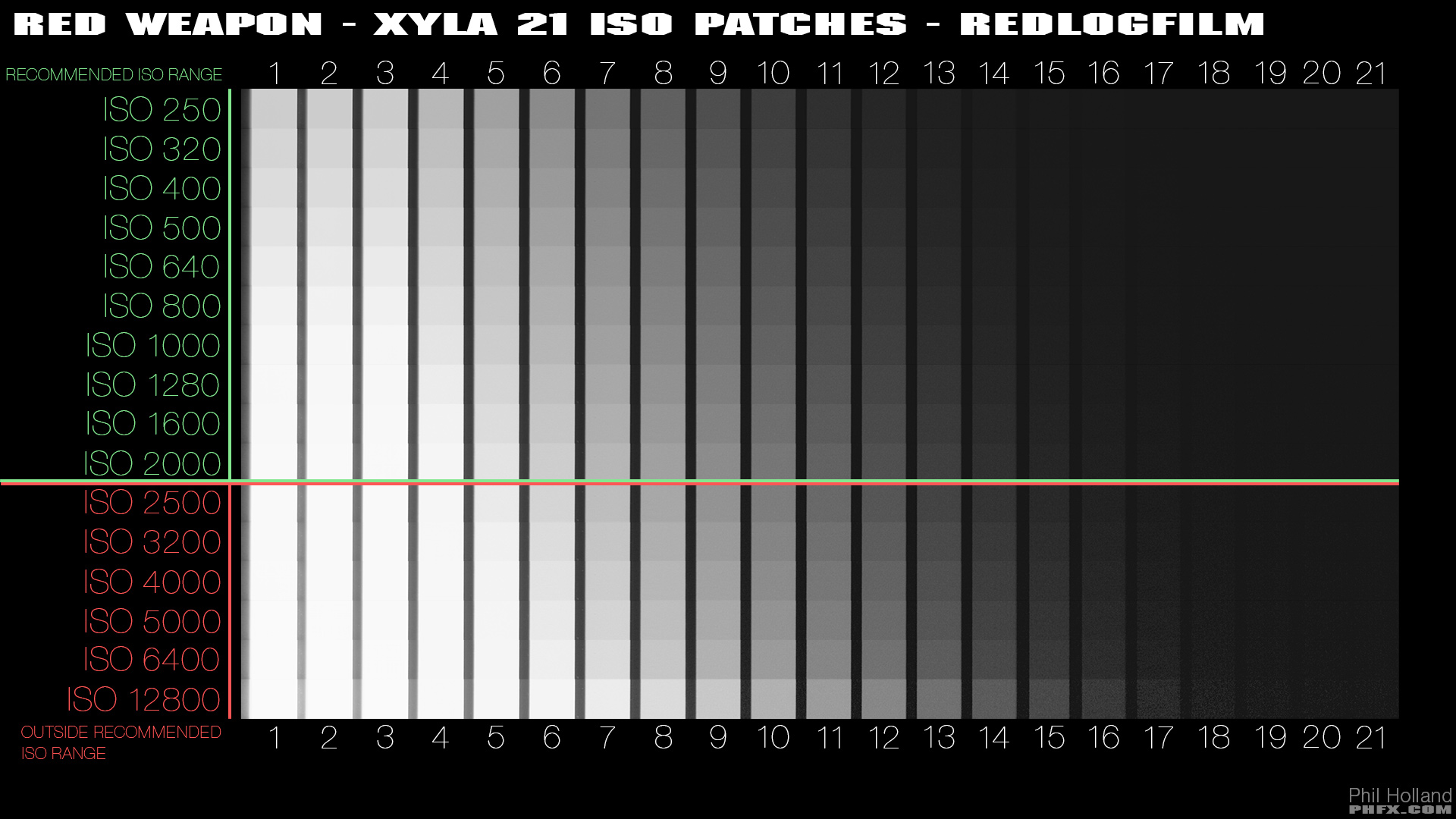
This is what it happens with RAW :


Illustration from Phil Holland

phfx_REDWeaponTest2015_xyla21_ISOPatches_RLF.jpg


Shooting 12800 iso will make you underexpose the sensor, you gain highlight protection (more stops above mid gray before clipping) but you will dig in the noise area of the sensor in the lowlights.
Shooting 250 iso will make you overexpose the sensor, you gain the cleanest image in the shadows (more stops below mid gray before noise level rises) but you will clip earlier your highlights and have less highlights roll off.

Increasing DR of the camera depends on your noise level tolerance. At one point you will only dig noise if you want to use a bigger DR by using a higher Iso base setting. Going from 14 stops to 17 stops for example (by using a curve or a higher ISO).


Pat
 
My mind is somewhat blown. For the first time, I went into the RAW data in Premiere when doing an edit of some RED footage. I was surprised to see that I can change the ISO in addition to exposure, white balance, etc. (A precursor to all this is I come from the still photo world. When I shoot raw stills, I know I have 3 stops or so latitude in my exposure when I get to post. In post, I can salvage those stops and also adjust white balance, etc.) So I started playing around with the RED RAW and it dawned on me that it does not matter what you set the ISO to when you shoot RED RAW. I feel like the sensor has it's sensitivity and sees a scene and captures everything that it is capable of regardless of what you set the ISO to. I feel like next time I'm on set, I could find my perfect exposure (lets say ISO 200 1/48th at F5.6 gets me a perfect exposure) and then change the ISO to 3200 so it looks like complete hell and freak everyone out on set and then in post adjust my ISO back down to 200 and be just fine. Am I delusional or is this really real?

Just like RAW in the photo world, the sensor gives you everything you EXPOSE for. If you expose as if you are shooting ISO 3200, you will tend to send a lot less light to the sensor than if you expose as if you are shooting ISO 80. People use light meters in different ways. Some meter the highlights (not specular, but reflective) and decide they want a stop of protection past that. Some measure 18% gray and decide they want +/- 5 stops from that. And you are right that no matter where you set the ISO in camera (or in post), as long as you have the right amount of light hitting the sensor, you'll get a sane result. But there are many on REDUSER.net who set the ISO to 3200 (because that's what the Helium sensor advertised when it was first revealed, before the ISO recalibration cut that down to 1600), they see enough details in the image to pull focus on a bright/contrasty monitor that hides all the noise in the shadows, and then their dreams are crushed when they realize that they underexposed by 2-3 stops.

There are many other tools for guiding one's exposure strategy: the histogram, the clipping indicators (called stoplights in the RED Operations Guide), false-color IRE, zebras, GIO scope, etc. All have their place. Variable ISO is not a magic bullet. It is a convenience for matching properly exposed images to your grading pipeline.
 
My mind is somewhat blown. For the first time, I went into the RAW data in Premiere when doing an edit of some RED footage. I was surprised to see that I can change the ISO in addition to exposure, white balance, etc. (A precursor to all this is I come from the still photo world. When I shoot raw stills, I know I have 3 stops or so latitude in my exposure when I get to post. In post, I can salvage those stops and also adjust white balance, etc.) So I started playing around with the RED RAW and it dawned on me that it does not matter what you set the ISO to when you shoot RED RAW. I feel like the sensor has it's sensitivity and sees a scene and captures everything that it is capable of regardless of what you set the ISO to. I feel like next time I'm on set, I could find my perfect exposure (lets say ISO 200 1/48th at F5.6 gets me a perfect exposure) and then change the ISO to 3200 so it looks like complete hell and freak everyone out on set and then in post adjust my ISO back down to 200 and be just fine. Am I delusional or is this really real?

Yes this is all true but you still have to expose properly.
 
Back
Top