Welcome to our community

Be a part of something great, join today!

  • Hey all, just changed over the backend after 15 years I figured time to give it a bit of an update, its probably gonna be a bit weird for most of you and i am sure there is a few bugs to work out but it should kinda work the same as before... hopefully :)

Looking to Buy an HMI.

To answer some earlier misinformation given by "Arrinick"

Howdy, didn't mean to intentionally misinform anyone. So where are "cool lights" made?

I'm not trying to knock any ones product, I'm just saying that it's tough to compare a light to a german made arri where quality control is absolute, and they have been making HMIs for 30 years. That's all I meant when I said you get what you pay for. Sure an arri 1200 costs an arm and a leg, but it will be happy getting the shit pounded out of it for 10 years on a rental truck.

No offense or misinformation intended.

By the way, I have all the heads I need, but would be interested in trying your ballasts. Are they for sale separately?

Cheers,

Nick
 
I was working with some tungsten lekos today and man after you gel them with daylight correction.... there's not a lot of juice left in em. Plus the heat... crazy... you can NOT leave these on the floor of the daycare....

makes me glad to have HMIs. And whoever got that last cool lights 575HMI fresnell, good for you, I told Richard today I'd take it but whoever you were, you had it shipped to you today. Have fun with it you lucky bastard ;)
 
:bleh:

I doubt I'll be using it on many music videos like you.

Probably a good deal of MOS, though, and some small-room interviews. If the head noise drives me nuts for the interviews, I'll let you know...:unsure:
 
My pleasure. The par itself (or any of the fresnels for that matter) is neither 5600K nor 6000K but that depends upon the bulb. The Arri standard HMI (that is followed by Philips and G.E. when they produce an HMI-compatible bulb) is 6000K. You won't notice a difference between 5600K and 6000K in most cases because of Mired Shift and the fact that color temperature differences are mostly noticeable in the lower temperatures like the 3000K to 4000K range for instance. I do know that Eiko has a 5600K bulb though and it should work although we've never specifically tested that bulb--I imagine if they closely followed the HMI standard then there should be no issue.

As for head noise, there is a bit so its not completely silent. We've talked about this before and it mostly has to do with resonances setup in the bulb by driving it at a high enough frequency to not see flicker. The ballast itself is quiet with a whisper fan.

The UV protection is built-in to the lens. Hope this helps.

Thanks for the info. Your product looks very good and the price is right, too. I wish there was a way to test drive your 1200W HMI PAR before purchasing it.

In the next few weeks I plan to buy a 1200W 5600K/6000K light. From where, I'm not sure, yet. So far, you're a pretty good contender.
 
Howdy, didn't mean to intentionally misinform anyone. So where are "cool lights" made?

I'm not trying to knock any ones product, I'm just saying that it's tough to compare a light to a german made arri where quality control is absolute, and they have been making HMIs for 30 years. That's all I meant when I said you get what you pay for. Sure an arri 1200 costs an arm and a leg, but it will be happy getting the shit pounded out of it for 10 years on a rental truck.

No offense or misinformation intended.

By the way, I have all the heads I need, but would be interested in trying your ballasts. Are they for sale separately?

Cheers,

Nick

Thats fine. Arri just started at one point too. No product is mature or totally finished on day one or early on. Quality is not something that comes fast, it comes with lots of feedback and manufacturing revisions. Anyone in manufacturing knows this to be the case.

The reason a company gets to that level of maturity is they don't give up and keep going even when they have plenty of opportunity or reasons to give up and that's our plan too. They also are constantly making changes wherever necessary. We're just at the start and we love what we're doing so we'll keep on doing it.

In any case, we're not manufacturing lights for the rental market--the idea was to make HMI and fluorescent less expensive so someone could own their own and so far we are advanced pretty well down that path after only about 2 years in business. When something costs $5000, that's a rental candidate and had better be tough for that price. When a similar item costs $999 or $1999, you can consider owning it.

So what if its missing that last 10% of frills or features that makes the 30 year old product what it is? The price is 60 to 75% of the other one but you got 90% of the functionality. In order to bring the different sacred cows like cameras and lighting down to earth, someone has to take a first crack at that and we're doing our part in the lighting area because I love film and video lighting and when I make lights for me and my uses, I most often find others like them too. We only use our own lighting and when I find something I don't like or someone mentions something thats a good idea, we just make the change. That's how things mature and after enough of that process you have people raving about quality and how wonderful it is.

On the question of ballasts--we do have the goal to sell the ballast alone in the future because we have a lot of requests like this particularly from gaffers but for the moment we've just been pairing them up with fixtures. So lets just say it will have to wait a bit longer but we will revisit that at some point.
 
Thanks for the info. Your product looks very good and the price is right, too. I wish there was a way to test drive your 1200W HMI PAR before purchasing it.

In the next few weeks I plan to buy a 1200W 5600K/6000K light. From where, I'm not sure, yet. So far, you're a pretty good contender.

I wish there was a way too. Most people standing in line for a RED never got to test drive it either including me. That's just the brave world of online marketing which is the future for where you'll be buying most of your stuff. Small, online, specialized equipment makers, using manufacturing contractors and other virtual resources to make what is effectively a very large company and using the Internet to market, sell and support.
 
Sorry to revive a semi dead thread and to complain on my first post here but I feel that a warning should be given about the Chinese Arri Clones.

I bought 2 lights from Ebay (Steven.Studio) and have thus far had a bad experience.

First 1200 showed up and would not fire, was the head unit, I took it appart and it appears that a capacitor had accidentally been smashed against the component housing and the screw on cover, it had shorted out and left a wee bit of carbon residue. Obviously from sloppy workmanship.

When I was sold the light I was told arri would work on them if ever they went down. this is not true at all. Arri refused.

So I was forced to send the head back to china at $275.

Replacement light took over a month to get (Shipping, customs, holidays, waiting for parts ect.. ect...) When it arrived I took it appart to make sure the same thing had not happened before I turned it on. Low and behold, the internals were of a completely different manufacture and thus were completely different. I was told in an email from them that they use almost all of the same parts as Arri, yet 2 different lights had 2 completely different makes of ignitors. Hmmm.

Anyway, yesterday, on set with A list talent, 1200 goes down. Wont fire up at the ballast. Power in, none out, no lights at all...unless you thump it. then they flicker and die.

Emailed "Steven" Once again, same story, send it to china and they will look at it. According to him he has never had even a single problem with any one elses lights failing, just me twice in a row. I find this hard to believe just on the law of averages.

I am curious if anyone else has had problems with his lights or if I really am a 2 time fluke of nature here.

Long story short? I feel I should have bought a single used arrisun instead of 2 new "SorrySun's"
 
I'm looking to purchase an affordable 1200W 5600K light with ballast, of course, one with no noise or flicker.

Buying a used 1200W HMI light has got to one of the hardest lights to buy. Because of the constant improvement in HMI technology there are many options available and if you are not careful you can get stuck with a lemon. In head design you can choose not only between Fresnel or Par, but also the older double ended globes verses the newer single ended globes. In ballast design you have a choice between magnetic and electronic ballasts; and to complicate matters even more, you have a choice between Power Factor Corrected electronic ballasts and non-Power Factor Corrected electronic ballasts.

The basic difference in head design between a Fresnel and Par is that a Fresnel gives you less output for the wattage, but the light is crisp and you will be able to cut a clean shadow edge. A Par on the other hand will give you more output, but the light is sloppy and you will not be able to cut a clean shadow edge. The newer single ended globes put out approximately 10% more light than the older double end globes and allowed manufacturers to make a more compact head design. The newer single ended heads are smaller and lighter for that reason.

In regard to ballasts, Power Factor Correction (PFC) is very new in 1200W HMIs and so you will not find it in a used ballast. In fact, I wouldn’t be surprised if you were not be even familiar with Power Factor Correction in HMI ballasts. Since Power Factor Correction (PFC) is not mandated in this country, as it is in Europe for any electrical device that draws more than 75W, we are pretty much ignorant of Power Factor and effect that poor Power Factor can have on a distribution system. However, any film technician familiar with large HMI heads will be quite familiar with Power Factor and Power Factor Correction (PFC.) That is because after a false start back in the 90s, all major manufacturers now include PFC circuitry in HMI ballasts in the 6-18kw range. They do so by necessity. The early line of Lightmaker electronic ballasts were nick named by film electricians “Troublemaker” ballasts because they were not Power Factor Corrected and proved that PFC circuitry was absolutely necessary in large ballasts to reduce heat and returns on the neutral, and to increase ballast reliability (beware, some are still kicking around ebay). But, because of the added cost, weight, and complexity of PFC circuitry, ballast manufacturers in the US still only offer PFC circuitry as an option in medium-sized 2.5-4kw ballasts. And, until very recently manufacturers did not offer PFC circuitry in HMI ballasts smaller than 2.5kw in the US (in the EU PFC circuitry in mandatory in all HMI ballasts sold.)

Part of the reason was that PFC circuitry did not offer a huge advantage when plugging into house power. A typical 1200W Power Factor Corrected electronic HMI ballast will draw 11 Amps at 120 Volts verses the 19 Amp draw of a non-PFC electronic ballast. While not a huge advantage when plugging into house power, the added efficiency of a PFC 1200 ballast can make a huge difference when powering a lighting package off of a portable generator. For example, when you consider that a Kino Flo Parabeam 400 draws only 2 amps, the 8 Amp difference between using a PFC 1200W electronic ballast and standard non-PFC 1200W electronic ballast, can mean the difference between running four additional Parabeam 400s on a portable generator or not – I think you would have to agree that is a major boost in production capability and pertinent to any one using a portable generator as their principle source of set power. Unfortunately, it is still the case that almost every 575 - 1200 W electronic ballast that you will find in a rental house or for sale used in North America will be a non-PFC electronic ballast.

Where I am just about out of space I will pick up with the advantages to using older magnetic ballasts over non_PFC electronic ballasts in a subsequent post.

- Guy Holt, Gaffer, ScreenLight & Grip Boston.
 
Macville--

1200w Cool Light fresnels? Did you get test units from Richard? The only 1200w units offered on the site so far are pars.

I'm about to close on the 575w "pro" fresnel, that is, the one with the 575/1200w ballast that is identical to the one sold with the 1200w par. Any opinions on the quality of the ballast in terms of build, performance, features?

maxwax--

Was the ballast that went down on you with your Cool Light 575w fresnel the previous ballast version offered or the new 575/1200w "pro" version?

I agree that Richard is easy to deal with, fair-minded, and take comfort in being able to talk with him and that distribution is U.S.-based, but I'm still a bit unsure whether the intro pricing is worth the risk on his higher-wattage units, given they are 1st generation products.

Have you noticed a head noise problem with the 575w fresnel? I have been using the 150w CDM fresnel and haven't noticed any objectionable sound from that unit.

I have got 2 of them. Very nice. Very light. I think I will buy 1 x 1200 watts to be "most of the cases" ready. But the is a big difference in weight betwen 575 and 1200 watts.
 
A couple of thoughts after reading this thread.

No matter what brand of 1200W hmi you get, get at least 50 feet (preferably 100) of header extension. You'll also want a full set of lenses for that light as well as scrims.

I would love to have 1 or 2 1200's for those little jobs, and price is important in that realm. But head noise would be a deal killer. Also, don't be too afraid of the magnetic ballasts. So what if they're heavy? At least they're reliable and probably easier to maintain. There are lots of safe HMI speeds you can still shoot at - alter the shutter angle and there are even more. And with the Red, you can VERIFY whether flicker is an issue or not right there on the set. (Another great thing about the Red!)

Also, brandwise, I'm a fan of LTM - a very reliable workhorse. Arri's alright too, but I like their cameras better.
 
.... don't be too afraid of the magnetic ballasts. So what if they're heavy? At least they're reliable and probably easier to maintain. There are lots of safe HMI speeds you can still shoot at - alter the shutter angle and there are even more. And with the Red, you can VERIFY whether flicker is an issue or not right there on the set. (Another great thing about the Red!).

I detect in Jim’s comment a whiff of nostalgia for the solidly reliable magnetic ballasts of yesteryear. I agree with him. There is a popular misconception that you should only use electronic ballasts with HD cameras. Where that is true when used with with conventional generators without crystal governors, it is not true of inverter generators like the Honda EU series. In the interest of full disclosure, I should say at this point that in addition to being a gaffer, I own and operate ScreenLight & Grip – a lighting and grip equipment rental and sales company. If what I am about to say sounds like I’m hyping magnetic ballasts it is not because we rent and sell them exclusively. We are dealers and rental agents for just about all the major brands and I don’t stand to profit from the sale or rental of magnetic HMI ballasts since we have made the transition to PFC electronic ballasts. As a professional Gaffer of a lot of tight budgeted historical documentaries for PBS’ American Experience and The History Channel (see my “credit-entials” on Imbd), I think it is worth noting that magnetic ballasts are still a viable production tool when used with the new inverter generators because they offer low budget independent filmmakers a cheaper alternative to high priced rental house equipment.

Magnetic ballasts will operate reliably on the Honda EU series generators because Honda's sine-wave inverter technology provides much higher quality power than conventional (non-inverter) generators. With a waveform distortion factor of less than 2.5%, the power generated by Honda’s EU series of generators is quite often better than what you get out of the wall outlet. The power these machines generate is rock solid with a frequency variance of only hundredths of a cycle - which eliminates the need for costly crystal governors. The Honda EU series generators provide true sine wave power with low enough distortion, and frequency stability, to power HMI's with magnetic ballasts without problems. As long as you shoot at one of the many safe frame rates, magnetic ballasts are also “flicker free” (where the topic of safe frame rates for magnetic ballasts is discussed extensively elsewhere in this forum I won’t get into it here.) Besides the extra bulk and weight of magnetic ballasts, the smaller magnetic ballasts (575-2500W) offer the distinct advantage of being less expensive and drawing less power (once they have come up to speed) than the commonly available non-PFC electronic equivalents.

If you don’t have access to the newest PFC electronic ballasts, you are better served by using the older magnetic ballasts on an inverter generator like the Honda EU 6500is over non-PFC electronic ballasts. I know this is contrary to the conventional wisdom, so I will quickly summarize why.

When electronic square wave HMI ballasts came on the market, they were at first thought to be the solution to all the problems inherent in running HMI lights on small portable generators. By eliminating the flicker problem associated with magnetic ballasts, they also eliminated the need for the expensive and ultimately unreliable AC governors required for flicker free filming with magnetic HMI ballasts and portable gas generators. Electronic square wave ballasts eliminate the potential for flicker by squaring off the curves of the AC sine wave supplying the globe. Squared off, the changeover period between cycles is so brief that the light no longer pulsates but is virtually continuous. Even if the AC Frequency of the power were to vary, a frame of film or video scan, would receive the same exposure because the light intensity is now not pulsating but nearly constant. Electronic square wave HMI ballasts allow you to film at any frame rate and even at a changing frame rate.

Since they are not frequency dependent, it was thought at first that electronic square wave ballasts would operate HMI more reliably on small portable generators – even those without frequency governors. For this reason, as soon as electronic square wave ballasts appeared on the market, many lighting rental houses replaced the more expensive crystal governed portable generators with less expensive non-synchronous portable generators. The theory was that an electronic square wave ballast would operate reliably on a non governed generator and allow filming at any frame rate, where as a magnetic HMI ballast operating on an unreliably AC governed generator allowed filming only at permitted frame rates.

In practice, electronic square wave ballasts turned out to be a mixed blessing. Part of the problem with operating electronic HMI ballasts on portable gas generators in the past has to do with the purity of the power waveform they generate. With an applied voltage waveform distortion of upwards of 19.5%, conventional generators do not interact well with the leading power factor (current leads voltage) of the capacitive reactance created by electronic square wave HMI ballasts (also by Kino, CFL, & LED ballasts as well.) The net result is harmonic currents are thrown back into the power stream, which results in a further degradation of the voltage waveform and ultimately to equipment failure or damage.

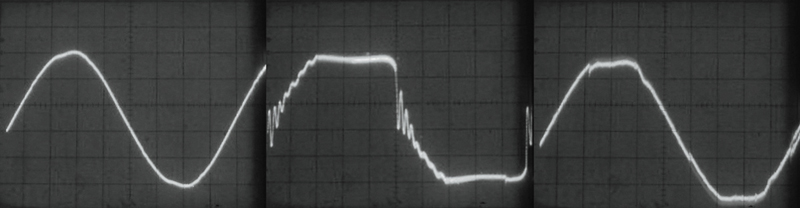
The oscilloscope shots of the power waveforms below are from an article I wrote on the use of portable generators in motion picture production and are typical of what results from the operation of a 1200W HMI with non-power factor corrected electronic ballast on grid power (left), on a conventional generator (middle), and inverter generator (right.) The adverse effects of the harmonic noise generated by non-PFC electronic ballast and exhibited here in the middle shot, can take the form of overheating and failing equipment, circuit breaker trips, excessive current on the neutral wire, and instability of the generator’s voltage and frequency. Harmonic noise of this magnitude can also damage HD digital cinema production equipment, create ground loops, and possibly create radio frequency (RF) interference.

wwaveform_elec_ballast.jpg

Left: Grid Power w/ 1.2Kw Arri non-PFC Elec. Ballast. Center: Conventional AVR Power w/ 1.2Kw Arri non-PFC Elec. Ballast. Right: Inverter Power w/ 1.2Kw Arri non-PFC Elec. Ballast.​

As is evident in the oscilloscope shots below of a 1200W magnetic HMI ballast on grid power, on power generated by a conventional Generator (Honda EX5500), and power generated by an inverter generator (Honda EU6500is), the lagging power factor caused by the inductive reactance of a magnetic ballast has by comparison only a moderately adverse effect on the power waveform. Outside of causing a voltage spike in the inverter power, magnetic ballasts actually show a positive effect on the already distorted power waveform of the Honda EX5500 conventional generator. For this reason magnetic ballasts work better on conventional generators with frequency governors than do non-PFC electronic square wave HMI ballasts.

wwaveform_mag_ballast.jpg

Left: Grid Power w/ 1.2Kw Arri Magnetic Ballast. Center: Conventional AVR Power w/ 1.2Kw Arri Magnetic Ballast. Right: Inverter Power w/ 1.2Kw Arri Magnetic Ballast.​

These oscilloscope shots show that if you don’t have access to the newest PFC electronic ballasts, the older magnetic ballasts are in fact cleaner running on portable gas generators than non-PFC electronic ballasts. And, where inverter generators like the Honda EU6500is do not require crystal governors to run at precisely 60Hz, you can operate magnetic HMI ballasts reliably on them. In addition, the smaller magnetic ballasts (575-2500W) offer the distinct advantage of being less expensive and draw less power (once they have come up to speed) than the commonly available non-PFC electronic equivalents (13.5A versus 19A for a 1.2kw.)

Where I am just about out of space, I will pick up in a subsequent post with the drawbacks to magnetic ballasts and how to overcome them.

- Guy Holt, Gaffer, ScreenLight & Grip, Lightng & Grip Rental in Boston
 
Where I am just about out of space, I will pick up in a subsequent post with the drawbacks to magnetic ballasts and how to overcome them.

Of course there are downsides to using magnetic ballasts. One down side is that you are restricted to using only the safe frame rates and shutter angles. But when you consider that every film made before the early 1990s was made this way, you realize it is not such a limitation. Another downside to magnetic ballasts is that you can’t load the generator to full capacity because you must leave “head room” for their higher front end striking load. When choosing HMIs to run off portable generators, bear in mind that a magnetic ballasts draws more current during the striking phase and then they “settle down” and require less power to maintain the HMI Arc. By contrast, an electronic ballasts “ramps up”. That is, its’ current draw gradually builds until it “tops off.”

For example, even though a 2.5kw magnetic ballast draws approximately 26 amps you will not be able to run it reliably on the 30A/120V twist-lock receptacle on a 6500W generator’s power panel. As mentioned above, magnetic ballasts have a high front end striking load. For this reason, you must always leave “head room” on the generator for the strike. But, even though the twist-lock receptacle is rated for 30 Amps conventional 6500W generators are only capable of sustaining a peak load of 27.5 Amps per leg for a short period of time. Their continuous load capacity (more than 30 minutes) is 23 Amps per leg. And if there is any line loss from a long cable run the draw of a 2.5kw magnetic ballast will climb to upward of 30 Amps. To make matters worse, the lagging power factor caused by the inductive reactance of the magnetic ballast causes spikes in the supply voltage that can cause erratic tripping of the breakers on the generator or ballast. For a more detailed explanation of why that is I, suggest you read my article. In my experience the load of a 2.5kw magnetic ballast is too near the operating threshold of a 6500W generator for it to operate reliably.

The only sure way to power a 120V 2.5kw (or even a 4kw) HMI magnetic ballast on a portable gas generator is from its 240V circuit through a 240v-to-120v step down transformer. A Transformer will step down the 240V output of the generator to a single 60A 120V circuit that is capable of accommodating the high front end striking load, and even the voltage spikes, of either a 2.5kw or 4kw magnetic ballast at 120V. And, by splitting the large front end striking load of 2.5/4kw HMIs evenly over the two legs of the 240V circuit of the generator, the transformer reduces the impact on the generator when you first switch on the light. The same holds true when you switch on large tungsten lights like 6000W Molepar Six Lights or 5ks. And since, magnetic HMI ballasts will operate flicker free at all standard frame rates on an inverter generator (without the need for a crystal governor), a transformer can give new production life to older 2.5kw & 4kw HMIs with 120V magnetic ballasts. It provides an affordable way of powering more affordable HMIs. Use this link for my newsletter article that explains the electrical engineering principles that makes this possible.

BoxBook.jpg

This article is cited in the just released 4th Edition of Harry Box's "Set Lighting Technician's Handbook" and featured on the companion website "Box Book Extras." Of the article Harry Box exclaims:

"Great work!... this is the kind of thing I think very few technician's ever get to see, and as a result many people have absolutely no idea why things stop working."

"Following the prescriptions contained in this article enables the operation of bigger lights, or more smaller lights, on portable generators than has ever been possible before."​

The article is available online at http://www.screenlightandgrip.com/html/emailnewsletter_generators.html.

Guy Holt, Gaffer, ScreenLight & Grip, Lightng & Grip Rental in Boston, MA
 
I don't think the cool lights are actually HMI's.

The LTM is going to draw a lot of amps, you will most likely need a dryer plug or electric range plug to use.

Is the "pro" one of the Chinese arri knock offs? They aren't bad, but you get what you pay for.

Your best bet is to buy a used ARRI, or Desisti, or something like that. Since it's used it will pretty much still be worth what you payed for it. Arri and Desisti both make excelent, bullet proof lights.

Try Pyramid films and see what they have. Call them, as their inventory changes all the time.

http://www.pyramid-films.com/desisti_2_5k_fresnel_hmi_system.htm

Nick

the cool lights are HMI. This is simply not true.
 
Back
Top