Welcome to our community

Be a part of something great, join today!

  • Hey all, just changed over the backend after 15 years I figured time to give it a bit of an update, its probably gonna be a bit weird for most of you and i am sure there is a few bugs to work out but it should kinda work the same as before... hopefully :)

Lenses for scarlet cinema

Less Area

Less Area

The maximum recordable area is actually 3072x1620. So 16:9 on Scarlet 2/3" is actually 2880x1620.

Oops! I thought it was a 16:9 3K sensor :(

So that means you need a little less sharp lens?

151 lp/mm

I wonder if the mini-primes can get that through the OLPF at 30% MTF?

I amended by previous post about the needed lp/mm to show that the 16:9 sensor area use is not really 3K.

About the drawing above, the 16mm camera aperture dimensions do not see quite right, I would need to take my BOLEX appart, but the older BOLEX have no frame line at all, so I think their aperture is larger, and on the net I see,

16mm (from web)=10.4mmx7.5mm, 12.82mm diagonal

Is there a real standard on that, like an old SMPTE pdf?

2880x1620 is the same as ALEXA, so you can use the 1/1.5x ratio trick to reduce the Bayer artifacts going to 1920x1080, maybe.
 
Dan,
I'm not an optics expert by any means, but I am used to comparing lenses with MTF charts. Just wondering why you keep saying 30% MTF while I'm used to looking at charts for 50% MTF, and what are the implications.

As far as the rest of the thread, it makes me want Scarlet Fixed even more. A cinema quality wide-tele zoom constant f/2.4, T 2.6 lens designed for that sensor - which requires a lens with more than twice the resolution of my best Zeiss ZF for optimum performance, plus a brain, for under $10K?

I'll be paying close attention to the tests people run with the Interchangeable and SLR lenses since I'd like to know if I can take advantage of the 3.8 crop factor with my better long lenses, but I'm happy to leave the experimentation to others.

Makes me think it's smart of RED to release the Fixed first, so people know what its 2/3 camera is capable of. Once the interchangeable is released, I can see people putting on whatever fits, with whoever's adapters (or two), with mixed reviews and a lot of FUD.

Also makes me think it would be critical to release the mini-primes at the same time as the Interchangeable.
 
Luma Tech, Inc. sells Super 16mm Illuminas (formerly known as Optar Illuminas.
http://www.lumatechinc.com

The Super 16mm Illuminas are highly regarded. They were sold for many years
by Abel Cine Tech. Production was resumed a few years ago and the lenses
are back in stock but only avbailable through Luma Tech of Weston, Florida.
These lenses are perfect for Scarlet and all 2K applications.

hello! will these lenses be able to resolve 3k rez
 
Makes me think it's smart of RED to release the Fixed first, so people know what its 2/3 camera is capable of. Once the interchangeable is released, I can see people putting on whatever fits, with whoever's adapters (or two), with mixed reviews and a lot of FUD.

Also makes me think it would be critical to release the mini-primes at the same time as the Interchangeable.

Well, the Fixed will probably be released first, but keep in mind that the Interchangeable will also be suited for lenses better then what's on the Fixed. On top of that releasing the Interchangeable without the mini-primes would not make sense.
 
Oops! I thought it was a 16:9 3K sensor :(

So that means you need a little less sharp lens?

151 lp/mm

I wonder if the mini-primes can get that through the OLPF at 30% MTF?

I amended by previous post about the needed lp/mm to show that the 16:9 sensor area use is not really 3K.

About the drawing above, the 16mm camera aperture dimensions do not see quite right, I would need to take my BOLEX appart, but the older BOLEX have no frame line at all, so I think their aperture is larger, and on the net I see,

16mm (from web)=10.4mmx7.5mm, 12.82mm diagonal

Is there a real standard on that, like an old SMPTE pdf?

2880x1620 is the same as ALEXA, so you can use the 1/1.5x ratio trick to reduce the Bayer artifacts going to 1920x1080, maybe.

Dan, my reference was Wikipedia for what that is worth. There are different apertures listed for camera, projection, and TV.
The reference frame coverage for 2/3" HD lenses is 9.6 x 5.4mm.
12.82mm image circle is probably correct for 16mm lens circle.
The Scarlet image sizes and Red 2k were calculated from the pixel pitch.
 
Well, the Fixed will probably be released first, but keep in mind that the Interchangeable will also be suited for lenses better then what's on the Fixed. On top of that releasing the Interchangeable without the mini-primes would not make sense.

No arguments on either point from me.

AFAIK the specs on the miniprimes have not changed since Dec. 2009:

The Mini Primes use a Mini PL mount... basically a scaled down version of a PL mount. This is different than the RED PRIME mount, which has a much larger image circle to accommodate full frame sensors.

And I cant wait for you guys to see the optics on the mini-primes... Well over 100 line pairs of resolution center to edge, Distortion incredibly low, Chromatic and Spherical Aberration is virtually absent. We spent alot of time on these little guys..

At the last announced price of just under $1K each, these look like a bargain. I hope the performance of the Fixed Zoom lens is in the same ballpark.
 
I think you may have a difficult time matching the optical performance of the fixed lens Scarlet unless you buy some very expensive glass. Like $18k and up for new zooms.
 
I think you may have a difficult time matching the optical performance of the fixed lens Scarlet unless you buy some very expensive glass. Like $18k and up for new zooms.

That's what I think, hope and expect, but we won't know for sure until it's released. I'd imagine there are huge challenges to overcome in mass-manufacturing a complex precision optic like the Fixed zoom lens at RED's price point. RED has very high standards and I'm sure they will not allow the amount of sample variation one sees in, for example, some Nikon pro zooms.

I have confidence RED will deliver a professional product, but recognizing their technical and manufacturing challenges is what gives me patience and willingness to live with the potential of price increases.
 
30% vs. 50%

30% vs. 50%

Dan,
I'm not an optics expert by any means, but I am used to comparing lenses with MTF charts. Just wondering why you keep saying 30% MTF while I'm used to looking at charts for 50% MTF, and what are the implications.

I don't think you are going to find any lens that can get 50% MTF at 151 lp/mm in C mount, if you find one please give the URL.

Even 30% in the center and 15% in the corners is probably more than you can find in a megapixel lens full open.

Mfg don't state what MTF they use much of the time for the stated lp/mm as far as I can see, I think they may be using 5% or less.

Also watch out for just "lines" as that is half the resolution of lp/mm, 150lp/mm is 300 lines per mm.

I state 30% as being a reasonable value for the lens in order to get the maximum sensor resolution since the OLPF sharpen can in part compensate for the low contrast at the maximum resolution, you need some OLPF sharpen even if the lens had 100% contrast at the pixel size since the OLPF will reduce the 30% MTF to maybe 10% or less anyway. If you start with 5% and put the OLPF blur on top of that, you get the typical camcorder edge noise because of the poor lens being compensated for with over-sharpen. For Digital Cinema you want the OLPF comp to give a roll off to the image resolution, and a sharp lens to give a sharp image to start with.

That said, because your eyes cannot see much above SD resolution on a small movie screen from the back of a long narrow theatre, some of the older movie lenses may produce usable results in that case, and if you increase the OLPF sharpen you may be able to pull their droopy MTF curve back up a bit at the expence of some extra noise and artifacts. If you want to blow your Scarlet footage up for IMAX projection, I would think that you would want the best lens you can get, since the larger screen takes a wider angle in the viewers field of vision.
 
Thanks, Dan.
Your answer was totally confusing to me at first until I realized I needed to understand the percent MTF concept better. This quick explanation helped:
http://www.edmundoptics.com/technical-support/optics/modulation-transfer-function/

So after reading that and thinking about it I now understand that there are several variables at play when talking about "MTF charts" often used to compare lenses, and several different kinds of charts in common use among manufacturers and lens reviewers.

Variables include: MTF expressed as percent or a ratio 0 to 1; line pairs, cycles, or lines per mm (where line pairs = cycles = lines/2); aperture, distance from center. And in the MTF charts usually supplied by lens manufacturers, there are also sagittal and meridional measurements of MTF. [I also found in my reading that some optical engineers (such as the ones at Nikon) tend to use lines per mm in the same way you mean lp/mm, since they assume the existence of the other line with opposite contrast.]

Since the different graphs I've seen are two dimensional they can only change two of the variables while keeping the others fixed.

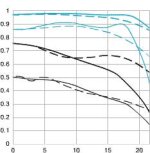
So the common MTF charts like the one below keep line pairs/mm fixed at 30 (thick lines)while measuring MTF on a scale of 0-1 or 0-100% vs. distance from the center of the lens. They often include a curve for MTF10 or 10 line pairs/mm (thin lines) which is supposed to correspond to contrast. The attached chart also gives measurements for the lens wide open (black) and at f/8 (blue), as well as saggital (solid) and meridional (dotted) measurements. Given the tiny pixel sizes common in these days of increasing MP counts I guess the utility of these low LP/mm measurements is debatable even for APS and FF sensors. But I guess they may still be helpful in apples to apples comparisons.

For a similar chart to be relevant for Scarlet I guess you're saying you'd need a MTF chart with readings taken at 150 lp/mm or similar? And any lens capable of 30% MTF or more should look fine?

Also implied is that when people state a lens has xxx lp/mm of resolution they should also state the MTF in percent at which the lens achieved that measurement, and why that MTF is sufficient.

Thanks for making me think about this a bit more. Your meaning may have been obvious to a lot of people, but it wasn't to me. Hopefully I've answered my own dumb questions.

And yes, I realize there's no substitute for real-world shooting and esthetic judgements of the actual image captured. Just passing the time until we are able to capture and judge images, and trying to educate myself.
 

Attachments

  • 50-mtf.jpg
    50-mtf.jpg
    9.5 KB · Views: 0
To put it in perspective, Fuji rates their top of the line B4 2/3" HD digi-primes at 80% MTF at 56 lp/mm.
 
measured or calculated

measured or calculated

56lp/mm at 80% is quite good for a 2/3" lens, but those are made for a three chip prism camera?

But with the image 1620 lines and the sensor about 5mm high, 56lp/mm is only about 100x5=500 lines, or SD. How qhick the MTF goes bad above SD resolution varies depending on the lens design, which is why I said it should be about 150lp/mm (line pairs per mm) at 30% MTF to get a real contrast of detail at the 1620 lines per image height. The 1620 is reduced to 1080, and so the contrast of detail at that lower lines count would be higher than 30% maybe (like the 50% you had in mind), depending on the setting of the OLPF compensation sharpen in the de-Bayer software.

Also you need to find out if the MTF curve is from the lens design software, or a measured result of a production lens.

Back when ILM was using film, they designed a "super" vista-vision to anamorphic 35mm scope printing lens they were "shocked" when they got the sample back and tested it and it was only like 60% as sharp as their computer plots said it should be.

In small lenses the element centering is much harder because the mechanical tolerances are smaller in ratio to the shorter focal lengths. When you are talking of centering the lens elements to +/- 2 micron, its almost impossable, which is why extra manual twiddling of the elements may be needed, and adds cost to very good lenses.

If you see a claim of resolution from a computer graph made of some ideal design program, the actual lens will never be as good, the best you can maybe expect from a production lens might be 60% to 30% at higher resolutions if you do lab measurments of a set of random samples pulled from a store shielf. Maybe the good brands screen their lenses better, and so trash half their production and charge twice as much, you cannot know that since that is an internal issue. That was one of the things that got Zeiss/SCHOTT in business, was trying to get more consistent optical glass, since you cannot re-compute each lens to match the index of each piece of optical glass used, and when you don't the lens will not match the target specs.

So watch out for "computer simulations" and look at the results, since the way a lens handles internal reflections and out of focus parts of the image do not show up on charts, and those are what make the difference between a sharp lens and a great cinema lens.
 
Jorge Diaz Amador sold a used Angenieux 12-120 on his Cinematechnic website that he said measured 200lp/mm center at f4 on his lens projector. No mention of MTF. Most older Angies would be relatively low contrast lenses and soft by reputation when wide open. MTF is as much a measure of contrast as resolution.
There is not much question that lens performance will likely be the limiting factor on Scarlet's resolving power under most conditions rather than the sensor /OLPF combination. But that is the way you want it to be if you want a smooth film like image.
Most broadcast HD video actually falls in the 400 line pair vertical resolution range anyway or around 800 TV lines.
 
For example, Nikon's MTFs are computer simulations. Even the lowly Cosina-made Zeiss SLR (ZF, ZE) MTF curves are measured. Others, I don't know.
 
It is going to be very interesting to see how some of these vintage 16mm lenses perform on Scarlet.
From the examples of C-mount lenses used on Lumix M4/3 cameras some of them will do very well.

5362338623_dbd5420ef6_o.jpg


This is a Carl Zeiss Jena Tevidon 25mm f1.4
 
Very nice, David. I like the feel of that...vintage glass always imparts a very subtle shift in the way images look. Maybe its the way they focus...

And now I have a strange yearning for takoyaki...what have you done?
 
image area

image area

It is going to be very interesting to see how some of these vintage 16mm lenses perform on Scarlet.
From the examples of C-mount lenses used on Lumix M4/3 cameras some of them will do very well.

This is a Carl Zeiss Jena Tevidon 25mm f1.4

What f/ stop was that image taken at?

4/3 is not a good example though of the much smaller sensor area used in Scarlet for 16:9 images, its like a 220% optical zoom maybe, so you need to crop the scarlet image area out and look at the 2880x1620 image to see what the minimum line with will be.

Also here the image is not shown 2880 wide, so you would need to crop like 400% to 600% to have the pixels 1:1 on the screen equal to the Scarlet 16:9 pixel size.
 
Well I have decided I dont know enough about what lenses would work with scarlet to make an investement . I agree with those that encourage mini primes entering market at same time as scarlet cinema. On this weeks RC podcast they talked about the importance of using lenses built for you sensor . I will have to wait for people who can afford to experiment with the various 16mm / super 16mm lenses and then have a verified list of lenses that work well.
 
My plan is to get a set of mini primes, if they live up to my expectations. That way I can rent Zeiss Ultra Primes if I need something better for a larger project.
 
4/3 is not a good example though of the much smaller sensor area used in Scarlet for 16:9 images, its like a 220% optical zoom maybe, so you need to crop the scarlet image area out and look at the 2880x1620 image to see what the minimum line with will be.

Also here the image is not shown 2880 wide, so you would need to crop like 400% to 600% to have the pixels 1:1 on the screen equal to the Scarlet 16:9 pixel size.

I'm not really following what you're saying. What does it matter if the image is overall a different size or shape than the Scarlet 2/3" image?

What's relevant for comparing lens resolving power is pixel density. Scarlet 2/3" is ~9.2 MP/cm2 and a GH2, just to pick a random 4/3" example, is ~6.9 MP/cm2, so I'd say that's close enough to give a fairly decent idea.
 
Back
Top