Welcome to our community

Be a part of something great, join today!

  • Hey all, just changed over the backend after 15 years I figured time to give it a bit of an update, its probably gonna be a bit weird for most of you and i am sure there is a few bugs to work out but it should kinda work the same as before... hopefully :)

Lens Math, help me understand....

Rick Burnett

Well-known member
Joined
Jan 20, 2009
Messages
896
Reaction score
0
Points
0
I look at all this numbers for lenses and I know that with different settings and distance to your subject, the same images can be obtained on difference sensor sizes (with some difference in how spread apart the objects look).

I am trying to wrap my brain around 2 questions. I use a 30mm lens on an APS-C sized sensor currently. At night I run this at F1.4. I imagine this is around 12mm for the Scarlet fixed. I would have to go with the 16mm if I go with the prime lenses for the cinema

(1) If I was using the Fixed, if I understand correctly, I would need to move backwards and use a longer focal length to achieve a shallower DoF. How do I calculate how far back to go to get the equivalent DoF as I would with the 30mm at F1.4 (Assuming fixed is F2.4 max and constant throughout all focal lengths of the fixed)

(2) If I went with the cinema and the 16mm, how far forward would I have to move and would that same shallow DoF be possible? I'm not sure what the F value is with these at a T1.5.

I've never worked with 2/3 size so I am just really out of my league as to what to expect. I was all set to want the fixed but now I am worried about shooting the Fixed at night given how much faster the primes are. I really don't want to lose the electronic abilities of the fixed either so I am undecided.

Given these sensors are SO MUCH more sensitive than what I am used to, it's hard to imagine how they will act at night with the fixed.

Any help would be greatly appreciated.
 
I wouldn't worry much about shooting at night. I have seen some footage from the MX on the R1 at 3600 with some light noise reduction and it looks pristine. The constant T2.6 of the Fixed lens is roughly a 5.6 on S35 size sensor (David Rasberry, correct me if I am wrong about that), which makes the Primes roughly 2 stops faster and thus 2x more able to give you shallower DOF at a wider focal range.
That said, if I had the $$, I would go Cinema in a heartbeat, but I don't and so I am quite looking forward to the challenges of the Fixed. It'll be my pleasure to make people have an O-face when they see the footage I am able to squeeze out of it. ;)

Anyhow, you should still have a bunch of lights for your night stuff anyhow...
 
The constant T2.6 of the Fixed lens is roughly a 5.6 on S35 size sensor (David Rasberry, correct me if I am wrong about that), which makes the Primes roughly 2 stops faster and thus 2x more able to give you shallower DOF at a wider focal range.

If you are trying to replicate similar DOF on the 2/3" Scarlet compared to an S35 camera, a good starting point is to know that you can achieve approximately the same DOF by opening up 2 to 2.5 stops. Two issues with this though... First of all, you probably will not be picking focal lengths just for the DOF you can create. You have to use a wider focal length on the 2/3" in most cases, otherwise you have to move back from the subject, to achieve the same framing as you would expect from S35. The wider focal length will give deeper DOF, which will cancel out the shallow DOF effect of the larger aperture. The other issue with the stop difference, assuming you can cope with the focal length issue, is that you will often not have 2 or more stops of freedom on the smaller lens. And if you do, shooting T1.5 or whatever, often has its own challenges. Lots of people get excited over fast lenses, so do I in many situations, but I spend far more time shooting at T3-T5 than I do shooting at T2 and faster, even when I have that option. It is just nice to have the option for those times you need it, and more often than not, it's more about the light than the DOF.

You also have to remember that DOF is a property of the lens or optical system and not the sensor size. The sensor or imager size only determines the field of view. So technically, if you use a 25mm lens on S35 at T2, and then do the same on a 2/3" sensor, you get the exact same DOF. However, since your FOV has changed drastically on the 2/3", you are forced to move to re-frame your shot, thus affecting how you perceive DOF in relation to your subject. Or you must then change the focal length to maintain the same set-up and framing. So by swapping out the 25mm for something like an 8mm, you drastically increase your DOF and will need to open the aperture to compensate.

Personally, I don't think this is a big deal. There are lots of great films shot with deep DOF and lots of great films shot on 16mm and 2/3" sized formats. Extreme shallow DOF is only one tool in a filmmaker's toolbox. It's often over-used and when I see lots of shallow-DOF, my first impression is I'm watching the work of a budding film student who has been deprived of 35mm photography in their youth or someone who just picked up a 35mm lens adapter for their HDV camera.
 
Last edited:
Just to clarify. The DOF on a 50, and a 15 is exactly the same if the shot is framed the same. The only things that affect depth of field are aperture and image magnification. Backing up and putting on a longer lens will change the angle of view but not the DOF.

Nick
 
Given my inexperience with any other sensor sizes/smaller lenses, where I am going with all this is just standard dialog shots, over the shoulder. I really like having a shallow DoF on these shots. For almost everything else, I tend to just use a deeper focus. I just didn't know what to expect or what would be possible.

Once again I am stuck at Fixed/Cinema ? :) Haha. At least it keeps me busy thinking about it!
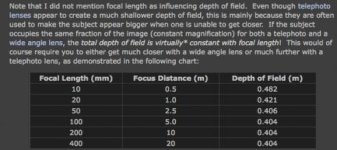
 
If shallow dof in a dialogue scene is what you are after, I suggest the scarlet 2/3 interchangeable. At T1.5, the lenses are very fast and if you open all the way and expose properly with ND's, you can get pretty shallow dof. All these 7d and 5D videos are way too shallow for my liking so in 2/3 format, your background, while not so blurred out that you can not tell what is going on, will be shallow enough to get the cinema look and draw attention to the actors. As has been stated multiple times on this forum, 2/3 is more than sufficient to get the shallow dof look, you just have to know how to use your lenses and filters.
 
As has been stated multiple times on this forum, 2/3 is more than sufficient to get the shallow dof look, you just have to know how to use your lenses and filters.

Haha, well that is the point of this post! :) I'm trying to close that knowledge gap. And I certainly agree, I can get some crazy shallow DoF right now that I don't like either.

Where I am, I don't think I will have any option of testing a 2/3 of both varieties to know which one I want. So instead, if I wrap my head around the mathematics of it, I'm hoping to be able to theoretically understand what I am getting. In this case, I don't know how to use the lenses right (but I do understand of course ND filtering and such). I mean ND filtering gets rid of aliasing right?!? (And that is a JOKE! :) So don't take that line seriously)
 
You could always rent both and see which one suits your needs. Since the accessories are interchangeable, you can keep the rental cost down.
 
That is a good point. Of course, I believe the 2/3 Fixed is a great value and even if I got it and decided I wanted the Cinema instead, the aftermarket would be great for it (and probably a better deal if I used it for awhile instead of renting).

The other factor for me is I do plan on adding the S35 brain in the future, so all along I've been wanting the fixed and the S35. I still may just end up going this route, as the big thing I want on the 2/3 is the frame rate.

I'm thinking I should just stick to my original plan of the Fixed. Who knows, maybe my projects will actually return enough to get the EPIC :)
 
Just to clarify. The DOF on a 50, and a 15 is exactly the same if the shot is framed the same. The only things that affect depth of field are aperture and image magnification. Backing up and putting on a longer lens will change the angle of view but not the DOF.

Not true, although in actual practice, it's not too far off when considering images shot at different focal lengths on the same image format with the same Circle of Confusion. I'll get to that in a minute. Focal length and focal distance are both factors in DOF. By framing a shot the same between two focal lengths, moving in much closer with the wider lens, this has a shallowing effect on the DOF, which offsets the deepening effect of the shorter focal length.

A 50mm lens with a subject focal distance of 20ft at an aperture of F2 will have a DOF of approximately 5ft.

A 15mm lens at F2 with a subject focal distance of 6.5ft, or very close to what is needed to achieve the same framing, will have a DOF of approximately 7ft.

This is assuming a CoC of 0.025mm for both calculations and we're talking about the same sensor or imager.

If we're talking about a comparison between S35 and 2/3" imagers, then you are basically getting the same framing at 15mm on the 2/3" as you would with a 50mm lens on S35. Which means your subject focal distance in this example would remain at 20ft. In this situation, noticeable shallow DOF of any kind will be difficult to achieve because your subject is probably beyond the hyperfocal distance and focus is infinite. However, assuming hyperfocal is not infinite, which once again depends on optical design and other factors, the hyperfocal could fall anywhere from about 14ft to 30ft. But your DOF in this situation is going to be anywhere from about 70 to 100 feet or more.
 
Also for comparison, if you're working in close to your subject at a distance of 4 feet. A 50mm on S35 at F2 would give about 3" of DOF. A 15mm on 2/3" at F2 would give about 18"

You could close down the aperture on the S35 lens 2 to 3 stops to compensate, but at this range, it would be hard to equalize the two.

The 16mm mini prime on the Scarlet 2/3" will probably give about 7" to 9" of DOF when shot at T1.5 at a subject distance of 4ft. ...Just sayin.
 
Is there a calculator application for all this? And is there some sort of general reference of CoC that I could estimate for the Scarlet 2/3 sensor?
 
I'm not trying to get into an argument, there is simply a lot of disinformation about this subject. Every book on lenses and optical design I own or have ever read says this
 

Attachments

  • Picture 1.jpg
    Picture 1.jpg
    22.6 KB · Views: 0
(1) If I was using the Fixed, if I understand correctly, I would need to move backwards and use a longer focal length to achieve a shallower DoF.

Moving backwards and using a longer focal length does not give you shallower DoF. It gives you more background blur (usually, but not always).

How do I calculate how far back to go to get the equivalent DoF as I would with the 30mm at F1.4 (Assuming fixed is F2.4 max and constant throughout all focal lengths of the fixed)

The calculation for DOF is very simple, but if you were given that, it would not answer your question, becuase what you actually want is "background blur". That is far more difficult to calculate, and cannot be generalized for all subject and subject-to-background distances. In other words, the answer would be different for an ECU in a small room than it would for a group shot exterior with backgrounds at infinity.

The best I can do is suggest that you play around with Bob Atkins background blur calculator:

http://www.bobatkins.com/photography/technical/bokeh_background_blur.html
 
Very true. I wasn't taking into account the subject to background difference. Unfortunately, I am OSX only and his program looks to be windows only (Visual Basic).

Someone should create a nice openGL lens/sensor simulator! :) I searched but found nothing.
 
I'm not trying to get into an argument, there is simply a lot of disinformation about this subject. Every book on lenses and optical design I own or have ever read says this

I have seen a lot of publications with numbers like this. And I have seen several that also differ from this. What it really comes down to is the mathematical approach used. When DOF values are considered without taking CoC into account, as they often are, then the chart you have posted works. Other properties of an optical system such as the resolving power of the lens can also play a role and I have rarely seen any DOF calculations that take that into account.

If more finite calculations with CoC values are considered, the math shows otherwise from the chart you have posted here. Or at least the most commonly accepted mathematical approaches within the industry do. As in the ones referenced in the ASC manual, which are the same as the ones on wikipedia. My calculations above used a CoC value of 0.025mm.

And here we could get into a lengthy discussion on determining proper values for Circle of Confusion and how much influence it truly has. There are many variations to calculating DOF and many factors that determine true DOF in the real world that can not be accounted for with general calculations. Individual lens designs as well as optical system designs vary and simplistic formulas of what usable DOF exists at what focal length and which focal distance are nothing more than a generalize reference.

Add to this that DOF is still highly perceptual and differs with delivery format, resolution and size in relation to the FOV of the person viewing it.

What Daniel says above about background blur (or bokeh as it's often called), is true. that is what most people are after and it's not the same thing as shallow DOF, but can not exist without limited DOF. Stronger background blur is often desired for "shallow DOF" applications and stronger blur will typically maintain or even increase the perception of a shallow DOF as final delivery or viewing sizes decrease.

FWIW, since Rick brought it up, I'm doing a software calculator for all this stuff, and other camera related things, for the iPad. I have been thinking of doing a DOF/bokeh simulator as part of it, but I'm having trouble getting time to finish up the simple stuff, let alone anything on the complexity level of an optically accurate rendering system...
 
FWIW, since Rick brought it up, I'm doing a software calculator for all this stuff, and other camera related things, for the iPad. I have been thinking of doing a DOF/bokeh simulator as part of it, but I'm having trouble getting time to finish up the simple stuff, let alone anything on the complexity level of an optically accurate rendering system...

That would be excellent. Are you doing a scaled down version maybe for the iPod? A nice pocket reference would be great. I use DOFMaster, but I am not 100% happy with it. The camera reference is out of date big time.

I too am a iPhone developer, I have one app in the app store right now. This of course means I am not going to bother starting an app. Although I did consider using the OpenGL API to do something, as you have mentioned, there are A LOT of factors involved with different sensors, lenses, etc and I don't have the resources or the expertise to properly design a simulation environment that would approximate even closely.

Let me know if you need a beta tester :)
 
Quick question for you iPad developers. I just bought the iPad Saturday and reading Reduser is fine but the images on Reduser won't pop up. Any explanation or solution?

And more on topic I'm interested in red related iPad products.
 
Don't have an iPad yet (you don't need one to develop, they have an iPad simulator) so I don't know. That is strange though!
 
There are plenty of DOF calculators out there on the internet. DOFMaster Online is for one: http://www.dofmaster.com/dofjs.html.

The Scarlet 2/3" is of similar width to 16mm than SD Video 2/3" sensors. 10.1mm vs. 9.6mm. So, selecting 16mm will give you a good idea. (Note: Super 16 is slightly further away at 11.8mm). Though of course as someone pointed out, background blur is a different thing altogether.

This simple Excel sheet can be immensely helpful too: http://www.cinematography.net/Files/ASPECT in 5.0.xls. Basically, you can work out the focal lengths for equivalent fields of view in different formats. Scarlet 2/3" is 10.1 mm width to the best of available info.

For the same depth of field at the same field of view, I am guessing the f-stop difference between APS-C and 2/3" is likely to be around 2 1/2 stops. A shallow depth of field without looking overly dreamy is definitely possible. On the plus side, shooting in night becomes easier as you have a deeper focus to work with.
 
Back
Top