Welcome to our community

Be a part of something great, join today!

  • Hey all, just changed over the backend after 15 years I figured time to give it a bit of an update, its probably gonna be a bit weird for most of you and i am sure there is a few bugs to work out but it should kinda work the same as before... hopefully :)

LED lighting for interviews...thoughts?

James B.

Well-known member
Joined
Mar 20, 2011
Messages
167
Reaction score
0
Points
0
Hi
Recently invested in a basic LED kit, a 500 LED and a couple of Z96's for a portable interview kit. I've read countless posts elsewhere that warn against using LED's when you need accurate flesh tones. These posts are usually quite lengthy and are accompanied by impressive charts and graphs showing the spectral distribution of white LED's and their deficiencies.
But in my personal tests using custom balances off a grey card, I've obtained results that I find quite pleasing. But I'm no expert and haven't done any comparison testing.
Is it possible to obtain results with LED's that are not only pleasing, but indistinguishable from those obtained using traditional tungsten lighting? I'm referring mostly to the reproduction of flesh tones but other qualities, such as light fall off, etc play a factor.

Or is it inevitable that all my LED shots will scream 'taken with LED's'?
 
I would say it depends on your work mostly. For years I shot interviews for TV shows with a fresnel Arri kit and it worked nicely when we had power. In the last 5 years, I've usually opted for battery powered LED lights like Lite Panels, Cool Lights, or Flo Lights for most my TV work. The speedy set up, light wieght, and battery power option out weighs the benifits of light quality for me in this case. We are sometimes shooting 3 or 4 interviews and B-roll in separate locations all in one day. So, time is of the essence. It may scream LED lights to other cinematographers, but I am confident the average viewer is unaffected by the difference. If you are happy with the results, than I think you made a wise choice. Good luck!
 
I've been using my lightpanel 1'x1' since its release 5 or 6 years ago as a easily placed and adjusted eye light. It does need gelling to get it to a color matched 3200 or 5600, but what doesn't really? Used sparingly in this capacity, it is never obtrusive. I've never fully lit interviews with just the LED though. Usually I combine it with some form of soft key (softbox, keno, etc), and it just softens the wrap to taste. I doubt that you have made a mistake though. The tech continues to improve. There are major newsroom studios lit only by LEDs.
 
I first used poor tungsten PAR, then kino, then PAR LED, and today Led + JokerBug. Tungsten PAR are too hot, your subject sweat too much. The kino's are too flat. The Led are intersting because of the battery power option and the quality of light : something betwenn the kino and fresnels.
When I have enough time, i like to use Joker's (chimera, or par, or fresnel, or very hard light, as you want), but I always have 2 PAR LEd with me for, at least, the fill lignt.
 
We have been using Litepanels daylight 1x1s to shoot interviews for the last three years and the crews, the clients and the talent have been extremely happy with the results.
For 6 years before that it was HMI joker 400s with chimeras and 5 years before that it was Kinos. We would not even think of going back to the HMI or Kinos.

Used indoors with the RED ONE MX Litepanels are a great match. The RED ONE MX is so sensitive that the amount of light from Litepanels is plenty for an interview. Our Joker 400s put out way too much light for a shallow depth of field interview setup. The Jokers need to be NDed to be used in an interview setup with a RED MX, unless you are going for a deep focus look or are shooting outside.

The crews like it because the lights are lightweight easy to rig and easy to power always cool and very portable when traveling and can be checked as excess baggage.

The DPs like them because they are a soft source for interviews and the Bi-Focus panels dim with out changing color temp and adjust from flood to spot. It is great to set the depth of field for what the DP wants and quickly dial in that light levels to provide the amount of illumination needed. The new Litepanels have DMX control of both Level and Focus. We use a DMX to Wi-Fi adapter and control the Lights from an Ipad. DPs enjoy sitting in front of a big monitor and using the Ipad to adjust for the look they want. The ring lights work great for eye lights and backlights and also allow for quick adjustment of light levels The panels are lightweight and we often use Matthews Max or Mini max stand to support the lights which get the stands well outside the shots. Litepanels also have Fresnel’s for when the gaffer prefers them. The only thing missing is a good LED focal spot for task like breakup gobos on the background. For that we use the Jokers with the Bug-A-Beam adapter on a Source 4.

The talent likes them because they are cool and most say less blinding then other lights.

The clients are happy with the results. When shooting RAW on the RED we find that there are No problems getting the colors and look we want when grading in REDCINE or Storm. Of course Resolve and Color with secondary’s can provide even more control if needed.
 
The new Coollight PAR LED 1200 bi color are quite large, powerful, very light and inexpensive.
The battery option is not yet available but will be.
 
Hi
Recently invested in a basic LED kit, a 500 LED and a couple of Z96's for a portable interview kit. I've read countless posts elsewhere that warn against using LED's when you need accurate flesh tones... But in my personal tests using custom balances off a grey card, I've obtained results that I find quite pleasing. But I'm no expert and haven't done any comparison testing. Is it possible to obtain results with LED's that are not only pleasing, but indistinguishable from those obtained using traditional tungsten lighting? I'm referring mostly to the reproduction of flesh tones but other qualities, such as light fall off, etc play a factor.


The color rendering capability of Phospher White LEDs, like Z96s or Litepanel 1x1s, are adequate in the situations described here. When used as the only light source in interview setups their off color can be compensated for to an acceptable degree in the camera. However, a Phosphor White LED is clearly not the best choice in applications where color rendition is critical (food/product shots) or mixed with a uniform continuous light source, such as a studio lit with tungsten fixtures, where its color deficiencies will be quite noticeable and unacceptable by comparison.

As you can see from the spectral power distribution graphs of LEDs below, the spectral distribution of even high CRI Phospher White LEDs, like the Litepanels, are less than optimum for applications where accurate color reproduction is critical.

LED_Comp_Sprectrum.jpg

A spectral power distribution of a lamp indicates how much energy is present in each part of the spectrum. Natural sunlight and incandescent lamps have a continuous spectrum. Given how they produce white light, even high CRI Phosphor White LEDS have a discontinuous spectral quality that is unlike that of natural daylight, HMI, or incandescent light. In the case of the 3200K Phosphor White LEDs above, the phosphors added shape the spectral distribution by enhancing certain colors in the spectrum to simulate the spectral distribution of incandescent light. As a result, the spectral distribution of Phosphor White LEDs resembles a series of peaks and valleys.There is a big spike at about 465nm (the blue LED) and a broader bump between 500 and 700nm produced by the phosphors. Even though the spectral power distribution has these peaks and valleys, the human eye perceives the light as white light.

While the discontinuous spectral distribution of high CRI Phosphor White LEDS may appear white to the eye, and the color of objects illuminated by it appear natural to the eye, to film emulsions and digital imaging systems designed to reproduce accurate color under continuous spectrum light sources (like daylight or incandescent lamps), the color of the same objects will appear unnatural on screen as the illustrations below make clear. That is, the hue of an object being illuminated by this "white light" can be drastically different than expected when it appears on the screen. For example, below is a "Macbeth chart" contrasting the resulting effect upon different color swatches of studio tungsten light and a representative high CRI Phosphor White LED lighting instrument.

LED_Macbeth_Tungsten-WhPhos.jpg

Split Macbeth chart: each color patch shows the visible effects of studio tungsten light in the top half of the patch, and a representative Phosphor White LED lighting instrument in the bottom half. ​

A common test chart used for assessing color performance of motion picture imaging systems, the chart above would be more accurately called a "split Macbeth chart" because each color patch shows the visible effects of the two light sources – studio tungsten in the top half of the patch, and the Phosphor White LED instrument in the bottom half. Although your computer display is not likely to be a calibrated reference monitor, the wide variations in color patch hue caused by the discontinuous spectral distribution of the Phosphor White LED should be readily apparent.

What accounts for these results? First, as you can see from its' spectral power distribution above, Phosphor White LEDS, compared to continuous light sources, have no output at wavelengths shorter than about 425nm, which means that violet colors don't render well. Second, there is minimal output in the medium blue-cyan-turquoise range from about 465-510nm, which is why the aqua-type colors don't render well either. Lacking these complementary colors within the spectrum, skin tones and warm, amber-yellow colors don't stand out. Third, with the long-wavelengths cutoff in the high-600 nm range, pinks, reds, oranges, and other long wave-length colors tend to look a little dull under Phosphor White LEDs, compared with how they look under continuous spectrum light sources (daylight, HMI, Tungsten) which extend all the way out on the long-wavelength end. Finally, as you can see from the gray scale at the bottom, this particular Phosphor White LED Luminary has an overall magenta bias. While you can white balance out/time out this magenta bias in digital video cameras/digital film intermediate, the camera/timer is not able to replace the parts of the spectrum that are missing all together. And since gels only rebalance the spectral distribution of a light source by passing the wavelength of the color that they are, gels cannot correct for these deficiencies because there is not much light of those wavelengths to pass in Phosphor White LEDs to begin with.

LED_Model_Comp.jpg

Left: Tungsten source, Right: White Phosphor LED source.​

This inability of Phosphor White LEDs to render color accurately is very visible in tests recently performed by The Academy of Motion Picture Arts and Sciences (AMPAS) as part of their “Solid State Lighting Project Technical Assessment.” (see http://www.screenlightandgrip.com/html/emailnewsletter_generators.html#anchorHigh Output AC LEDs for details.) In one (above) a model was photographed wearing a dress that had a number of different blue tints. Footage was shot with both a true tungsten source and a White Phosphor LED source. The tungsten-lit footage displayed all of the subtle differences in blue tones in the fabric, while the LED-lit footage, lacking cyan output, showed just a nice blue dress, without the same richness of hue. You can also see above that, absent cyan, the skin tones don’t stand out because that complementary color (cyan) within the spectrum is not present. Since the light doesn’t put out much cyan, the camera/film simply can’t record it. And, as Cinematographer Daryn Okada, ASC, discovered the hard way, color gel packs, camera white balance, or digital intermediate timing can’t bring it out if it isn’t there to begin with.

Like many of us, Daryn Okada uses LEDs as “touch up” lights to add a little something where key lights don’t cover. Needing to touch up a face on one talent mark, he once hid a small LED unit behind a chair, to add some glow to an actress’s face when she reached a mark where the keys had fallen off. “The manufacturer claimed the unit to be a ‘tungsten LED source,’” he recounts. “She stopped right in the doorway, where I had this LED, and looked fine. But when I got the dailies back, her face was totally magenta.” What’s worse, Okada says the image could not be repaired in post, because there wasn’t enough of the right color of light in the scanned negative for a color timer to bring out. This is a good example of the fact that, the bottom line is that, simply by nature of their discontinuous spectral distribution, even high CRI Phosphor White LEDs will never accurately reproduce colors on screen regardless what can be done in post. To make matters worse, common color meters, like the Minolta III F, are completely useless with LEDs in determining what gels to use. The meter makes its calculation of the color temperature based on an assumption that the light source has a continuous spectrum. Color readings of an LED have been shown to be misleading for both correlated color temperature and green/magenta shift.

I doubt that you have made a mistake though. The tech continues to improve. There are major newsroom studios lit only by LEDs.

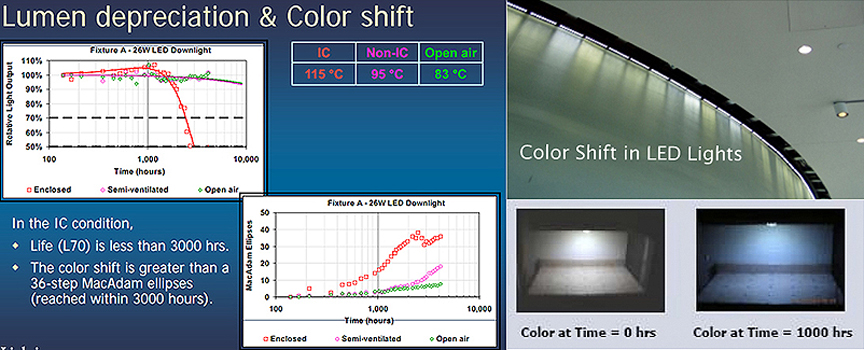
Another drawback to White Phosphor LEDs that broadcast studios lit exclusively with them are finding out is that, as illustrated below, their output depreciates overtime and their color shifts much faster than the manufacturers say.

LED_Lumen-Color_Shift_A.jpg

You have to be wary of all the claims made by head manufacturers. Whenever a new lighting technology comes on the market, the manufacturers put a little spin on the scientific data which has a tendency to cloud issues. For this reason, to pick the right LED luminary for a particular job it helps to have a thorough understanding of the technology. For our company newsletter I have put together an overview of the technology and what LED products are available for motion picture lighting (available at http://www.screenlightandgrip.com/html/emailnewsletter_generators.html#anchorHigh Output AC LEDs.)

Guy Holt, Gaffer, ScreenLight & Grip, Lighting Rental and Sales in Boston.
 
I use minus green gel and it rids my 1x1 of the dreaded 'green spike'. I agree with Clint, most people won't know the difference.


It is a common mistake to think that a custom camera white balance or gel can correct for the deficiencies of LEDs in all situations. Take Daryn Okada’s situation I gave as an example above. Had Daryn Okada been shooting with a digital video camera, he would have noticed the off color of the LED source immediately. But, given the limited spectral output of Phosphor White LEDs, his ability to remedy the problem would have been limited. If he white balanced the camera for the LED source, the background of the room beyond the doorway that was lit by tungsten lights would turn very green. In a mixed light situation such as this, the only alternative is to match the LED source to the prevalent tungsten source with a custom gel pack on the LED head. But, since gels rebalance the spectral distribution of a light source by passing the wavelength of the color that they are, gels cannot completely correct for these deficiencies either because there is not light of some wavelengths to pass in White Phosphor LEDs to begin with. In other words, White Phosphor LEDS are so deficit in certain parts of the color spectrum that by the time you came up with a color gel pack to match them to a continuous light source like a tungsten light, the LED panel would put out very little light with all those gels on it.

LED_Comp_Sprectrum.jpg

To understand why this is so, we need only look at a similar situation: the conversion of tungsten light to daylight using full CTB gel. As you can see in the Spectral Power Distribution graph of tungsten light above, tungsten light is so deficient in the blue part of the spectrum that it takes a quite saturated blue gel to balance it to daylight. In fact, the transmission coefficient of full CTB gel is only 36%, which means that it passes only 36% of the source. That is why gelling tungsten lights is a very inefficient way to create a daylight source (a tungsten 1000w gelled with CTB becomes a 350W daylight source.)

As you can see from the Spectral Power Distribution graph of the White Phosphor LED light above left, a gel pack that would match it to tungsten light would have to include a violet gel to extend its’ spectral output below 425nm. It would have to include medium blue, cyan, and turquoise gels to fill in the missing wavelength from 465-510nm. Finally it would have to include pink, red, and orange gels to extend its’ spectral output beyond its’ 600nm cut-off. All of these gels would have to be quite saturated, since there is very little, if any, output of these wavelengths in White Phosphor LEDs to begin with. Imagine how much light you will get out of a LED light panel with such a gel pack (LED light panels put out barely enough to begin with, and have no output to waste to such accurate color correction.) Since, under most circumstances it is simply not feasible to completely match LED sources to tungsten sources with a gel pack, in mixed light situations such as the one being discussed here you are left, without recourse, with the off color generated by Phosphor White LED.

LED_Model_Comp.jpg

Left: Tungsten source, Right: White Phosphor LED source.​

If the actress in Daryn Okada’s shot were the model in the Blue/Cyan dress above, you can imagine what would happen when she stepped onto the mark lit with the LED source by looking closely at the contrasting photos above. Since, under the circumstances, Daryn Okada could not white balance for the LED source, and it would not be feasible to match the LED source with a gel pack, the rich Blue/Cyan Hue of her dress in the left photo would turn into the simple blue of the right photo. The vibrant skin tone of the left photo would turn into the flat skin tone of the right photo, and have an overall magenta cast to boot. This example clearly demonstrates that, the bottom line is that, Phosphor White LEDs, simply by nature of their discontinuous spectral distribution, can not accurately reproduce colors on screen under all circumstances.

While they are less than perfect at reproducing parts of the color spectrum, the color rendering capabilities of Phosphor White LEDs may be adequate in some situations: the isolated interview situations described above being one. Or, applications such as when lights must be operated off of batteries, the unique advantage of the greater power efficiency of LEDs over conventional lights, may out weigh their shortcomings in color rendering. However, a Phosphor White LED is clearly not the best choice in applications where color rendition is critical (food/product shots) or mixed with a uniform continuous light source, such as a studio lit with tungsten fixtures, where its color deficiencies will be quite noticeable and unacceptable by comparison. For this reason, to pick the right LED luminary for a particular job it helps to have a thorough understanding of the technology. For our company newsletter I have put together an overview of the technology and what products are available for motion picture lighting (available at http://www.screenlightandgrip.com/html/emailnewsletter_generators.html#anchorHigh Output AC LEDs.)

- Guy Holt, Gaffer, ScreenLight & Grip, Lighting Rental and Sales in Boston.
 
Yes I agree thanks Guy this was a very informative and a very interesting post, thanks also for the link to your newsletter.

Since the RED and EPIC CMOS sensors are balanced for day light it would be great to see a similar comparison shot at daylight which is what most RED users shoot.

It would also be nice if the sensor were actually white balanced to the white on the chart. Jim has shared a lot of great information on how critical it is to make sure the white balance is right in the world of colorimetry.

Of course the tungsten light will only be putting out 1/3 the light with Full CTO on it.
 
Many thanks Guy! Incredible post. Just took a look at your E-News Letter. It's amazing.
 
I have an LED interview kit that is light and can be run off batteries if need be and no one has ever said, "this looks bad."
Very pleasing light with no heat and very durable. I can dial in tungsten or daylight then white balance. If things need to be warmed
up, I have gels, problem solved.

I do bring some dedo lights for modeling of the background which you just can't do with a soft source.
 
ditto re 'Guy! Incredible post.'
Thanks for sharing. It does seem that LEP is far superior in terms of having a near continuous spectrum, but for those of us on limited budgets, and don't always have to color balance in mixed lighting scenarios, I think LED's are still an attractive option.
My total investment for a 500 LED and 2 z96's is under $500. Are the results as good as those if I had invested 5 to 10 times as much on a LEP setup? Probably not, but both the client and myself are pleased with the results.
I may invest in LEP's in the future if the prices come down, but for me at least, it's not an affordable option right now.
 
I don't like LEDs for several reasons, but the major one is that they are impossible to use with talent close to a wall without using significant diffusion (and there goes your light). I find the myriad shadows thrown by a Litepanel (each individual diode casts its own unique shadow) very distracting. In more "open room" settings, however, I doubt if this is ever much of an issue.

Stephen
 
Back
Top