
Navigation
Install the app
How to install the app on iOS
Follow along with the video below to see how to install our site as a web app on your home screen.

Note: this_feature_currently_requires_accessing_site_using_safari
More options
Welcome to our community
Be a part of something great, join today!
You are using an out of date browser. It may not display this or other websites correctly.
You should upgrade or use an alternative browser.
You should upgrade or use an alternative browser.
Joker Bug 400 and camping battery
- Thread starter Rob Ruffo
- Start date
- Moderator
- #2

Evin Grant
Moderator
- Joined
- Dec 28, 2006
- Messages
- 4,433
- Reaction score
- 0
- Points
- 36
- Location
- SoCal
- Website
- www.evingrantdp.com
Get a little Honda 1000W genie, trust me.
- Banned
- #3
Guy Bryan Holt
Banned
- Joined
- Sep 20, 2009
- Messages
- 149
- Reaction score
- 0
- Points
- 0
Get a little Honda 1000W genie, trust me.
Sizing a portable generator for a lighting load can be very complicated when you use lights sources like HMIs, Kinos, CLF lamp banks, & even LEDs. On generators it matters not only what type of generator you use but also what type of ballasts the lights use. The poor Power Factor and Harmonic Noise that magnetic and non-Power Factor Corrected electronic ballasts (HMI, Kino, CFL, & LED incld.) kick back into the power stream can have a severe adverse effect on the power waveform of some generators, but not others. Since Power Factor is commonly overlooked in choosing generators, it is worth explaing in detail and how it effects Rob’s choices.
If we look at the technical specifications for the Joker 400, the electronic ballast that it uses has a Power Factor of .54. What that means is that it draws 6.2 Amps rather than the 3.3 Amps you would think using Ohm’s Law (W=VA.) The difference between the actual current drawn by the bulb, 6.2 Amps, and the 3.3 Amps a 400W bulb should draw using Ohm’s Law (W=VxA), is the difference between what is called “Apparent Power” and “True Power.”
If, in this case, you were to measure the actual current (using a Amp Meter) and voltage (using a Volt Meter) traveling through the cable supplying the Kobold EWB 400 ballast and multiply them according to Ohm’s Law (VxA= W) you would get the “apparent power” of the bulb (120V x 6.2A = 744W). But, if you were to instead, use a wattmeter to measure the actual amount of energy being converted into real work (light) by the ballast of the Kolbod 400SES you would get the “true power” of the bulb which in this case is specified by the manufacturer as 400W. The ratio of “true power” to “apparent power” is called the “Power Factor” of the light.
A favorite analogy electricians like to use to explain power factor is that if apparent power is a glass of beer, power factor is the foam that prevents you from filling the glass all the way up with beer. When lights with a low power factor are used, a generator must be sized to supply the apparent power (beer plus foam), even though only the true power (beer) counts. With a Power Factor of .54, you must take into account that the Joker 400 ballast draws nearly twice the power (744W) for it’s true power output of 400W.
The same is true when it comes to Kino Flos. According to Kino Flo’s website a 4’ – 4 bank fixture has an apparent power of 552W, or again draws nearly twice the power (a PFC of .54) for it’s true power output of 300W (4x 75W bulbs.) If you were to use both these lights on a Honda EU1000i, the total load 1292W (740W + 552W), would overload the generator because the continuous load rating of the Honda EU1000i, according to their website, is 900W.
The greater Apparent Power of Lights with a poor Power Factor is not the only consideration when choosing a generator for motion picture lighting applications. When you use lights sources like HMIs, Kinos, CLF lamp banks, and even LEDs, on generators it matters not only what type of ballasts the light uses, but also what type of generator you use to power it. The Harmonic Noise that ballasts with poor Power Factor kick back into the power stream can have a severe adverse effect on the power waveform of some generators. It all depends on whether the light ballasts are Power Factor Corrected (PFC) and whether the generator is an inverter generator or a conventional AVR generator. Unless they are Power Factor Corrected, the Switch Mode Power Supplies that HMI, Kino, CFL, & LEDs use can cause them to use not only excessive amounts of power for the wattage of light they generate, but also to kick harmonics back into the power stream that can have a severe adverse effect on not only the generator, but also other electronic equipment operating on the same power. There is a video on You-Tube by a Lighting Designer by the name of Kevan Shaw that illustrates just this.
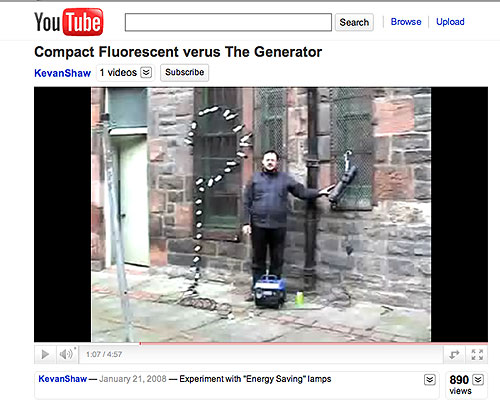
In his You-Tube Video, “Compact Fluorescent verses the generator,” (available at http://www.youtube.com/watch?v=LeCqreRMzKM) Kevan Shaw compares the effect of equal wattages of CFLs and Incandescent lights on a small portable generator. In his test, he first operates a 575W ETC Source Four Leko with Quartz Halogen bulb on an 850W two stroke conventional gas generator without problem. However, when he tries to operate an equivalent wattage of CFLs (30-18W bulbs) the generator goes berserk. Only after turning off half the CFL Bulbs does the generator operate normally with a remaining load of 15 - 18W CFLs (270 W.) What accounts for the erratic behavior of the generator in this video under a smaller load of CFLs? It is a combination of the poor Power Factor of the CFL bulbs and the harmonic currents they generate.
Even though the 15 CFL bulbs have a True Power of 270W (15 x 18W = 270W ), the Watt indicator on Kevan's generator indicates that they draw twice that in Apparent Power (535W), or have a Power Factor of .5 (270W/535W =.504.) The fact that CFL bulbs consume double the energy (Apparent Power) for the 18 Watts of light (True Power) they generate, is only half the story here. Kevan Shaw’s video also clearly demonstrates the severe effect that loads - like CFLs, HMIs, Kinos, & LEDS - with leading power factor can have on the governing systems of conventional AVR generators.
When Kevan turns off the 18W CFL bulbs one at a time until the generator stabilizes, he is not only demonstrating that 15 – 18W CFL bulbs has roughly the same Apparent Power (535W), according to the generator’s Watt meter, as a 575W incandescent light; but, also that the maximum Leading Power Factor load a 850W conventional generator can operate satisfactorily is 270 Watts (15 – 18W CFL bulbs). Looked at from another angle, 576 Watts of Apparent Power with a Leading Power Factor (16 - 18W CFL bulbs) overloaded the generator, while 575 Watts of Apparent Power with a Unity Power Factor (the 575W Quartz Leko) did not. What accounts for this difference? Since the load is almost the same (576 & 575 Watts of Apparent Power respectively), the only factor that can account for the generator going berserk with the equivalent load of CFL lights is the harmonic currents that they generate, that the Quartz Leko does not. Without a doubt, Kevan Shaw’s video is a clear demonstration of the adverse effect that harmonic currents have on the governing systems of conventional AVR generators.
For the same reason that Kevan Shaw was not able to operate more than 270 Watts of CFL bulbs (15–18W bulbs) on his little 850W generator, Rob may not be able to operate more than just his Joker 400 on a 1000W conventional AVR generator. The adverse effects of the harmonic currents that non-PFC ballasts generate, so graphically demonstrated in Kevan’s video, limits the total amount of Leading Power Factor loads, as compared to Unity Power Factor loads, that can be reliably operated on conventional AVR generators. These power generation issues have been vexing set electricians for years. Use this link for an informative newsletter article that explains the electrical engineering principles behind these issues and how to resolve them.

This article is cited in the just released 4th Edition of Harry Box's "Set Lighting Technician's Handbook" and featured on the companion website
"Box Book Extras." Of the article Harry Box exclaims:
"Great work!... this is the kind of thing I think very few technician's ever get to see, and as a result many people have absolutely no idea why things stop working."
"Following the prescriptions contained in this article enables the operation of bigger lights, or more smaller lights, on portable generators than has ever been possible before."
"Following the prescriptions contained in this article enables the operation of bigger lights, or more smaller lights, on portable generators than has ever been possible before."
The article is available online at http://www.screenlightandgrip.com/html/emailnewsletter_generators.html.
Guy Holt, Gaffer, ScreenLight & Grip, Lightng & Grip Rental and Sales in Boston
- Thread starter
- #4
- Thread starter
- #5
- Banned
- #7
Guy Bryan Holt
Banned
- Joined
- Sep 20, 2009
- Messages
- 149
- Reaction score
- 0
- Points
- 0
…. is it just the Honda brand, or any 1000w gas genny should be OK?
You don’t necessarily need to use the Honda EU2000, but you should definitely use an Inverter generator (Subaru, Yamaha, Onan also make them.) If you were using incandescent lights, you could use a home-depot type of AVR generator (AVR stands for Automatic Voltage Regulator.) But since you want to use a non Power Factor Corrected HMI like a Joker 400 it matters what type of generator you use. As graphically illustrated in Ken Shaw's You-Tube video above, the harmonic noise that the non-PFC electronic ballasts (both HMI & Kino) kick back into the power stream can have a severe adverse effect on the power waveform of conventional AVR generators like those available from Home Depot. The harmonic noise these light sources generate will not have nearly as bad an effect on the power supplied by an inverter generator like the Honda EU2000is.
As the middle oscilloscope shot below indicates, when you power a standard non-PFC HMI Electronic ballast from a conventional portable generators, the harmonic noise they kick back into the power stream can have a severe adverse effect on the power waveform of conventional AVR generators. Given the large sub-transient impedance of conventional portable generators, even a small degree of harmonic noise being fed back into the power stream will result in a large amount of distortion in its’ voltage. Add to that, the likely hood that the percentage of the generator’s capacity taken up by electronic HMI & Kino ballasts will to be very high given its small size relative to typical lighting packages, and given the increasing prevalence of these types of light sources in production. Finally, add that the original supply voltage waveform of a conventional generator is appreciably distorted to begin with (17-19% THD, see no-load oscilloscope shots above), and you have a situation where the return of any harmonic currents by an HMI ballast will result in significant waveform distortion of the voltage at the power bus as seen in the middle shot above.

Left: Grid Power w/ 1.2Kw Arri non-PFC Elec. Ballast. Center: Conventional AVR Power w/ 1.2Kw Arri non-PFC Elec. Ballast. Right: Inverter Power w/ 1.2Kw Arri non-PFC Elec. Ballast.
The adverse effects of the harmonic noise exhibited here, can take the form of overheating and failing equipment, circuit breaker trips, excessive current on the neutral wire, and instability of the generator’s voltage and frequency. It is for these reasons, that it has never been possible to reliably operate more than a couple of 1200W HMIs with electronic ballasts on a conventional 6500W portable gas generator. Harmonic noise of this magnitude can also damage HD digital cinema production equipment, create ground loops, and possibly create radio frequency (RF) interference.
In the past, attention was given to generator features such as automatic voltage regulation and crystal speed regulation. But, as the oscilloscope shot above of a standard electronic ballast on an inverter generator indicates, an increasingly more important feature today is the quality of the generated power waveform and how well it interacts with the lighting units predominantly used today. When your lighting package consists predominantly of non-linear light sources, like HMI and Fluorescent lights, it is essential to have Power Factor Correction circuitry (PFC) in the ballasts and to operate them on an inverter generator. The combination of improved power factor and the nearly pure power waveform (1-2 %THD) of the inverter generator creates clean stable set power (like that in the power waveform below right).

Left: Grid Power w/ 1.2Kw P-2-L PFC Elec. Ballast. Center: Conventional AVR Power w/ 1.2Kw P-2-L PFC Elec. Ballast. Right: Inverter Power w/ 1.2Kw P-2-L PFC Elec. Ballast.
Rob’s best bet would be to find a Joker 400 with a Power-2-Light or Power Gems PFC ballast and use an inverter generator like the Honda EU2000is. The Honda EU2000is will also generate less than half the noise of Home Depot type generators – making it easier to record clean audio tracks.
For more details on what type of generator to use with HMIs and fluorescent lights read the article I wrote for our company news letter on the use of portable generators in motion picture production. The article is available online at http://www.screenlightandgrip.com/html/emailnewsletter_generators.html.
Guy Holt, Gaffer, ScreenLight & Grip, Lightng & Grip Rental and Sales in Boston