Welcome to our community

Be a part of something great, join today!

  • Hey all, just changed over the backend after 15 years I figured time to give it a bit of an update, its probably gonna be a bit weird for most of you and i am sure there is a few bugs to work out but it should kinda work the same as before... hopefully :)

Inventors&Explorers Who Changed the World

Inventors&Explorers Who Changed the World

  • Galieo Galilei

    Votes: 7 9.7%
  • Leonardo Da Vinci

    Votes: 20 27.8%
  • Nikola Tesla

    Votes: 36 50.0%
  • Thomas Edison

    Votes: 11 15.3%
  • Alexander Graham Bell

    Votes: 2 2.8%

  • Total voters
    72

Denizhan Nacar

Well-known member
Joined
Sep 7, 2011
Messages
431
Reaction score
0
Points
0
Location
Planet Earth
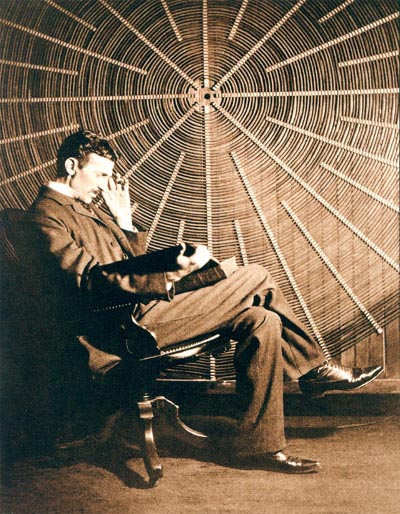
ntesla12.jpg
 
Last edited:
Shoe in for Leonardo Da Vinci in my opinion.

I feel though like a number of scientists should be included just because they laid so much groundwork for inventors to make practical. For instance without General Relativity we wouldn't have accurate GPS (alternately though you could have said that we would have very quickly discovered relativity if we ever tried to deploy and calibrate GPS).

On the opposite end of the scale I think the futurists like H.G. Wells, Arthur C Clarke and many others deserve recognition for inventing things and worlds before the technology was even there.

I think though that while all brilliant inventors, there is also an element of chance that is often forgotten in these discussions. What would Davinci be if he was born in Tesla's time and vice versa? There were many other brilliant contemporaries and everyone stands on the backs of giants. To glorify and deify our idols too much we risk elevating them beyond mortal achievement. There are lots of Leonardo Da Vincis alive and doing really amazing things today (the film industry is particularly full of them).
 
Don't forget about this one. Just look at the years!

Wardenclyffe Tower (1901–1917) also known as the Tesla Tower, was an early wireless telecommunications tower designed by Nikola Tesla and intended for commercial trans-Atlantic wireless telephony, broadcasting, and to demonstrate the transmission of power without interconnecting wires. The core facility was not completed due to financial problems and was never fully operational.

r2t2z6.jpg
 
Has to be Leonardo, one has to visit the Museum in Rome of of some of his work, reinstated and built in Wood as best they could, its just crazy... The rest of his theories proven correct, are just as insane!!

Not to mention the fact that he probably was one of the first to mention a process to "fix" images obtained via camera obscura on surfaces...i.e. photography
 
Socrates

Little bit of a departure from the normal thought of "Inventor".

But for me Socrates and his creation/invention of the Socratic method, and his exploring and contributions to the fields of epistemology and logic really fired a lot of thinkers to come after.

He really questioned the status quo of thought, better then anybody up until that time, and paid the ultimate price for it with his murder/suicide.

He really invented a form of disciplined debate that was revolutionary.

side credit to Plato for writing and archiving it all.
 
Denizhan,

absolutely, but I see Epic of Gilgamesh as a sort of awakening to the edges of the existential conundrum; and the beginning of study of the sometimes absurdity of it all. These were the tools of basic thought that the later Greeks would fashion into whole sets of conventions of self, ego ID etc.

For me I feel like Socrates invented the act of stripping away all narratives (religion mythology etc.) and looking at self an inner self and asking profound questions. Sort of screaming into the dark abyss with "the" questions, only to be answered with a riposte of an echo.

I believe this relentless questioning of himself, then conventions around him (station, wealth and the systems that reinforce this) really scared the Aristocracy at the time (backed somewhat by Plato) leading to his murder/suicide.

He went inside the box per se, which really at that time was "thinking outside the box".


I know it is not an invention we can hold in our hands, but I still feel nevertheless it is a viable thing to discuss.
 
I have enormous respect for all the listed and could not bring myself to vote for the single best...

Although I would like to point out two people for interests sake:

Firstly Edgar Allen Poe's 'Eureka' where he outlines ideas about The big bang/crunch, parallel universes, general relativity, nearly a century before anyone else.


Also, Paracelsus who nobody listened to at the time, and if we did we may have been four hundreds ahead in medicine. He is a truly interesting character from the sixteenth century.

"He rejected the Galenic theory of illness as a result of conflicts among the "four humors," and the ideas that health and disease are determined by astrology and the influence of saints and demons. Paracelsus placed no reliance on "supernatural" forces in his work. To Paracelsus, magic meant the use of natural forces which were not yet completely understood.

But nobody listened to him for over 250 years.

He developed the novel conceptions that the human body is an organic, self-constituted, sovereign whole, and that it is subject to the same natural forces to which animals and plants are subject. His idea of treatment was that the doctor assists the body to heal itself through its own natural healing processes, which ran against the conventional wisdom of the time which was that the doctor had to overcome Nature to achieve healing. That no all poisons were negative and that most sicknesses were derived from external agents.

He founded the science of chemical pharmacology, divorced psychology from theology and demonology, and did pioneering work in the fields of occupational medicine, psychiatry and gynecology. He discovered zinc; the idea that herbal medicines contain active principles is his; and he coined the terms "chemistry" and "protoplasm." He also contributed the aspect of "salt" to the alchemical/philosophical theory of the three alchemical principles, salt, sulfur and mercury. Amonst other things talked about the unconscious, invented Laudinum and apparently grew a tiny human in his lab. hehe...
 
bill-gates-patento-un-motor-de-inyeccion-de-plasma1.jpg
 
It is like to compare apples to oranges :-)
 
Repetitiveness tends to weaken the point.
 
Back
Top