Welcome to our community

Be a part of something great, join today!

  • Hey all, just changed over the backend after 15 years I figured time to give it a bit of an update, its probably gonna be a bit weird for most of you and i am sure there is a few bugs to work out but it should kinda work the same as before... hopefully :)

IF ANY LENS TECH ARE WALKING BY.

Robert Hart

Well-known member
Joined
Feb 26, 2012
Messages
1,258
Reaction score
3
Points
38
I have a ruined Angenieux 16-44 16mm zoom which had been "repaired" by a tech in S E Asia with UV cure optical cement in a humid environment. There were also loose elements inside. The original metal cylinder around a group had been cut away, some edges chipped and the group crudely reinstalled in a loose-fittng space.

It had been assess as not possible to repair. With a lot of patience, I managed to separate the fogged groups except the very last one which exploded, so that was the end of that adventure.

I kept an eye on eBay and other vendors for used lenses and did eventually buy one which had a small gouge on the front element with a view to replacing that with the good front element off the ruined lens.

Then I discovered a small wrinkle. The ruined lens is a T1.1 version whereas the other is a T0.95 version.

The lens bodies appear identical. With a move to a 4K camera I did not persevere with the 16-44 but in a week or so a 16mm film camera comes out of hibernation for some folk to shoot film with.

If any lens techs happen to chance by this post, your advice on the wisdom or otherwise of swapping out that front element would be appreciated. The small gouge does not seem to affect the image in all lighting conditions. My choice is to let the borrowers put up with it or swap the front element.

Any advice will be appreciated.
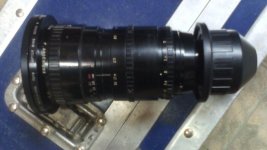
 

Attachments

  • ANGENIEUX POST.jpg
    ANGENIEUX POST.jpg
    46.2 KB · Views: 0
I have often wondered if this might be possible on certain lenses, especially if it's going from one optical revision of a lens to the next as most of the changes or updates in lenses are in the middle and rear elements. That's really a bummer to hear about the faulty repair job, I hope you got a refund for that nonsense! I still have some busted lenses that have no hope of repair save for extracting good parts from another lens. I still use some of them like my Minolta 58mm 1.2 Rokkor X which unfortunately got damaged when I did a full teardown CLA of it as the chunky front elements slipped and clanged together just right to chip a chunk out of the rear of the front element, thankfully this wasn't in the optical path and I lightly blacked it out with some black Sharpie in case it caused any reflections but the only real fix is to get another front element if I wanted it to be pristine again but I am glad that in my research that there's not much visible difference between the older MC and newer Rokkor X versions so swapping a fresh front out of an MC wouldn't be a problem if I ever happen upon a cheap "for parts" MC copy.

However, that's only really a minor coating difference, in your case, there's a whole difference aperture range difference and I can tell you just by getting optical elements flipped around wrong or putting the inner spacer in the wrong order during reassembly, if there's even the slightest bit of difference, the whole image could be completely off. Anything from focusing distance to simple optical defects like unwanted blooming, severe chromatic abberations, and warping could occur if the optics aren't correctly placed and match in design. The only way to know for sure in this instance is to simply try one optical piece at a time and see what happens and if it's just the front element then that should be easy to tell whether it doesn't work or not.

In any case, don't just throw the lens away either, there's useful parts in there and even if you didn't want to deal with it anymore at some point, by all means sell it for parts at least. In my early days of trying to repair lenses, I look back and regret throwing lenses away that I accidentally ruined by bad disassembly or where I had one optical element slip out of my hand to shatter on the floor because I now realize that I've come across more copies of those lenses that could have used, say, a better rear element, a replacement for an odd unique screw, the rubber of the focusing grip, a smoother helicoid, and even just like you, a better front element, but I threw them away without thinking about it, so don't repeat my mistake with that.
 
I actually bought the lens at a really deep discount from the owner who had it "serviced" in Singapore. If the elements had been debonded and reassembled with UV cure, then likely they had older balsam bonding which had begun to disbond or turn yellow. A rear set of elements was what appeared to have once been a triplet in a cell. They were floating around loose and were chipped at the edges. The original owner would have been better off shipping the lens back to Australia. On the upside, the "good" lens has a PL-Mount tail whereas the ruined lens is an Aaton mount.

I also have an Angenieux 10-150 which came with a camera I bought from our national broadcaster a long time ago. In this instance, the available lens tech was in our eastern states and knew his job. He fixed a disbonded element with UV cure and offered to separate and rebond the rest. However I declined the extra work at the time. UV cement was still a relatively new process at the time. That lens is beginning to go yellow again but it is rarely used in these days of 4K+.

I may be able to get away with running the front lens assembly off its helicoid and install the good one entire without tearing the assembly apart. Getting helicoids back on their threads in the correct orientation is an absolute hell. Interestingly I have bought three lenses used and found they had been re-assembled incorrectly by somebody, I spsuect the owners but maybe not. Sometimes things are sold off onto eBay when they have gone wrong, yet a fix is relatively easy.

One was a Nikon f1.4 35mm which was never quite right. and went really weird when used with a focal reducer (Speedbooster). I eventually had to do a fungus clean on it. Thanks to a how-to generously posted on the internet, I was able to take it apart safely, clean everything and then set it up correctly. It has a tricky double helicoid arrangement which moves two groups. There was a CP Ultra T* which was somehow messed up. I was setting up a 3D pair so had another good one to very carefully take apart for a reference. The third was an Optica Elite Series 3 Super16mm 35mm which was a bit gritty.

The main reason for digging the 16-44 out for another go at a fix is that I have dragged out an old CP16R for some folk to try their hand at film and use up some old short ends which are far too old already. The image except for an occasional flare is as sweet as any 16mm prime I have.

I hand-dressed an old lens element which had fungus pits in the glass and by a minor miracle rather than any skill preserved the figure of the element. I have since discovered that I committed a real sacrilege as it was an old Cooke Speed Panchro 70mm Series 2. My consolation is that it had been assessed as uneconomic to repair. If I knew then what I know now, I would have respected it and not have touched it. The original owner now has it back. I think he is selling it and a Cooke 50mm which was likewise fungussed.

As a result of that adventure, I now have an absolute respect for the craftsmen who put these things together on skill and accumulated knowledge without the benefit of computer-aided design and automated machinery. Folk like Matthew Duclos must cringe when reading these sort of posts and what the likes of me do to the work of past good craftsmen, albeit with great care.
 
Last edited:
Back
Top