Welcome to our community

Be a part of something great, join today!

  • Hey all, just changed over the backend after 15 years I figured time to give it a bit of an update, its probably gonna be a bit weird for most of you and i am sure there is a few bugs to work out but it should kinda work the same as before... hopefully :)

how does expert choose lens to shoot from 1ft wide to 2 feet wide at 10 feet with 4K?

Les C.

Well-known member
Joined
Nov 24, 2009
Messages
813
Reaction score
0
Points
0
How does an expert know which lens to pull from his bag to be able to shoot from 1 foot wide to 2 feet wide at 10 feet while at 4K resolution?

I keep thinking there must be some formula that would calculate that he needs an xx-xx zoom to insure he's covered?

And ... a question I just asked in Lens Tests, but may be more general and belongs here :

How many grams must a lens weigh before you need to use lens support for a Canon mount lens?

And does this vary for AL or TI?

Thanks!!!
 
How does an expert know which lens to pull from his bag to be able to shoot from 1 foot wide to 2 feet wide at 10 feet while at 4K resolution?

I keep thinking there must be some formula that would calculate that he needs an xx-xx zoom to insure he's covered?

I have a simple excel spredsheet giving me this information. Took me a minute to come up with it. Basic trigonometry. See attached picture. Otherwise, if you are in the field, you kind of have a rough idea based on your past experience.

How many grams must a lens weigh before you need to use lens support for a Canon mount lens?

And does this vary for AL or TI?

Thanks!!!
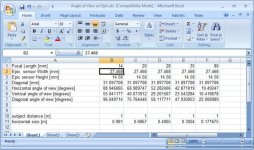
You need to support longer lenses because of the vibrations due to wind before you need to worry about the lens weight. For example, RED Prime Pro 300mm can be used without the support, but practically the image will shake too much at 300mm. It is not just the weight, it is the length of the lens too as short lens can be quite heavy without needing a support.
It's common sense, really.
 

Attachments

  • angle of view.jpg
    angle of view.jpg
    72.2 KB · Views: 0
I have a simple excel spredsheet giving me this information. Took me a minute to come up with it. Basic trigonometry. See attached picture. Otherwise, if you are in the field, you kind of have a rough idea based on your past experience.

Would it be possible to share the XLS or just the formulas - or by PM? I'm a bit out of my league! Thanks!

You need to support longer lenses because of the vibrations due to wind before you need to worry about the lens weight. For example, RED Prime Pro 300mm can be used without the support, but practically the image will shake too much at 300mm. It is not just the weight, it is the length of the lens too as short lens can be quite heavy without needing a support.
It's common sense, really.

Is there any ballpark on the minimum length that requires support?
 
How does an expert know which lens to pull from his bag to be able to shoot from 1 foot wide to 2 feet wide at 10 feet while at 4K resolution?

they shoot. alot.

you don't have time to be calculating trigonometry... grab a lens and use it. switch it if you need to.


Is there any ballpark on the minimum length that requires support?

if it's over a foot long start thinkin about it.
 
actually, my real use is to be able determine which single lens to buy, which is a bit confusing at the moment.

I only wish I had a bag of lenses to learn from experience!

That Pcam app looks great, but ... if I buy the Scarlet, my budget for other cool toys (I have a cheap virgin mobile phone), will stay low.
 
i wouldn't buy anything until you acquire a bit more general knowledge... and i don't mean that to be offensive.

what camera systems do you have experience with, and what is making you consider a scarlet?
 
i wouldn't buy anything until you acquire a bit more general knowledge... and i don't mean that to be offensive.

what camera systems do you have experience with, and what is making you consider a scarlet?

I've been using a Canon HV20 recorded 'live' while tethered with an Intensity hdmi to get 1920 x 1080 without any mpeg compression artifacts, going directly to ProRes HQ.

I do 3D animation, and would like to record without the rolling shutter so that I can use Synth Eyes to track and composite my animations with the green screen footage (have a studio setup for green screen and motion capture). I have FCP 7 but recently bought Production Premium 5.5 on Win7 after Apple dumbed down FCP7.

I use Eyeon's Fusion for compositing.

I understand that Scarlet is overkill and I'd be operating way beyond my skill and competence level, but ... I learn pretty fast. I'm just trying to avoid making any massively stupid mistakes where I purchase something that I can't use at all (wrong lens, etc.). A bit alarmed that Premiere doesn't seem to use RED's audio as Adobe hasn't updated it - but, there's an annoying workaround, and hopefully it will all come together.

I'm trying to price a bare-bones system just for recording in a studio initially (no batteries). I may be able to record using hdmi to get the framing, etc. working before I actually record 4K to flash (and thus get by with a single flash for now) when recording short 30 second shots (much of which will be in front of a teleprompter).

I don't take offense at all to negative comments - and in fact would encourage honesty. Thanks!!
 
a good rule of thumb is if you want to fill the frame with a head & shoulders it works out at 10mm per foot therefore at 10 ft you would need a 100mm, 20ft a 200mm or 5ft a 50mm etc etc. It is the old clapperboard trick know what lens is on you will know exactly where to put the board.
 
I do 3D animation, and would like to record without the rolling shutter so that I can use Synth Eyes to track and composite my animations with the green screen footage (have a studio setup for green screen and motion capture). I have FCP 7 but recently bought Production Premium 5.5 on Win7 after Apple dumbed down FCP7.

Scarlet uses a rolling shutter. So do Epic and Red One.
 
Les - I do visual effects work, and the Scarlet/Epic/R1 are all really good for it. However, you can do vfx with just about any camera system. On a side note, "rolling shutter" is common between all CMOS sensors, and even displays itself on film (as the shutter rolls through...). I've worked with quite a bit of DSLR footage... not the best detail or color, but definitely usable - especially for projects that don't hit the big screen. Rolling shutter isn't a problem 95% of the time, and there are applications and plugins that can diminish its effect quite a bit. That being said, I prefer Red footage 100% of the time to work with (or look at). However, you shouldn't have any trouble with tracking on any of the current systems, so long as you take a little care in your shooting style. Do some research on rolling shutter - what it is and how to avoid it.

Scarlet is easy to use, you'll get the hang of it pretty quickly, especially if you're post savvy. Just hang around here (use the search function and/or google advanced search) and you'll learn a lot. I really encourage doing that search before you ask questions, but questions are always welcome here. Don't worry about the audio... it'll work. Alternatively, most people use external recorders anyhow... pick up a Zoom H4n or something temporarily if necessary, I saw one at best buy the other day. It's very important to realize that the Scarlet is not a camcorder. If you want a camcorder, it may not be for you... look into something like the eminent Canon C300, perhaps. Scarlet is a huge step into another world from a 'handycam' - not saying you can't do it or handle it, just proceed with caution. There are a LOT of accessories and peripherals to familiarize with. $$$

As far as lenses and mount, I'd recommend the Canon Aluminum with Canon mount lenses. You need to study how lenses work, especially focal length and f-stop (aperture). You should do this anyways and be studying filmmaking/photography/art if you're doing computer graphics, I can't emphasize that enough, so I won't.

There are a bunch of lenses out there for canon mount (or that can be adapted so). A good lens to start out with that I really like is the Canon 28-135. This will cover you for a very wide range. Pick up one for $400/500, or get a used one under $300 (http://www.bhphotovideo.com/c/used/149629/Canon_2562A002AA_EF_28_135mm_f_3_5_5_6_IS.html). I highly recommend B&H for photo/audio/video equipment. There are some other good places like amazon and adorama, just don't trust places with sketchy prices/sites. Ebay can be a good (or bad) place for used lenses and especially for older lenses (that need adapting). Older lenses can sometimes be more lightweight and better quality (and usually cheaper), at the expense of losing electrical connection/control with the camera.

If you want the next step up, check out the Canon 24-70 2.8L or 24-105 f4L - although when you get into this price range, I'd seriously consider picking up some decent prime (fixed focal length) lenses, like from Zeiss. Primes are almost always higher quality, and better suited for low-light and a greater range of depth of field options.

We've only been talking about glass originally meant for still photography at this point. Cinema glass (PL-mount) is a whole nother topic, and I'm guessing as you're wanting to keep it cheap that may be out of the question for now, let me know if it's not.

As far as still glass goes, it depends on if you want autofocus/aperture control, or if you're willing to use older manual lenses with adapters (dumb mounts that don't 'talk' to the camera). I'd look into the canon mid-range (non-L) series glass. The 50mm 1.8 performs extremely well for $100, but it's super ridiculously cheap and lightweight, the 50 1.4 is probably a better choice just for build quality - but watch out for autofocus issues. The 85mm 1.8 is just awesome, as is the 28 1.8. You could be pretty much set with those 3 lenses. The tokina 11-16 is a really great lens if you need wider angle and so is the Canon 70-200 2.8 ISII for telephoto (worth the extra $$). There are also other brands of lenses, some cheaper and some more expensive, some better and some less so. Almost all the lenses out there perform reasonably well if used properly. Research the different ones and ask questions about specifics on here, or elsewhere - there's some guys that really know their lenses around here, and they may give you better recommendations than I. As always, do your own do-diligence before making a purchase.

Finally, you can always rent lenses (or cameras) from places like http://borrowlenses.com... and test them out. All in all, I would get more comfortable with interchangeable lens systems. It really wouldn't be a bad idea to check out a cheap dslr to play around with. You can get some really cheap used ones and learn a lot, really quick. For photos, I'd recommend something cheap like a Canon Digital Rebel (any flavor, though the XT or XTi would probably be your best price/performance). If you want to shoot halfway decent video with one, and not throw too much money at it, I'd highly recommend either a canon t2i or a panasonic gh2. As it were, they both offer firmware 'upgrades' from open source parties (they're pretty good parties :). Either of those might be a good stepping stone up to a scarlet, or just handy to have around. In any case, they take really really nice photos and timelapse - and you will pick up really fast on all of this stuff just by shooting with one, even photos.

I remember when I first started getting into photography, and I felt like I needed to memorize what film speed + aperture + shutter speed to use in any and every situation. Mind you, this was back right before digital cameras emerged, so there wasn't any of this immediate gratification of seeing something on screen to be able to learn quickly - I had to find out when a whole roll of film came back under or over exposed. But I did have a little light meter on my camera (an old olympus) that worked fairly well (most of the time anyways) - and I learned the more I went out and shot, and then came back and asked people who knew about it (this was before I had internet, I think... in any case I didn't find out about forums until a few years ago) to build even more knowledge. I promise if you go out and shoot, this stuff will become second nature over time and you won't even see the need to worry about such details. So do that, and stick around here and study up online and you'll likely get right on track.

good luck!
 
Scarlet uses a rolling shutter. So do Epic and Red One.

My understanding is that the 'rolling shutter' effect for the sensor is greatly minimized from other cameras as it pulls the data at a higher rate from the chip, but ... come to think of it, this 'understanding' was based on threads from over a year ago, so maybe I should check this out?

But - if the Hobbit is being shot with 50 or so REDs, I'd expect that if it's good enough for them (and they must be using a lot of tracking for their added CGI), that I would have no problems?
 
Les - I do visual effects work, and the Scarlet/Epic/R1 are all really good for it. However, you can do vfx with just about any camera system. On a side note, "rolling shutter" is common between all CMOS sensors, and even displays itself on film (as the shutter rolls through...). I've worked with quite a bit of DSLR footage... not the best detail or color, but definitely usable - especially for projects that don't hit the big screen. Rolling shutter isn't a problem 95% of the time, and there are applications and plugins that can diminish its effect quite a bit. That being said, I prefer Red footage 100% of the time to work with (or look at). However, you shouldn't have any trouble with tracking on any of the current systems, so long as you take a little care in your shooting style. Do some research on rolling shutter - what it is and how to avoid it.

Wow - a fellow pixel-junkie!!! I get the idea the Scarlet is a VFX dream machine!

Yes, I should have said 'rolling shutter problem' rather than rolling shutter. I'm just going to bet that with all the work put into the sensor, etc. - that the 'problem' is a non-problem now? Would be interesting to see a test between the Canon DSLRs and a Scarlet while panning past a flagpole at a high rate of speed. I'd bet on the Scarlet!!!


Alternatively, most people use external recorders anyhow... pick up a Zoom H4n or something temporarily if necessary, I saw one at best buy the other day. It's very important to realize that the Scarlet is not a camcorder. If you want a camcorder, it may not be for you...

My understanding is that I'd need to buy something like:
http://woodencamera.com/a-box-epic-scarlet
to be able to record from my Rode shotgun condenser - and that there will soon be a fix so that phantom power is supplied. Are you saying that there's an advantage to using an external recorder rather than recording using the Scarlet's inputs? I guess I'm unclear on why (besides having input level knobs) - so I'm very interested in your thoughts on that!

As far as lenses and mount, I'd recommend the Canon Aluminum with Canon mount lenses. You need to study how lenses work, especially focal length and f-stop (aperture). There are a bunch of lenses out there for canon mount (or that can be adapted so). A good lens to start out with that I really like is the Canon 28-135. This will cover you for a very wide range. Pick up one for $400/500, or get a used one under $300 (http://www.bhphotovideo.com/c/used/149629/Canon_2562A002AA_EF_28_135mm_f_3_5_5_6_IS.html). I highly recommend B&H for photo/audio/video equipment. There are some other good places like amazon and adorama, but don't trust places with sketchy prices/sites. Ebay can be a good (or bad) place for used lenses and especially for older lenses (that need adapting). if you want the next step up, check out the Canon 24-70 2.8L or 24-105 f4L - although when you get into this price range, i'd seriously consider picking up some decent prime (fixed focal length) lenses. Primes are almost always higher quality, and better suited for low-light and a greater range of depth of field options. We've only been talking about glass originally meant for still photography at this point. Cinema glass (PL-mount) is a whole nother topic, and I'm guessing as you're wanting to keep it cheap that may be out of the question for now, let me know if it's not. As far as still glass goes, it depends on if you want autofocus/aperture control, or if you're willing to use older manual lenses with adapters (dumb mounts that don't 'talk' to the camera). i'd look into the canon mid-range (non-L) series glass. the 50mm 1.8 performs extremely well for $100, but it's super ridiculously cheap and lightweight, the 50 1.4 is probably a better choice just for build quality but watch out for autofocus issues. the 85mm 1.8 is awesome, as is the 28 1.8. you could be pretty much set with those 3 lenses. the tokina 11-16 is a really great lens if you need wider angle and so is the 70-200 2.8 ISII for telephoto (worth the extra $$). there are also other brands of lenses, some cheaper and some more expensive, some better and some less so. almost all the lenses out there perform reasonably well if used properly. research the different ones and ask questions about specifics on here, or elsewhere - there's some guys that really know their lenses around here, and they may give you better recommendations than i. as always, do your own do-diligence before making a purchase.

finally, you can always rent lenses (or cameras) from places like http://borrowlenses.com... and test them out. all in all, i would get more comfortable with interchangeable lens cameras. it really wouldn't be a bad idea to check out a cheap dslr to play around with. you can get some really cheap used ones and learn a lot, really quick. if you want to shoot video with one, and not throw too much money at it, i'd highly recommend either a canon t2i or a panasonic gh2. as it were, they both offer firmware 'upgrades' from open source parties (they're pretty good parties :). either of those might be a good stepping stone up to a scarlet, or just handy to have around. in any case, they take really really nice photos and timelapse.

good luck!

Yes, after pricing the PL mount lenses, I quickly saw the wisdom of the Canon mount!

I'd been looking at the specs for these (I can only get one), and saw the 24-70 was on your list

Canon 16-35 f2.8 EF II USM 640g
Canon 17-55 f/2.8 EF-S IS USM 645g
Canon 24-70 f/2.8L EF USM 950g

But, I was having trouble visualizing what range of widths I'd be able to see from 8' to 16' - which was really why I asked the original questions of this thread on figuring the widths and whether I'd need lens support.

That 24-70 would provide auto-focus, right?

BTW - very, very dumb question, but I've got a Canon Digital Rebel with a Sigma 28-105 3.8/5.6 UC-III Aspherical.

Would that work at all with the Scarlet?

Thanks so much for your very lengthy reply! I've got to try to make a decision on the Scarlet and accessories by the 1st I guess - and lost a week due to getting a 5 degree fever last Friday, so I'm running a bit behind!

Thanks!!!
 
My understanding is that the 'rolling shutter' effect for the sensor is greatly minimized from other cameras as it pulls the data at a higher rate from the chip, but ... come to think of it, this 'understanding' was based on threads from over a year ago, so maybe I should check this out?

But - if the Hobbit is being shot with 50 or so REDs, I'd expect that if it's good enough for them (and they must be using a lot of tracking for their added CGI), that I would have no problems?

the epic/scarlet have a very fast read/reset time. so does the red one.

the reason for rolling shutter on cmos sensors is that one line is read at a time, progressively, until a whole frame is captured. this all happens really fast, of course... but if there is something like a quickly strobing light this could cause only part of the frame to be exposed (i.e. it turns off halfway through a scan) or if the camera or something in front of it is moving really fast you get slanted veticals because the camera/subject moved that much between scans. the most experience i've had with it (except testing out jello cam on my dslr with quick pans) is from high frequency vibrations shooting from a moving vehicle like a car or airplane, which causes a kind of crazy, almost cool overall wobble. all these things can still happen on any cmos chip, but with normal shooting conditions you will hardly notice it, even moreso with any red cam.
 
Wow - a fellow pixel-junkie!!! I get the idea the Scarlet is a VFX dream machine!

Yes, I should have said 'rolling shutter problem' rather than rolling shutter. I'm just going to bet that with all the work put into the sensor, etc. - that the 'problem' is a non-problem now? Would be interesting to see a test between the Canon DSLRs and a Scarlet while panning past a flagpole at a high rate of speed. I'd bet on the Scarlet!!!

check out the zacuto camera shootout, very informative. they do a rolling shutter test, towards the end i think... it would be well worth your time to watch it all the way through. http://www.zacuto.com/the-great-camera-shootout-2011

the a box is a very good solution, so is everything from wooden camera. as of right now, i'm not 100% sure phantom power is enabled on the scarlet, but it probably would be by the time you got one in hand (kinda like premiere pro working audio).

there are a lot of reasons why you would or would not want to separate your audio from your camera. basically, most people don't want to be tied between the two and prefer to keep them apart for better quality on both sides. however, if you're wanting to mount a mic (not as high quality results, typically) you'd probably rather record the audio in the camera, rather than syncing it up later.

yes, your sigma will work on the scarlet. the effective sensor size (and resolution) of the red at 4k is similar to that of canon rebels (aps-c), so what you see through the lens on your rebel will be darn close to what you see on the red at 4k. however, that particular lens may or may not be recognized (yet) by the mount for focus control. it probably (should) still be able to autofocus and adjust aperture, but i'm not 101% sure on that. to visualize, look through your digital rebel with that lens, the focal lengths will match up.

remember, when switching to other modes (like 3k and 2k) these are done with a crop to the sensor. i attempted to explain that here: http://reduser.net/forum/showthread.php?65973-Crop-Factor-Demystified and here's an even better collection of resources: http://reduser.net/forum/showthread.php?66210-Scarlet-X-Data-Sheet

hope you're feeling better. take a step back and breathe, always sleep on a big decision.

on a side note, debt is not a good thing unless it represents real potential wealth and a conservatively calculated risk/reward... but let's not get into politics tonight ;) all i'm saying is, there are more important things than cameras. consider those things first.
 
a good rule of thumb is if you want to fill the frame with a head & shoulders it works out at 10mm per foot therefore at 10 ft you would need a 100mm, 20ft a 200mm or 5ft a 50mm etc etc. It is the old clapperboard trick know what lens is on you will know exactly where to put the board.

Nice, haven't heard that one before. It reminds me of the ole shutter to mm trick, aka 30mm needs at least 1/30th shutter for stable hand held footage. Of course that all goes out the window when you're dealing w/ (some) studio AC powered lighting setup... where shutter speed are sometime best set based on AC hz to prevent (sometimes minor) light strobing, aka if in the states 60hz AC means 1/60 shutter. But then again, why would you do much hand held work in a studio (unless budget/unforeseen/creative issues come into play)
 
Nice, haven't heard that one before. It reminds me of the ole shutter to mm trick, aka 30mm needs at least 1/30th shutter for stable hand held footage. Of course that all goes out the window when you're dealing w/ (some) studio AC powered lighting setup... where shutter speed are sometime best set based on AC hz to prevent (sometimes minor) light strobing, aka if in the states 60hz AC means 1/60 shutter. But then again, why would you do much hand held work in a studio (unless budget/unforeseen/creative issues come into play)

think fashion and style... tripods are so 1999.
 
Back
Top