Welcome to our community

Be a part of something great, join today!

  • Hey all, just changed over the backend after 15 years I figured time to give it a bit of an update, its probably gonna be a bit weird for most of you and i am sure there is a few bugs to work out but it should kinda work the same as before... hopefully :)

"HDR MODE" - Possible on Red?

Ooops, sorry for the wait.

Well, I've no Red to shoot with, but there's one clip in this TL reel that has a 25fps 1sec exposure stream on the waves at about 1:05. Just shot with an FX1 to try stuff out.
http://www.vimeo.com/6685310

That's about the easiest thing to do, then you can mix it up a bit with variations on the theme.
 
Once you start shooting 360 shutter and working the frame stream in post you have a bunch of options and dehree of freedom for choosing how to use the images in post.

Exactly -

I've shot video sections to drop into timelapse comps posted to give a 25fps stream with each post-post frame having a 1s exposure, just by shooting 25fps, 360 shutter and doing a rolling blend for 25 frames.

I've tried that too - what's also cool, is that blending 25 frames together gives you a noise-free image even if you use gain...

Lots of possibilites, just by thinking a little bit outside the usual film camera setups to see some of them.

Exactly, again. And the higher frame rate you shoot with, the more options you have...
 
Oh, BTW, i'd still be interested in some test material to have a go with my "EDR" concept - we've had some red projects since i posted the request, but i've always had too many other things on my mind and thus forgotten to shoot / ask to shoot the test footage... and, nope, i don't have a R1 of my own...

So here's the specs again, in case someone has a few minutes of extra time:

Set up a scene where there's a high contrast ratio and some motion.

Clip 1: Set camera to 2K, 24 fps, 1/48 (180 degree) shutter. Adjust the aperture so that some parts of the image are overexposed to white (by about one stop). Let it roll for a second or two (not much more to keep file size down).

Clip 2: Change frame rate to 96 fps, shutter speed to 1/96 sec. (360 degrees). Do not change anything else. Shoot a second or so.

...if my theory is correct, i should be able to extract one stop better dynamic range from the latter clip, without motion- or other artifacts.

Yes, that makes sense, although the workflow would be entirely convoluted and it might be hard getting good results.

When it boils down to it, a camera catches light, not an image. The resulting frame is an estimate of the real-life "image" from averaged-together photon samples across a limited sample of space and time. With more light, you can capture with more accuracy with respect to spatial resolution (as much light per photosite, but more photosites). Or you can also capture with more accuracy with respect to time; you can use a faster shutter.

But for cinema, time's not a variable; it's (generally) a constant. 90% of theatrical footage is shot at 24fps 1/48sec shutter and distributed as such.

But a camera could capture a very high level of temporal resolution instead of ever-increasing megapixels at 24fps 1/48sec shutter. Let's say I record (standard, not over-cranking) at 240fps at 12 bits per sample. I could combine five samples linearly to get 1/48th second frames, or I could blend them in ways ensuring they don't clip--so really I'd get an underexposed image at 240fps (360º shutter), which could turn into a correctly exposed image at normal 24fps (with a "normal" s/n ratio), but I could combine data in other ways to get way more highlight detail, too. I could also choose common denominator frame-rates in post, do accurate speed ramping with mathematically perfect exposure-compensating software (with noise being the only variable), or use the extra motion for super-accurate motion vectors for post-processing and 3d tracking--even if you just use 1/48th shutter in the final image, you'd have an extra 100% more information hidden away in the odd frames, and you could use all your frames for temporal noise reduction, motion vectors, etc. even if you only end up showing half of them.

Right now, cinema cameras (though they allow speed ramping, open shutters, etc.) basically operate with temporal resolution as the constant and spatial resolution is an ever-increasing variable. But, guess what? The difference between 2k and 4k in 3D (if 3D catches on, which it may soon) is quite minor, but 24fps and 48fps in 3D are appreciably different... I think we may find a standard resolution that's good enough for normal screens; I honestly think 2k is that resolution, but others will disagree. But beyond 2k is diminishing returns for normal-sized screens. True, 6k bayer is good for true 4k, as 4k bayer is good for true 2k, but would 12k bayer help theater-goers at all? Not those watching on normal-sized screens, no. Most film prints are about 720p equivalent after all that MTF-type stuff.

So, as silicon gets faster and recording capacities increase, I think cameras will record more in the "time" dimension and time will be recorded as a coherent whole--Xfps (a multiple of 120 most likely) with a full open shutter, that a computer can then downsample, take motion vectors from, blend light from multiple samples in different ways to increase exposure latitude/reduce noise with, etc. at whim. Particularly as 3D catches on, this type of camera will be useful since we'll need 24fps 1/48sec for normal theaters and 48fps 1/96sec for 3D, and then that usefulness will only increase as computers increase in power and the digital image becomes more malleable with increasingly complex algorithms. Just as sound is temporally oversampled, I think images will be soon, too.
 
Last edited:
Yes, that makes sense, although the workflow would be entirely convoluted and it might be hard getting good results.

Yep - but the procedure could be made trasparent to the user - as easy as setting the checkbox for "EDR", or Extended Dynamic Range mode when shooting in the camera's menu (or a "24p EDR" frame rate), and choosing from a list of appropriate blending options when debayering the image in post.

I wrote a description how this could be implemented as a firmware / software update a few pages back...

http://www.reduser.net/forum/showthread.php?t=31683&page=3#25

I could combine five samples linearly to get 1/48th second frames, or I could blend them...

Exactly - and the idea of using the "discardable" extra frames for noise reduction / 3D tracking is an excellent one - kudos for that... that would also work @3K resolution in R1, shooting 48 or 50 fps and 360 degree shutter...
 
Yes, it will be interesting when cameras record with enough frames per second that we start to view frames like pixels...a kind of mesh of data that can be manipulated at whim and delivered scaled down at any resolution (60fps, 50fps, 48fps, 24fps, etc.) like we can scale film down to 2k, 1080p, DVD, iPod video, etc... This will also begin to open up whole new approaches to time remapping, over-cranking, exposure, etc.

However, it looks most likely that increased light sensitivity will first go toward scaling chips down from s35 to 2/3'' to give the extra depth of focus needed for 3d imaging. The next major camera revolution will be delivered by the first company to convert something along the lines of Cameron's PACE camera but easily and cheaply operated/monitored.
 
HDR on the same frame

HDR on the same frame

Now that 4.5K wide screen mode is working, you can use a special kind of beam splitter as was used in the early Technicolor "two strip" (not the later 3-strip type, 2-strip like side-by-side stereo format) cameras to make two exposures side by side, each 2.25K images.

You then put an ND on one of the two images, and presto you get HDR in your REDONE camera, and you can adjust the HDR range with the ND filter.

The prism used makes two images from one taking lens, so both images are in sync and there is zero parallax problem.

Sounds OK for the RED One... Resolution wouldn't be so high, perhaps acceptable for 1080p and a little beter with M-X.

However it would be a very good technique for the upcoming bigger sensors with more resolution (645 Monstro).
 
Filmout

Filmout

Sounds OK for the RED One... Resolution wouldn't be so high, perhaps acceptable for 1080p and a little beter with M-X.

You can use a 1.33:1 anamorphic as the "prime" lens for the image splitter, so you get enough resolution for 2K filmout.

Che it seems was a 2K filmout and most of the time the projector was too far out of focus to see even that.

Tests show that 35mm projection is about 600 to 800 video lines resolution, so 2.25K is enough resolution since you mix 2 images, with adjustment of the prism you can offset one of the images from the other by 1/2 pixel, then interpolate in software later to "re-gain" 4.5K "resolution".

The more important thing for filmout is to loose the "video look" by using HDR to get 2 to 4 stops more dynamic range, resolution does not mean much for 35mm filmout, but dynamic range shows at ALL RESOLUTIONS even on a DVD.
 
Now that 4.5K wide screen mode is working, you can use a special kind of beam splitter as was used in the early Technicolor "two strip" (not the later 3-strip type, 2-strip like side-by-side stereo format) cameras to make two exposures side by side, each 2.25K images.

You then put an ND on one of the two images, and presto you get HDR in your REDONE camera, and you can adjust the HDR range with the ND filter.

The prism used makes two images from one taking lens, so both images are in sync and there is zero parallax problem.

brilliant:idea:
 
Now that 4.5K wide screen mode is working, you can use a special kind of beam splitter as was used in the early Technicolor "two strip" (not the later 3-strip type, 2-strip like side-by-side stereo format) cameras to make two exposures side by side, each 2.25K images.

You then put an ND on one of the two images, and presto you get HDR in your REDONE camera, and you can adjust the HDR range with the ND filter.

The prism used makes two images from one taking lens, so both images are in sync and there is zero parallax problem.

This sounds very interesting... Probably easier to accomplish than a two-camera setup?

Could you please elaborate on the *re-gaining* of resolution you mentioned in your next post?

If we could extract a good ~720p HDR image from the 3K Scarlet, that is very, very interesting indeed.
 
Prism

Prism

There is a drawing on one of the Technicolor prisms here,

http://www.widescreenmuseum.com/oldcolor/technicolor1.htm

But that is not the one I was thinking of, I saw an old drawing on another one with a triangle prism closer to the film so the images were together, and the light entered at an angle to the film of like 30 to 45 degrees if I am remembering it right, I saw that drawing for a few seconds maybe 20 years ago. It was a while back so it may take some effort to find that drawing again. It think that camera was Geneva advance 8 perf pulldown for 270 degree shutter?

There may be a patent drawing for early two strip cameras showing the other Prism arrangements.

If you interpolate the images and have them offset so that a point right on a pixel in one of the two images is between four pixels in another image then you can use sharpen to recover some of the blur when the two images are mixed for the overlap in the HDR range, there would be less detail in the highlights and shadows since they do not overlap, but that is so for color print stock as well the resolution peaks in the mid-tones (when printed from a dupe-negative), so you get more film-like results, HDR and peak-resolution in the mid-tones.

REDCODE (tm) artifacts may limit how much you can sharpen the images, but having the shift can only help hide aliasing by upsizing the two 2.25K images to 4.5K for "half" pixel overlap HDR mixing and such. (half pixel in the 2.25K images, full pixel in the upsized 4.5K images).

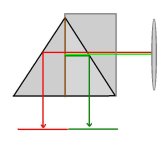
Edit: I attached a drawing of a Prism something like what I see in my mind's eye of the drawing I saw 20 years ago, I think they had the angles less than 45 degrees, but I drew it at 45 degrees since that is easer to draw and build with standard prisms maybe, there are two silvered surfaces, since the "green" is a double reflection it would be the dimmer one for the highlights in the HDR image, and the "red" image would get most of the light for the shadow image. You could put another 45 degree prism or mirror to have the lens coming in from the front. The relay lens would need to be corrected for the extra glass thickness to get sharp results. You might need to take the mount off the camera to squeeze the optics back that far to get close to the sensor so that the blur gap between the two images is small.

HDR is useful for high contrast lighting so the results match or exceed what film can do, it just looks better not to have heavy noise in the shadows or blown out highlights, I think. It can be better to have a low contrast camera and high contrast lights, like the "Super-Pan" of the 1930's.
 

Attachments

  • _prism_a.jpg
    _prism_a.jpg
    19.5 KB · Views: 0
Hi, my question is this: suppose we have the footage shot with motion control, normal exposure, +1 and -1 ...., as would be the merge in software like the after effects? as would be the blending of these layers?(Overlay, screen etc...)
thanks
 
Hi, my question is this: suppose we have the footage shot with motion control, normal exposure, +1 and -1 ...., as would be the merge in software like the after effects? as would be the blending of these layers?(Overlay, screen etc...)
thanks

If you have a completely static subject, it should work.

For everything else... It wouldn't.
 
Pre-grading

Pre-grading

Hi, my question is this: suppose we have the footage shot with motion control, normal exposure, +1 and -1 ...., as would be the merge in software like the after effects? as would be the blending of these layers?(Overlay, screen etc...)
thanks

Before you merge (fuse) the images you need to put an S curve on the source bracketed exposures or you get a "kink" in the transfer curve because of the hard clip points in digital camera images. The "kink" can make an artifact something like a "tone band", one at the top and another at the bottom if you have two expsoures, if you use the right curves the images blend together better to make one longer curve with a straight section in the middle like film.
 
..with adjustment of the prism you can offset one of the images from the other by 1/2 pixel, then interpolate in software later to "re-gain" 4.5K "resolution".

I wonder if something similar is possible with a 2-Camera-Setup, in order to "gain" some more resolution (as well as the extra DR) via interpolation in post?
 
Back
Top