Welcome to our community

Be a part of something great, join today!

  • Hey all, just changed over the backend after 15 years I figured time to give it a bit of an update, its probably gonna be a bit weird for most of you and i am sure there is a few bugs to work out but it should kinda work the same as before... hopefully :)

Greenscreen Lighting for sunset scene?

Leo Burton

Well-known member
Joined
Nov 13, 2012
Messages
123
Reaction score
0
Points
0
Website
www.3barrelsmedia.com
Hi Guys,

I've got a project that I need some help on. Looking for best settings for my R1MX.

Shooting a greenscreen piece in which the subject will be comped into a pink/red or golden skies for a dusk setting.

Do I shoot the subject with flat, clean lighting, at 5600k (then adjust in post)? Or do I gel the subject 's lights at 5600k with orange or red gels on fill, or key lights?

Or do I WB for 5600k, but throw a tungsten key or fill light in their for an orange cast?

Suggestions are appreciated, and thanks in advance!
 
I'd say there are a few things you could do.

Light the green screen at 5600k with it far enough from the actors to have no spill.

you have to then light the actors as if you were on a fixed set. Light position is probably most important as you want to cast those long dusk shadows, or hit them with bounced light ifits afterglow.

Talk to the compositor to see how they want to combine it. You can do some things to warm it up but maybe they want to stay flexible with it in the grade, then you just have to get one large source low and into the actors faces.

If you try to mess with the color too much it could complicate the key. You said, pink red or golden, that is three potential different lighting filtration approaches.

david
 
Ignore the color temp setting for the moment -- you should like the foreground subject as how they would be naturally lit on location in available light.

It would be slightly different if it were semi-overcast / hazy versus a sunset on a really clear day, but generally you'd be talking about a dim overhead soft skylight that was more blue in color than the warm setting sun, and then the subject would have some sort of backlight edge or 3/4 back key from the setting sun depending on where it was in the frame. If the weather was semi-overcast, then that setting sun would be diffused and create a soft back edge over the subject, probably warm in color depending on the sunset. If the weather were clear, then the setting sun would hit the subject harder with a very warm light, combined with the top dimmer blue-ish skylight.

Also, if the sunset was very bright and you stopped down to hold detail and color, odds are high that the subject in front of the sun would be silhouette or nearly so. But don't have to underexpose the subject as much on stage against the green screen if you want to hold shadow detail and reduce noise, but you need to talk to your compositor to make sure that they need to bring down the foreground subject to a dimmer level that looks realistic against the sunset plate.

Now as to how you light the green screen, create the cool overhead soft light and the warm back edge light, etc. it depends on what is practical for you. Ideally, you'd work around a 5600K base so the greenscreen would be lit by 5600K light (or greenscreen Kino tubes), the soft overhead light would be gelled cooler than 5600K (maybe daylight Kinos with 1/2 blue) and the back edge sunset effect would be gelled warmer than 5600K, probably at least to 3200K depending on how warm the sunset was in your plate. Obviously you could use 3200K lights as a starting point for that effect. It may be semi-diffused and warm or semi-hard and very, very warm depending on the sunset. You could even create the skylight effect with a large frame over the subjects, like a 20'x20' UltraBounce or Bleached Muslin with some blueish light bounced into it, or even start with a Day Blue Muslin rag in the frame.

But really you have to first know how the subject would have been lit on location in front of that sunset you shot, and whether it was clear or semi-cloudy will create a different look.

At dusk, just after the sunset, the light would be much more diffused, going from soft blue overhead with a soft warm edge coming from the more orange parts of the sky. And again, the subject should look somewhat dim in the final composite against the brighter sky.
 
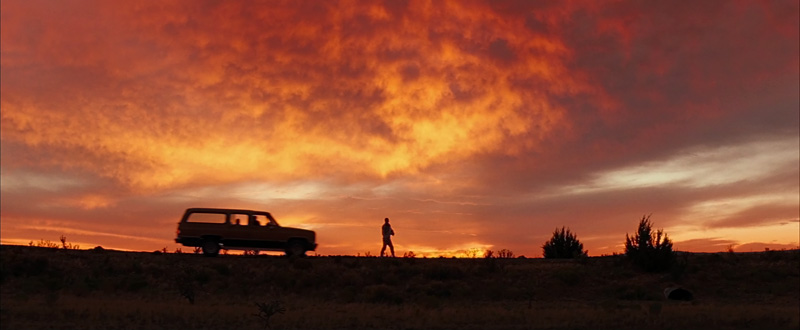
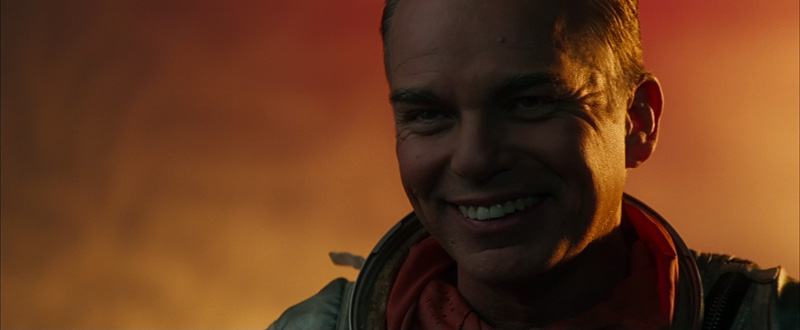
I had a similar situation come up on the last scene in "Astronaut Farmer" -- we did a wide shot at sunset, which had some wild orange and red colors in it, and knew we'd have to get some close-ups later to cut into that. In parking lot at night I set up a white screen and lit it with some random splashes of red and orange using gobo patterns in a Leko, and then used a colder soft key from a Kinoflo for the face. It was a quick cutaway so I knew it would be OK as a cheat, plus in 35mm anamorphic, the background in the close-up would be very out of focus anyway.

af31.jpg


af32.jpg
 
af32.jpg
[/QUOTE]


Thanks Davids! Thats some great info.

Backs up my first thoughts, to light the subject for the plate. We should have all the plates before the shoot, so we can colour and position the lights as best we can for each shot.

The photo is very similar to the lighting I have in mind, so that is some great advice. Though I will still be on greenscreen, so I will have to careful about spill.

Thanks guys!
 
Back
Top