Welcome to our community

Be a part of something great, join today!

  • Hey all, just changed over the backend after 15 years I figured time to give it a bit of an update, its probably gonna be a bit weird for most of you and i am sure there is a few bugs to work out but it should kinda work the same as before... hopefully :)

Good enough...

Status
Not open for further replies.
Anyone who has bought carpet or wood flooring KNOWS how the scaling of both dimensions works. When you get that quote and it's 4 times higher than you thought, you suddenly realize, oh yeah, two dimensions. And if you don't, the person writing the quote will!

:)
 
"JVC’s DLA-RS4000 delivers a 10 megapixel image with a native resolution of 4,096 x 2,400—more than four times the resolution of HD"

I know I'm :beatdeadhorse5: here but
that's only a bit more than TWICE the resolution of HD.
Four times as many PIXELS maybe, but not four times the resolution!

You are just confusing a horse that is still very much alive and just trying to get to sleep actually.

For your consideration:

1270580188.jpg


If we watched video that was only 1 pixel high you would be absolutely right however. ^_^
 
Or we would have had a 28k camera, but it would have been 28.672 x 4 pixel ;)

I don't see the problem. Interlace that sucker and you've got '8' pixels!
 
It takes 4 quadrants of 2K to fill up a 4K projector... :-)

Jim
 
And 5K has 66% more resolution than 4K.

Jim
 
Okay that is crazy, just watched all the videos. Haha, I just saw you fixed the 8TB to 16TB. I bet that thing is mad loud. I love how it looks like a floppy disk holder.
 
An Apple 30" Display (or NEC, etc.) at 2560x1600 has double the resolution of 1080P... 4MP vs. 2MP.

I started this thread as 1080P is not good enough... I stand by that.

Jim
 
attachment.php


OK.
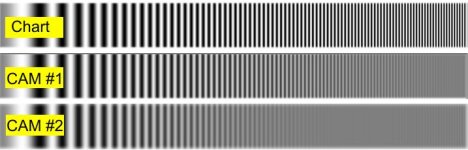
Look at this picture.
The first is a small strip of a resolution chart. CAM #1 and CAM #2 represent the best those cameras can do with that level of detail.
It would be reasonable to say that CAM #1 has about twice the resolution of CAM #2, using the orignial meaning of "resolution", as in "ability to resolve fine detail" at any rate.

Supposing you are shooting with a 16 x 9 CMOS camera, which, like the RED etc, you can switch off unwanted pixels to reduce the data rate.

Suppose it's a 1920 x 1080 sensor, about 2 megapixels, and you want to shoot 2.35:1. The native 16 x 9 is about 1.33 times the height of 2.35:1, so it follows that switching to 2.35:1, you're going to be shooting on about three quarters of the pixels.

So by your reasoning, the point where the image blurs to gray should now move to the left, since we now have only "three quarters the resolution!"

I'd like to see a demonstration of that, if you can swing it:confused5:
 

Attachments

  • Resolution.jpg
    Resolution.jpg
    32.3 KB · Views: 0
I started this thread as 1080P is not good enough... I stand by that.

Jim

I think you are preaching to the wrong crowd though.... film makers, cinema goers and home cinema enthusiasts will jump all over 4k..... but if it is to go truely mainstream.... it is the sports industry that will need to make the move.

You must have some good sports connections from the Oakley days.... get on the phone!

4K sports = 4K in the home, widespread.

The fact that they are shooting the world cup in 3D has led to widespread take up of 3D home displays... they will be all but redundant, other than for sport and the occasional movie. That shows the power of the consumer sports fan.

I know people laying down $2-3k on a 3D TV, just to watch England play maybe 5 games and then crash out in 3D glory (they have perfectly good HD TVs too).
 
attachment.php


OK.
Look at this picture.
The first is a small strip of a resolution chart. CAM #1 and CAM #2 represent the best those cameras can do with that level of detail.
It would be reasonable to say that CAM #1 has about twice the resolution of CAM #2, using the orignial meaning of "resolution", as in "ability to resolve fine detail" at any rate.

Supposing you are shooting with a 16 x 9 CMOS camera, which, like the RED etc, you can switch off unwanted pixels to reduce the data rate.

Suppose it's a 1920 x 1080 sensor, about 2 megapixels, and you want to shoot 2.35:1. The native 16 x 9 is about 1.33 times the height of 2.35:1, so it follows that switching to 2.35:1, you're going to be shooting on about three quarters of the pixels.

So by your reasoning, the point where the image blurs to gray should now move to the left, since we now have only "three quarters the resolution!"

I'd like to see a demonstration of that, if you can swing it:confused5:

No its not. Youre only cutting away pixels in one axis, and the wrong one.. In this example cutting away vertical resolution has no impact.
 
Technically speaking a Toyota Camry is good enough, so why make a Ferrari or race Formula one? Manichevitz is good enough, so why do people devote their lives to the impossible task of making the perfect bottle of wine. We already had Led Zeppelin so why make any more rock and roll? We already have planes whats with all this ridiculous talk of commercial space travel? We already had a Micheal Jordan so why does the NBA even exists, lets just watch re runs in Standard Def! We already figured out the whole amputation thing so like we're good on the medicine thing right?

Its a little concept called furthering humanity, based on the Human Spirit's need to explore the outermost and innermost regions of self and space. Some call it art, others call it science.

If this all sound obnoxiously grandiose than keep reading.

The very reason there is such a thing as 1080 p is because someone once said "hmmm maybe these interlaced lines of blurry boxes aren't the full extent of our technological communication abilities?", "I do declare, this just isn't good enough, maybe we should aim for a higher definition picture?".

"good enough" = no progression = nothing new for you to accept as "good enough"....fn' morons.
 
..."good enough" = no progression = nothing new for you to accept as "good enough"....fn' morons.

Sorry, did your mother really call you Redolutionary? Just curious....that's cruel...sorry, dude couldn't resist...there is a real name policy on this forum :hand:
 
Technically speaking a Toyota Camry is good enough, so why make a Ferrari or race Formula one?

So are you saying that Red is the Camry or the Formula one car?

Because I would never buy a Formula One car. It is totally unsuited to my requirements in a car.

I see the purpose of Epic's modularity being that people can choose to have either a standard Camry, or to plug in a super-upgraded engine and braking system if that is what they require.

Making JUST Formula One cars, would put Toyota out of business because almost none of their customers would buy one!

I think a successful business needs to strike some balance between "the ultimate" at one end of the spectrum and "what people will actually buy" at the other end.

So far Red seems to have had the balance just about right.
 
OK.
Look at this picture.
The first is a small strip of a resolution chart. CAM #1 and CAM #2 represent the best those cameras can do with that level of detail.
It would be reasonable to say that CAM #1 has about twice the resolution of CAM #2, using the orignial meaning of "resolution", as in "ability to resolve fine detail" at any rate.

Supposing you are shooting with a 16 x 9 CMOS camera, which, like the RED etc, you can switch off unwanted pixels to reduce the data rate.

Suppose it's a 1920 x 1080 sensor, about 2 megapixels, and you want to shoot 2.35:1. The native 16 x 9 is about 1.33 times the height of 2.35:1, so it follows that switching to 2.35:1, you're going to be shooting on about three quarters of the pixels.

So by your reasoning, the point where the image blurs to gray should now move to the left, since we now have only "three quarters the resolution!"

I'd like to see a demonstration of that, if you can swing it:confused5:

David, I had good laugh reading your example.
It is how technical language could be confusing.
That is why Jim posted 101 of resolution explanation.

Your example is exploring the fundamental difference in the term ‘sensor resolution’ versus ‘sensor resolving power’
and 'mesured resolution'
Actually we shouldn’t even use ‘sensor resolution’ term because it is not saying what resolution we are referring to.

Sensor resolution could be:

pixel count

mesured resolution

resolving power

how given sensor could be upgraded to the next higher level (by 1K increment or .5K, like in size)

what wish the sensor has (like in to be good sensor) :-)

Yes, we have our own language here on this forum and for someone from outside sometimes it is very confusing.
But as posted many times here, in cinema formats, the horizontal resolution (mesured resolution) is what is fixed and the vertical resolution (pixel count) is variable depending of the screen dimensions ratio. 16:9 2.4:1 etc.

In TV we like other way around 520 lines 1080 lines etc referring to the vertical line count, don’t mix it up with the mesured resolution since 1080 horizontal lines for instance will give you about 800 lines of mesured resolution in best.

Again sensors tend to have the same resolving power both in horizontal and vertical axis.

Example:
4K format is referring to the 4K horizontal mesured resolution.
4K horizontal mesured resolution could be achieved by using approximately 20% of more of horizontal pixels then 4K on most of the sensors. So 5K of horizontal pixels will give you 4K mesured resolution.

I have seen the chart here on this forum showing acceptable mesured resolution of 4K just by using 4.5 K of pixels, this is true but extremely efficient example.
 
Status
Not open for further replies.
Back
Top