Welcome to our community

Be a part of something great, join today!

  • Hey all, just changed over the backend after 15 years I figured time to give it a bit of an update, its probably gonna be a bit weird for most of you and i am sure there is a few bugs to work out but it should kinda work the same as before... hopefully :)

Foveon Sensor for RED ?

@doondoon: Did you ever shoot with a camera using a Foveon sensor?
I've been there, had a Sigma, and it was horrible! I own a Canon now, which is pretty close to a Red image wise (if you are using RAW), and I'd never look back.
Foveon is one of those nice concepts in theory, which didn't succeed practically. Mankind has seen that quite a few times…

No I've never shot with a camera that used a Foveon sensor. My original post was based on about ten minutes of reading about them on the Foveon site. Prior to that I hadn't heard of them. The way they describe the Foveon sensors collecting light (just like film does) in theory sounds great... but in practice I guess they're not what they're cracked up to be.
 
Capturing all colours in one spot is good, but what compromises you do to achieve that, can make it bad. In Foveon it's colour that's compromised, and chroma noise to an extent to. With a 3 chip system, it's that big block of glass called a prism... With film, you get all the positives and negatives (no pun intended) of film.

What I'm looking for is the most flexible image and camera to produce that image.

Graeme
 
Just wanted to add it's actually kind of a shock how much of a bomb Foveon has been in the DSLR industry. It was amazing technology 3 or 4 years ago when it first came out but now the quality of equivalent resolutions CMOS sensors have largely surpassed it. Perhaps Foveon was ahead of its time?

Noah
 
I think the issue is that you're dealing with a complex to manufacture sensor, raw processing of equivalent complexity as a demosaic (due to the chroma denoise component), then you've got to read 3x the data off the chip, which adds further issues.

Graeme
 
RAW footage from a Foveon-like sensor should be something like 3 x RAW, right?

I mean, RAW information from each of the three layers.

I wonder how it is in Foveon DSLRs?

How do they build the RGB image?
 
One of the things that I notice when shooting digitally is that the highlights clip harshly. To me this is the single most obvious characteristic of digital that will ruin the "illusion" that something may have been shot on film. Everything will look beautiful and organic to me... and then suddenly a wide day time exterior is the dead give away that it was shot DIGITALLY. This is not to say that film can't look bad... but even bad film daytime exteriors seem to hold up better that their digital counterparts. It's getting better, but IMO digital doesn't seem to have the nice organic roll off that film has.

Graeme- beyond improving the dynamic range of sensors is there anything else that's being done to address the highlights? Not necessarily RED specific... more of a general digital cinematography question. Is it possible that a sensor can effectively take two simultaneous exposures (one for the "main /correct" exposure and one that only looks at the highlights? kind of like HDR photography.
 
There's a foveon paper that goes over the raw image processing. Basically, the 3 layers, which really not RGB, get added to make a luma, and then the separately to make chroma. The chroma gets denoised, combined back with the luma, and then matrixed to make RGB.

For highlights, it's simple enough that for every stop you under-expose the main body of the image, one more stop of highlight rolloff can be achieved. The problem is to do that with keeping noise out of the main body of the image.

Graeme
 
Just wanted to add it's actually kind of a shock how much of a bomb Foveon has been in the DSLR industry. It was amazing technology 3 or 4 years ago when it first came out but now the quality of equivalent resolutions CMOS sensors have largely surpassed it.

Technically, Foveon is a CMOS sensor, but I know you mean Bayer CFA CMOS.

There are a far greater amount of vanilla CMOS sensor designers and investment in CMOS infrastructure (e.g. fabrication) than Foveon. Those factors lead to much faster evolution just by themselves, but then you factor in the technological advantages of Bayer CFA and the disparity grows.
 
Graeme, since you have no or mot much experience with the Foveon workflow let me clear out a few things here. Aliased? In what sense? The lower physical resolution of the outcome? Or the fact that you get what you shoot? I've been shooting X3F for around 5 years give or take and none of my images show aliasing. If you mean it purely technical yes they're not interpolated. If you mean it by stepping artifacts, then it's a false statement.

Actually quite the opposite is the case. When shooting on one of my mosaic sensor cams I get significantly less detail rendering than with the SD9 even. As you know a lot of colors share a similar luminance range and with a mosaic sensor you only get a fraction of them. That's why after so many years I'm still excited by the Foveon chips. Even despite that horrible app which Sigma ships.

The only real shortcoming of the Foveon sensor is the over reaction to the red channel, a bit like the human eye or some Agfa stocks.

The Toshiba video and Polaroid still cams aren't that widely known mostly because it's in the law enforcement sector and the Polaroid one was rushed to market and sucked plenty. While the Sigma bodies to me always had pisspoor ergonomics


@Aymen The harsh digital look is almost entirely based on the focusing. If you focus manually you don't get the absolute edges that a robot gets when it's focusing for you.

The term Film Look will probably die out in the next 50 years, people will probably call other looks "cheap" and what we call film look, "value". What film look really is, is an organic look that has a sharpness closer to the human eye than what some robot focusing achieves.
 
is there anything else that's being done to address the highlights?

There are dozens of patents for dynamic range extension in the sensor. Only Fuji has marketed one of them successfully, but there are many other and better ideas. There have been big improvements in shrinking pixel size, increasing QE, and reducing read noise (which gives you more highlight headroom).

Maybe when those areas of improvement are dried up (it appears QE is close), then I would guess that more attention will turn to other areas.
 
Three years ago I bought my first digital camera Sigma sd10. If it wasn't for its sensor, and in need of fast electronic image, I would still be shooting film (mostly). I don't plan anytime soon to upgrade to sd14 or what-nut (might get some primes though but I am not in a rush)
My2c.
 
Aliasing shows itself as stair stepping and moire patterns, and false detail on edges. It's visible very visible on Sigma Foveon images. Any sampled system will alias if you don't filter the incoming image to avoid aliasing artifacts. The Sigma cameras avoid such filtering, in a misguided attempt to increase their resolution, and thus allow significant levels of aliasing.

Graeme
 
I've been shooting X3F for around 5 years give or take and none of my images show aliasing.

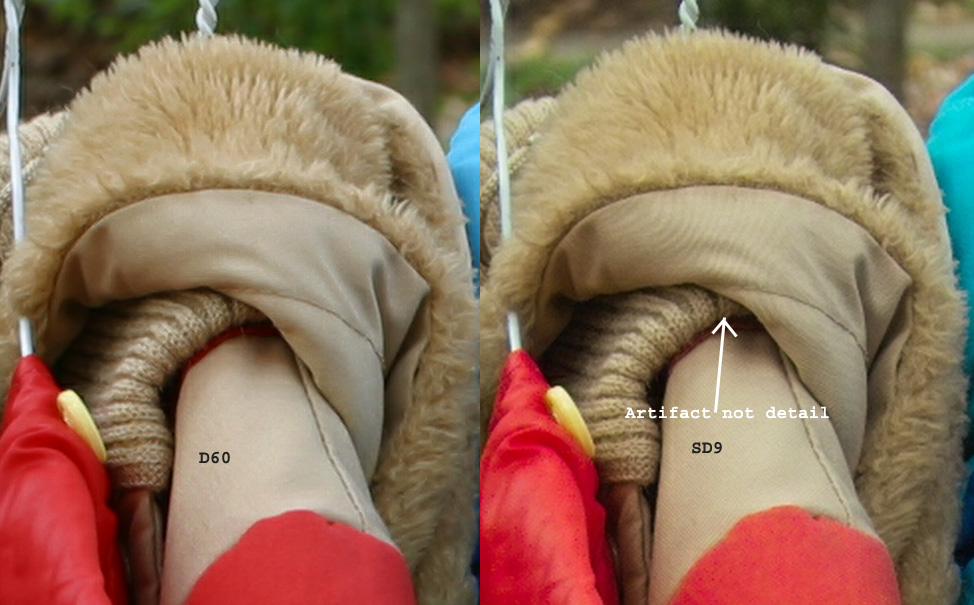
Here is an example:
artifact.jpg


That's from Matthew's web page.

The aliasing is further described in this SD9 Review

What I call "aliasing", other shooters call "crunchiness" or "crispness" or "sharpness". Many photographers like the look, and emulate it on Bayer CFA with certain downsampling filters. I dislike it.

Just to be clear: there's nothing inherent about Foveon that requires it to have aliasing. In fact, Foveon recommends that an anti-alias filter be used. The camera manufacturers elected not to use one, because the resolution is already so low, and the OLPF is so expensive. It turned out to be a wise choice, because there is a market of people who actually *like* aliased images.
 
I like Foveon's images. I think after the Foveon patent expires, we're going to see lots of camera manufacturers suddenly jumping onto the Foveon bandwagon. Then we'll start to see improvements made to the technology that will push its performance beyond Bayer. Fundamentally the aspect of stacking detection sites is going to allow greater pixel density in the Foveon chip compared to the same surface area of a Bayer sensor, so it is almost inevitably going to win the sensor fight in the long run.

But that's in the future. In modern times, Foveon is a long way off from patent expiration, and a long way off from technological improvements. Plus, we've already had Foveon/Bayer debates here on the board several times over. We all have our views about it and it's like the PC/Mac debate... personal preferences and a lot of hypothetical scenarios. Arguing in favor of Foveon at this time is not going to get anyone anywhere.
 
@Daniel wow that SD9 image really looks shite. I never had banding issues like this. The blotches in the satin-esque cloth remind me more of a compact el-cheapo cam.

I don't know about false detail, I just know the SD9 images sold where the Canon images didn't. At almost the exact same framings. I shot Canon as a backup back then interchangeably with film.
 
Again, elusive "film look" speculation that ends nowhere... I can't believe.

Sensors may be the start for an image that possibly has any kind of look, it depends on processing. All it takes is starting with a big, clean image with good dynamic range. Then you can do whatever you want. You can make it look like 65mm film, 35mm film, 16mm film, 8mm film, fisher price camera. You can walk on it, and you can make it look like an old dirty dry and wet print in a hoven for an even more elusive look that is even more impossible to describe than simply film look.
I wander why in the still photo world people got over this film look story years ago. Despite here digital makes more sense than in still world, I can't believe that some are so bound to the tools of the old times. Actually I don't believe them. They talk about it, but don't change their Red in favor of film. It is not going to happen, and this gets more true with time, because Red becames more and more capable, while film in motion pictures was, is, and will always be a pain in the ass, no matter how good it used to look.
I enjoy taking pictures with film still cameras, especially medium format - I think it makes sense, it often takes only one or two rolls of film to get a good still series. Compare it to motion pictures making. I will never shoot film for video or motion pictures or what you want to call it.
But I know, when no-one will remember what film was, some one will go on talking about it's so called, very subjective, elusive superiority, even when video technology will look like film more then film does. It's ideology. Ideology without a shadow of ideals.
I expect tomorrow some else will bring video look vs film look speculation again. We can't do anything abut it. Thank you, freedom.
Photo professional, who are no less obsessive about quality, know well that digital is better then film. It's just some people working with motion don't know it. Thay talk about it, but seem to rarely compare them side by side.
When they compare them side by side, they usually see the obvious 4k superiority to what may be 3k equivalent 35mm film.
crying for a recreation of 35mm imperfections at any cost but ending up never satisfied is like one playing with own dick instead of putting effort in what's in front of the camera.
As there was rightly written in Red homepage, there is no excuse now with Red.
One may complain about some artifacts some may see - I'm perfectly happy with image quality - but complaining for video just not being film genetically sounds like an excuse to me.
Instead, someone please try to make one decent film higher than these discussions of lower type. It is much more difficult to make a good film.
Well, I find it difficult. I don't care if my shit is made of film or electricity. It will suck if I only talk about why my camera is not (supposed to be) elusive enough like some other old tools. I don't even konw what I would be talking about.
In real world, no one can honestly complain about Red's incredible image quality.
If some one will make a film that equals Red quality, I will criticize its product to death, I promise. I will find any possible elusive aspect of Red being superior and impossible to replicate by film.

Hey, I think (since Red is superior to film), this should be the more appropriate approch: let's see if any film is good enough to replicate Red's unique look, with Red's elusive feeling (or at least to equal Red resolution). Without a revolution in chemistry, I doubt it.
 
@Lowkus: exactly. And that's why I don't use Foveon cams anymore these days. The industry chose not to support it and with just Adobe's partial implementation and one shitty tool (Sigma Photo Pro) that's not enough.

And besides the mosaic stuff. What RED has done with that looks good enough to be a future proof investment. In the theater the whole image counts, not the pixel peeping that you do in post production. And if you shoot non fiction I doubt you'll be thinking about the mosaic background of your image much.
 
@Daniel wow that SD9 image really looks shite. I never had banding issues like this.

A camera without an anti-alias filter will show moire like that image if the subject matter has pattern detail at the Nyquist frequency. In Bayer cameras, the anti-alias filter is made for the green, so moire appears first for the chroma. That is much more rare in real life than luma aliasing. Chroma aliasing can be remedied by having more resolution or in post processing by utilizing the non-aliasing color information.

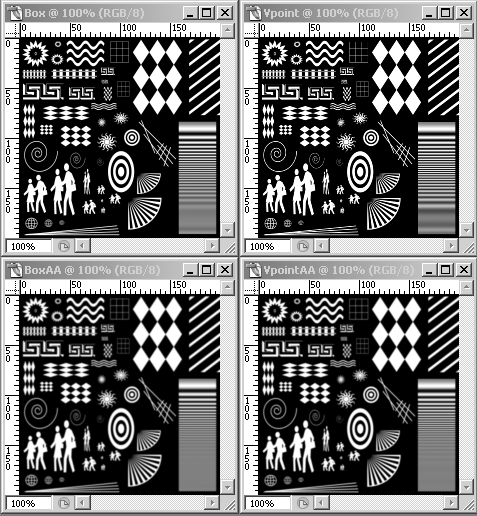
That example was just the most easy to demonstrate. The other aliasing artifacts are more prevalent, and they are exactly what people like about Foveon, which makes it more difficult to discuss. This post has good illustration:

original.jpg


See how the anti-aliased images are more blurry, with no sharp contrast from one pixel to another? And the non-AA images have more contrast at the pixel level (Nyquist)?

Incidentally, the "look" that Foven has (aliasing) is very fragile in post processing. As soon as you downsample the image, say, to half the size, any well-written resampling filter will remove the aliasing. As I said earlier, that's why people find and use resampling filters that add aliasing (even with Bayer cameras).
 
That said, our eyes capture in separate RGB sensors with a brain de-bayering (?), so perhaps this method isn't too far off how we perceive things after all.
Our eye's cone cells are arranged somewhat like a Bayer pattern (they aren't stacked), so our vision is similar to a Bayer camera in that sense.

However:
A- Our vision has a very low proportion of blue-sensitive cones compared to red and green.
B- Our eyes move/saccade when we scan a scene. Our visual system likely takes advantage of this to deliver significantly higher resolution with lower aliasing.
e.g. Think about a flatbed scanner. The sensor is 1 pixel wide, yet because the sensor moves, the effective resolution is way way higher.
Now if you take that piece of paper and move it while scanning, the image will look totally screwed up. Yet this doesn't happen most of the time with our visual system. So our brain is likely doing some complex motion estimation on top of what it's already doing. And in some cases our motion estimation will fail, which is to be expected. There are visual illusions where we see motion even though we are looking at a still image, and many other sorts of visual illusions out there.

---
If you really look at human vision, there is something called hyperacuity / vernier resolution.
http://www.michaelbach.de/ot/lum_hyperacuity/index.html

We are very good at figuring out the relative alignments between different lines. Calipers are a real-world measuring tool that takes advantage of this phenomenon. If we truly wanted a system with (pretty much) perfect resolution, we have to go waaaay higher resolution than what we have now (or go with film projection).
In practice, while this can be noticeable, it generally doesn't get noticed. Many consumers think they are watching a HD signal when they are in fact getting a SD one (and we're not even getting into 4K or ultra high def territory here).
 
Back
Top