Welcome to our community

Be a part of something great, join today!

  • Hey all, just changed over the backend after 15 years I figured time to give it a bit of an update, its probably gonna be a bit weird for most of you and i am sure there is a few bugs to work out but it should kinda work the same as before... hopefully :)

Focus pulling in documentary

If you have to pull focus yourself the most important thing is to get a good feel for the logarithmic scale of the lens... keep in mind that if objects move closer or further away the corresponding movement of the focus barrel is not linear...

and remember in which direction you have to turn the lens barrel if the subject or you move closer or farther away... but that´s pretty obvious I guess...

I try to place my fingers on the lens or the follow focus knob in a way that I know my index finger rests on the 3 feet mark, my middle finger rest on the 6 feet mark etc... so I know if my index finger is in the 12 o´clock position I´m at 3 feet etc...

I try to keep the eye that does not rest on the viewfinder open to check my position and gauge distances....

I measure the length of my wingspread, the distance between the tips of my fingers and my elbow, my shoulder etc... and whenever I can I walk around on set trying to take measurements with my arms spread wide to get a feel for the distances... (looks pretty silly...)

I always select a few spots in my frame that have high contrast because that makes judging focus a lot easier...

in certain situations it can be very helpful to just try and keep the same distance to your subject if it´s in focus... in those situations I make a few mental notes to remind me of the framing I have when the subject is in focus... the distance between the top of the head and the top frameline and where the lower frameline cuts through the torso for example and I use that as a guide to hold the framing and stay in focus while following the subject...

sometimes I focus not by changing focus on the lens but by moving in or away until the object is in focus...

just a few hints... but the most important thing is practice, practice, practice... or even better, an experienced AC...

Kay
 
For some reason I just miss read the title of this thread as "focus pulling in a democracy"
 
For some reason I just miss read the title of this thread as "focus pulling in a democracy"

In Soviet Russia the focus pulls YOU!

If you have to pull focus yourself the most important thing is to get a good feel for the logarithmic scale of the lens... keep in mind that if objects move closer or further away the corresponding movement of the focus barrel is not linear...

and remember in which direction you have to turn the lens barrel if the subject or you move closer or farther away... but that´s pretty obvious I guess...

Having experience with your equipment sounds like the real difference.

I don't know why no one mentioned, but working with Scarlet 2/3" could be beneficial, more DOF, lighter camera.
 
I think there is a psychological problem for many people about what is a "documentary" and why an AC should or should not be on the crew. My own feeling is that if you are shooting something whose budget is so low that you can't have an AC, then you should probably not be using a Red. AC's are not just focus pullers, they also provide a level of safety to the cameraman by assisting him, carry cases so the cameraman is not exhausted all the time, assist in setting up and rigging so the job goes faster and increases the production quality overall.

The fact that many documentaries have been down-graded to home-movie style shooting by ultra-low budget cable budgets does not mean that they should be. In many ways, documentary production is more difficult than narrative production, if you are serious about the production values (ask anybody that shoots blue-chip documentaries). My experience has always been if you shoot cheap it is going to look cheap. Serious documentaries are not news shows and should not look like news footage.

Sorry if this became a rant. But if you want serious footage, bring an AC.
 
My own feeling is that if you are shooting something whose budget is so low that you can't have an AC, then you should probably not be using a Red.

Sorry if this became a rant. But if you want serious footage, bring an AC.

A lot of guys shoot RED by themselves and get serious footage. Just depends on what you're shooting and the skill level of the operator.

I like having people around to lug my stuff, but I only ask for focus help about 20% of the time, I'd guess. It takes me a second to grab focus or do a straighforward rack. Complicated camera moves are when I get help focusing. That's it.
 
I think it depends upon what you mean by "serious footage". Certainly wildlife photographers who spend all day waiting for the loon to mate or the bear to come out of the cave can make very nice footage alone—assuming they have the ability in the first place. But most production means making something ordinary look extraordinary and that's just hard to do when every element of the production rests on the shoulder of one man or woman.

To me this is primarily a problem of low budgets and the lowering of standards in the non-fiction television world overall. Compare National Geographic Explorer episodes from 10 years ago with those shot today (they are all on youtube). The difference is pretty dramatic and it is not just a function of the fact that they were then shot on film and are now shot on small video cameras (so they used to have larger crews).

Budget realities are budget realities and most production budgets for non-fiction television have gone nowhere but down. But this does not mean that fundamental standards should be lower.

I'm just sayin'...
 
that's just hard to do when every element of the production rests on the shoulder of one man or woman.
I'm just sayin'...

I don't think we're having the same conversation. I just got off a shoot with 50 people running around making things look cool. And I set my own focus 80% of the time.

Every element of production didn't rest on my shoulders.

I thought we were talking about focusing a RED here.
 
I thought the context was documentaries. I'm sure you can pull your own focus all day long, but that doesn't mean you can go off and shoot a serious broadcast documentary all by your lonesome. Or maybe you can. If so, god bless you...
 
If you have to pull focus yourself

...remember in which direction you have to turn the lens barrel if the subject or you move closer or farther away

...try to place my fingers on the lens or the follow focus knob in a way that I know my index finger rests on the 3 feet mar...etc

...whenever I can I walk around on set trying to take measurements with my arms

...always select a few spots in my frame that have high contrast because that makes judging focus a lot easier...

...sometimes I focus not by changing focus on the lens but by moving in or away until the object is in focus...

Excellent advice Kay! These things were in the back of my mind when I formed my response but didn't get mentioned because they have become second nature.

The most important thing to remember about focus is that it is done by feel.
Get a feel for your lenses and how they are scaled - every lens is different, no lens scaling is perfectly logarithmic. Video lenses have about a .1 degree turn between 20 feet and 30 feet, but the Red's depth of field shows the difference between 20 feet and 21.

Get a feel for the size of the room you are in and find some objects that are a known distance apart for quick checks (floor tiles, sidewalk cracks, trees).

Get a feel for how your subject moves to anticipate what they will do - people often lean in to confess something and lean away when they don't want to answer.​

Excellent focus is all about preparation, anticipation, and observation. You let me watch a subject speak for a few minutes I can tell you which direction they will move while expressing almost any thought or emotion.

Having said that, the most important part of Kay's comment was: "... or even better, an experienced AC..."

Shooting in Canada? You know who to call. :-)
 
A great AC I once worked with told me only 50% of his job is pulling focus, the other half is moral support...


Brent, if I get the chance to work in Canada anytime soon I´ll let you know...
 
What is the best way to ensure good focus in unscripted scenes with various movement? Obviously you could just shoot at a very wide DoF, but what I'm more interested in is if you were shooting with a shallow DoF in this scenario.

How helpful would electronic tape measurers be, or are there better ways to get reliable focus results?

Thanks


Except for re-enactments, which can be staged and rehearsed, documentaries essentially involve quickly and accurately capturing quite often-spontaneous images – no marks, no staging, etc. Because they like working that way, some may choose to take a traditional cine style approach to docs, using an AC, but for issues of cost and mobility, far and away the largest percentage of documentaries are shot with small, mobile crews using EFP style camera techniques and crew – no AC (which is a cine industry term), but rather a PA (production assistant – an EFP industry term). A PA doesn’t pull focus, but assists with about everything else. On these crews the shooter does their own focusing by eye, racking the lens barrel – more on that below.

Since this is RED User, lets narrow this down to doing documentaries with the RED One camera. First, large amounts of documentaries have been, are now, and will be done using RED One – and IMO and even larger amount in the future with Epic and especially with Scarlet. How have/are most documentaries done with RED One? Here’s the answer: Small mobile crews with lightweight hybrid camera setups - 35mm stills lenses, screw-on filters, usually no matte box and follow focus, lightweight tripod systems, Cine Saddles, and shoulder mount systems like the ET Mantis, Easy Rig, etc. Mobility is critical for documentaries – and the more crew you have and accessories on the camera, the less mobility you have. So, are only tiny-budget documentaries working this way? Absolutely not – docs of all budgets are regularly done with RED One using hybrid camera setups and EFP style techniques.

Shallow DOF is rarely used in documentaries, except for certain creative montage shots in some genres of subject matter. Most docs are shot at apertures between f5.6 and f11. Eye focusing RED One by hand racking the lens barrel is quite easy for experienced shooters at those apertures. Experienced RED One shooters using RED’s 1:1 image magnification can eye focus the camera themselves quickly on the fly at apertures all the way down to 2.8 (if needed).

There are two elements of eye focusing with RED One – reaction and anticipation. Reactive focusing in docs is often times the only way to capture a spontaneous event. Skilled eye focusers aren’t simply reacting to the action, but are also combining anticipatory focusing methods by continuously anticipating what the subject matter will do next. With practice, skill, and experience in the subject matter being shot, someone with talent gets very fast at this technique of eye focusing by themselves on the fly.

On the EFP/ENG and RED forum here on RED User you’ll find a lot of threads with info on documentary production. There is always the option with Red One documentaries to shoot in 2k using the RED B4 to PL adaptor, and 2/3” HD EFP/ENG zooms powered via a cable RED’s 12v auxiliary bus, for a straight EFP-style setup.

RED One is a convergence camera. Professional shooters from three formerly separate industries have adopted RED One – cine, EFP, and stills. Thus there is naturally a cross-pollination of equipment setups and usage techniques. With RED One (and Epic and Scarlet to come) being modular, flexible, and utilitarian, there is no best way to use the camera – just a best way for individual productions or portions thereof. On any production, the most cost-effective way to get the quality level of images you need for the project is probably the best choice.

I hope this insight helps you Yousuf. About 70% of my productions over my career have been documentaries - and about that same percentage of docs with my multiple RED One cameras I’ve owned since the very first RED cameras shipped.
 
I have a question for you Steve, if you had to choose one, now that you've been using both for a while, which do you prefer, the EVF or LCD for critical focus? For me, if I can get away with using the LCD, I will, simply because it's easier for my eyes to focus using the 1:1, which is a fantastic feature, btw.
 
Thanks for the sharing, Gibby. I agree that the far greater number of documentaries on the air today are shot with little crews and small budgets. That doesn't make them good. The first casualties of low-budget documentaries are the production value—focus being one of these, or the dependence on wide lenses in order to avoid focus issues.

I hired a guy to go across the west Antarctic ice sheet for me and shoot the trek and he did it with a little handicam. It was great footage, but a lot of it was shakey and soft. But he was on the Antarctic ice sheet in a blizzard so it looked pretty cool.

But suggesting that most documentary subjects somehow are moving too fast are too unpredictable to shoot in a controlled fashion is just silly. There are documentaries about all kinds of things and all kinds of situations. Just because the bulk of them today are low-rent cable fodder does not mean that production values are not important.

The bottom line to me is that focus at the depth of field that we are dealing with on the Red is best accomplished—in any kind of filmmaking—with a trained AC. You can do with out it and sometimes you must, but the bedrock truth is that the best focus, even on spontaneous action, is going to come with a skilled guy pulling focus.

That's my story and I'm sticking to it.
 
Mark,

It depends on what type of shots we're after. The EVF is 1280x868 resolution, with a good diopter, so for shots where I can get my eye to and EVF, I prefer to use it. But obviously for high-angle and low-angle shots where getting your eye to an EVF isn't practical, eye focusing with the RED LCD and 1:1 image magnification is definitely workable. If the LCD is all you have, then yes, with practice eye focusing RED with the LCD is doable at apertures of 2.8 and stopped down from there. Like everything else its practice, practice, practice.
 
Rob,

When I produce a documentary (or any other genre production) I'm after high production values while retaining mobility, and keeping the budget in line what has been alloted. That's a juggling act for sure.

Since me and my crews have done a lot of documentaries with my RED One cameras, here are some examples of them to consider:

With REDs last year I was one of the executive producers for an independently produced wildlife blue chip doc shot on location in Alaska. The show was syndicated for airing on National Geographic Channel and various other networks in Europe and Asia. The crew was around 35, we shot cineflex from helicopters and boats using a Sony HDC1500 with Fujinon 2/3" HD EFP/ENG zooms, and RED One on land and underwater. The budget for the production was around $2.5 million USD. The production values were on a par with Planet Earth and Blue Planet. We shot RED in 4k, and used absolutely no ACs on any of our crews. All focusing was by the shooter via eye using 1:1 image magnification in the case of RED. We did use production assistants occasionally - but no ACs.

Earlier this year I was a DP and stage front camera for a 10 RED camera documentary production of the classic rock band Journey in Manila - which is BTW currently the #1 selling music video on the Billboard charts. The budget was large, and the crew was over 50 people. The dolly and stationary long lens cameras used cine zooms (Optimo 12x), but the stage front, both jibs, and Steadicam used 35mm stills lenses for lightness and focal range. We shot Quad HD, used no ACs on the production, but did use several PAs. The lighting director was on our crew. We purposely lit to 5.6, and all shooters eye focused RED on the fly - rarely with the time to even use RED's 1:1 image magnification, because of the pace of production. Every shooter on the crew was highly skilled at eye focusing RED One in a fast paced environment. We insisted on high production values - and got them.

I'm also about half way through a very moderate budget cultural documentary, with some historical lookbacks, being shot with RED One on the Navajo Reservation in Arizona and New Mexico. It involves tons of interviews, creative shots of Navajos doing various activities, celebrations, festivals, etc, and Kern Burns style traditional still photo sequences. Its being shot with small, mobile crews using REDs equipped with 35mm stills lenses, no MB or FF, ET Mantis, Cine Saddles, and lightweight tripods. The crews consist of a person who functions as a combination field producer/director/cinamatographer, a sound person at times, and a production assistant. All focusing is by eye using 1:1 image magnification. DOF ranges from very shallow for some creative montages of nature, medium for many people sequences, and occasionally deep for wide scenics, establishing shots, etc.

So there are examples of a nature documentary, music documentary, and cultural documentary that all share the common workflow of equipment setup and field techniques. I also have a sports documentary in development which will use the same equipment and techniques. All of them also share the need to be very mobile and for the most part entail content that makes it advantages to have experienced shooters who are also very good at doing their own focusing - especially the nature, sports, and music documentaries.

Let me shift gears to the low end of the documentary spectrum with RED. If you click on the links in my signature for my Artbeats or Mammoth HD RED stock footage collections, you'll find high production values throughout. I insist on high production values from myself and anyone who is on my crews. All my footage on Artbeats and Mammoth HD was shot in mobile hybrid documentary style with my RED cameras - using 35mm stills lenses exclusively, eye focused by myself (no AC), no matte boxes (screw-on filters), and no follow focus units. There are many of my collections of cultures and people with very shallow DOF which have not yet been posted up on my stock collections.

Yes, I agree that there are some really funky documentaries clogging up certain television networks - shot by unskilled, inexperienced crews using sub-standard cameras, and the resulting bad production values. Like you, I can't stand to watch them - they disgust me! But this is RED User, and its not fair to lump those marginal camcorder, bad production value shooters in with the many RED-using professionals doing docs in hybrid and EFP styles - who insist on high production values. In my experience RED documentary producers and shooters, even those with limited budgets, are achieving very good to outstanding production values from small, mobile hybrid and EFP style crews - no matter what the project budget is.

The cool thing about RED (and Epic and Scarlet to come) when doing doc production is that they are modular, small, can be used with a minimal amount of accessories and crew when necessary - and docs can be shot in choice in three different styles and setups - cine, hybrid, and EFP. If someone has a documentary that they feel is better suited for cine style equipment and crew composition, fine, go for it. There are some genres of docs which are more stationary, but there are a lot of others which require extreme mobility. But that doesn't mean others of us are going to approach a doc with a modular and flexible camera like RED the same as traditional cine style people will. This is a big, convergent family of professionals from the cine, EFP, and stills industries here at RED User - and respect is a 2-way street - everyone should give it and receive it.

The above has been my RED story every since I received my first RED One cameras in August 2007 - I've seen nothing with RED One to change my mind about it - and Scarlet (and Epic) should push the small crew/eye focus/high quality possibilities and paradigm even farther.
 
The cool thing about RED (and Epic and Scarlet to come) when doing doc production is that they are modular, small, can be used with a minimal amount of accessories and crew when necessary

Whew, Gibby to the rescue.

RED surely is a lot more involved than grabbing an EX1 and shooting BUT I hate to see people scared away from the camera because they think you need a crew to get a shot. Is there a learning curve? Sure. But can you do it? Yeah, if you've got a knack focus pulling for someone else you can do it yourself.

I have met guys that have worked with AC's only and have never pulled their own focus. They literally can't do it. Don't want to attempt it. That is totally different than this crop of shooters coming up right now that have been pulling their own focus since they were 12.
 
Hey, Gibby, its a big wide wonderful world out there with a lot of variety, not all of it good. And just having a Red camera doesn't mean a production won't have flaws or the people might lack experience.

All i am saying is that you will get more footage in focus if you have an AC than if you don't. I'm not saying you can't shoot with a Red by yourself, or that your footage won't be fine within the limits of the budget.

I'm just saying that there is a reason that God made AC's...
 
Well...we'll just have to agree to disagree. Me and my crew's footage is consistently in focus, as is the footage of the other hybrid setup, eye focusing crews we associate with, so the end justifies the means.

We're both industry veterans, and we both have our own solutions for the production issues we face - and that's just fine. The cool thing about RED is that it has the modularity and flexibility to enable many approaches to setting up and using the camera. Use RED in the setups and style you want - and we'll do the same.
 
Does the RED offer any focusing tools? I used to love my JVC GY-HD100 becuase it had a feature that the monitor would go into a black and white mode with RED and BLUE lines that would appear as soon as your subject was in focus.

Also recently, the Canon 7d allows me to do a sharp 10x magnification on the subject allowing me crisp focus.

Any tools like this on the RED ONE camera?
 
focus aid

focus aid

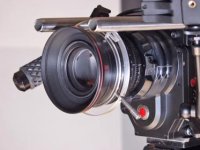
I had this focus-ring made for my 18-50. It works very simple: at infinity the stick points straight down, 90 degrees left is about 2 mtrs, straight up is minimum distance. I used reading glasses to watch my monitor (did not have EVF at that time) at a distance of about 8". Shot a 120min docu-style feature - mostly at 2,8 or 4 at best - in a crowded underground area (yes, no space for ACs), which was chosen for Rotterdam 2009 Tiger Award competition. Missed focus only once by a margin (still angry with myself ...)
 

Attachments

  • focus_ring_1.jpg
    focus_ring_1.jpg
    17.3 KB · Views: 0
  • focus_ring_2.jpg
    focus_ring_2.jpg
    17.3 KB · Views: 0
Back
Top