Philip Powell
Well-known member
- Joined
- Sep 23, 2007
- Messages
- 176
- Reaction score
- 0
- Points
- 0
- Age
- 62
I have read about Floating windows, but not certain I get them. Please confirm, correct and elaborate.
The purpose of Floating Windows - Putting it in my own words - They serve three basic functions:
1. To snug up the left and right images, so that no objects are visible on only the left or right eye. This is usually equal in pixels to the amount of IO between the images.
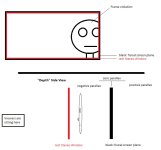
2. To deal with negative parallax stereo window violations. I.E when an object enters or exits frame while in negative parallax. This is achieved by literally cropping the left and or right image in towards the center, i.e making the projected image actually smaller.
The reason this is done is to prevent depth cue conflicts when an object in negative Z space exits fame AT the apparent screen plane edge. When you crop the image in, and visually disassociate it from the actual screen plane edge, objects in negative Z space can enter and or exit cleanly on this new exit line, that is no longer at the screen plane edge. It APPEARS to the audience that this new exit line is a "floating negative Z window" (albeit smaller and still hard edged) that is contained WITHIN the boundaries of the actual screen plane edge.
If successful, audiences are not bothered by objects entering or leaving frame because you have "eliminated" the depth cue conflict caused by the actual screen plane.
3. It is used for effects, i.e to potentially convey a greater sense of depth, by cropping in one edge more than another and creating more apparent negative "pop" on other side.
Thanks for enlightening me.