Welcome to our community

Be a part of something great, join today!

  • Hey all, just changed over the backend after 15 years I figured time to give it a bit of an update, its probably gonna be a bit weird for most of you and i am sure there is a few bugs to work out but it should kinda work the same as before... hopefully :)

FISCAL CLIFF EXPLAINED Simply.... Poor old USA.

Status
Not open for further replies.

Mark Toia

Well-known member
Joined
Jan 23, 2008
Messages
4,142
Reaction score
0
Points
0
Location
Could be anywhere in the world today.
Imagine if we let our personal accounts get this bad, You'd be made bankrupt in a flash by your creditors and banks and then thrown in jail.

I'll I can say is, I hope you guys pull through over there.
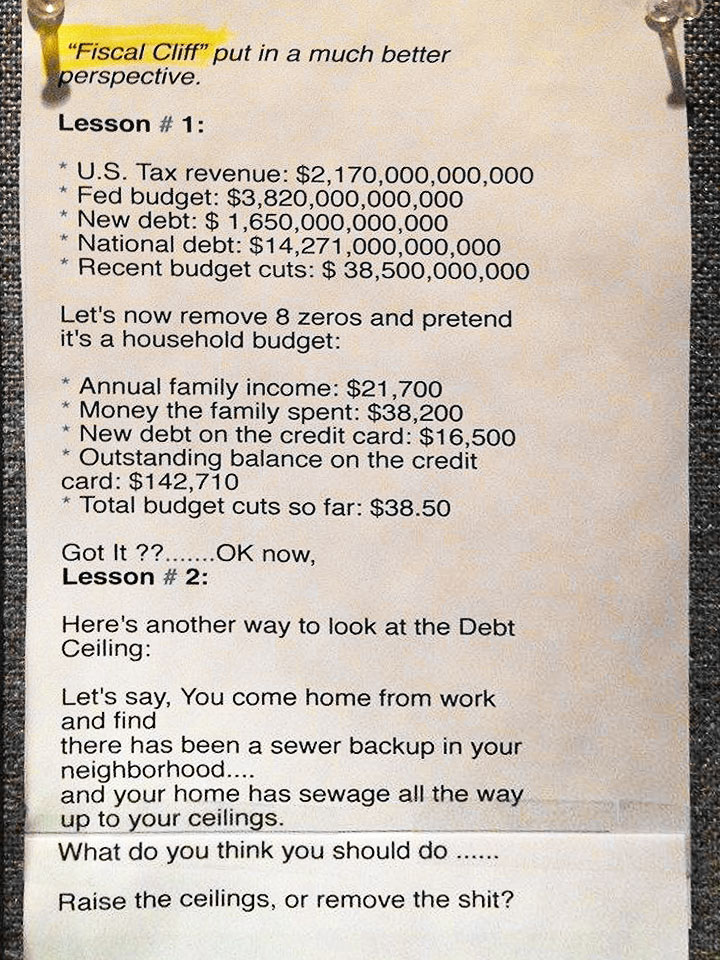
Fiscal_cliff_explained.jpg
 
Mark, sometimes the simplest explanations are the most elegant. (Like button) push.
 
But you don't want governments pulling back on spending at the same time individuals are -- the government is not a private household. If anything, you want and need government to spend when the times are the worst for the private citizen. If my neighbor cuts his personal spending, it doesn't necessarily affect me, but if my government cuts its spending, it may very well affect me -- I may even lose my job because of it. Trouble is that when times are good and tax revenues are healthy, the pressure to cut government spending isn't there. But I think it's wrong to think of a public entity in the same way you think of a private family.
 
Imagine if we let our personal accounts get this bad, You'd be made bankrupt in a flash by your creditors and banks and then thrown in jail.

I'll I can say is, I hope you guys pull through over there.

Fiscal_cliff_explained.jpg


In other words....sooner or later the shit will hit the fan!
 
The public debt isn't as nearly the pressing issue as folks make it out to be. Short term, we would do better to implement policy to improve our employment situation rather than our debt/deficit situation.
 
Probably going to be my generation that has to pay for it. WOO HOO!
 
But you don't want governments pulling back on spending at the same time individuals are -- the government is not a private household. If anything, you want and need government to spend when the times are the worst for the private citizen. If my neighbor cuts his personal spending, it doesn't necessarily affect me, but if my government cuts its spending, it may very well affect me -- I may even lose my job because of it. Trouble is that when times are good and tax revenues are healthy, the pressure to cut government spending isn't there. But I think it's wrong to think of a public entity in the same way you think of a private family.

Your right David.
Catch 22.
 
But you don't want governments pulling back on spending at the same time individuals are -- the government is not a private household. If anything, you want and need government to spend when the times are the worst for the private citizen. If my neighbor cuts his personal spending, it doesn't necessarily affect me, but if my government cuts its spending, it may very well affect me -- I may even lose my job because of it. Trouble is that when times are good and tax revenues are healthy, the pressure to cut government spending isn't there. But I think it's wrong to think of a public entity in the same way you think of a private family.

It is a more complex issue than "balancing the family budget," however, Mark Toia's post does a fine job in illustrating that we are indeed on a non-sustainable path that needs to be changed somewhere along the line. I'm of the belief that we are in need of small (if any) budget cuts in the near term - so as not to threaten the economic recovery at this point. Yet we ought to institute some long term adjustments to our so-called entitlements so that we can have more assurance that we are not on a self-annihilating path. This will only get more painful the longer we try to ignore it. We need both revenue-enhancement AND spending cuts. (Wow, it would be great if we could somehow stop the massive escalation in healthcare costs. That would solve a lot of it right there.)
 
http://foolsonthehillmovie.com/


What may not be covered in the documentary linked above is the degree to which large private enterprise outfits have insinuated themselves into public service administration or have procured outsourcing of services. They may take a loss-lead hit until the original public service they replace is dismantled at which point they are no longer optional but unavoidably essential. Accountability for the tax spend becomes obscured by in-confidence or commercial confidentiality deals. Eventually it must boil down to the commercial blackmail of "pay us what we demand or screw you, go ahead and do it yourself".

There is only one way that the private sector can harvest profit from provision of formerly directly provided government services, flog the workforce, pare services down to below essential, run government funded equipment into the ground, bury the failures and maybe buy a few friends at the political level and in public administration. When we have transnationl outfits, which are bigger than the entire states they provide services for, it is becoming a concern.

Here in Australia, we are now running into weasel words couched in commercial speak such as "percentage efficiency dividends", - cutbacks by any other name. No one will sensibly contest the need for efficiencies in public administration but there is also some truth in the adage, "with the lean comes the mean" beyond which actual effiency is compromised, also well demonstrated historically by private sector failures. If fiscal pragmatism subordinates fairness, eventually the population will adapt as some third-world countries amply demonstrate - criminally. Commerce requires confidence in being able to expect and make promises.

Beyond a certain tipping point, winding back the "social contract" drives citizens into an equality of desperate measures of which a higher percentage of criminality may just become an acceptable measure, the cost of staying alive and doing business.

Once the population evolves a second-tier economy in order to cope as is happening now in Greece, governments become harder pressed to extract revenue and may be forced more and more into unsustainably higher and higher existential taxation. Historically this has produced dissent, repressive reaction to this dissent and a pushback from the population in the form of revolutionary extremity. It seems some lessons are inevitably destined for repetition.

The "social contract" as it is fashionably defined needs to balance economic realities with fairness. Arriving at that balance is the challenge. Open-ness and accountability in governance is a good start. Will it happen? I am not exactly holding my breath but one can hope.
 
Last edited:
You shouldn't run a country, or manage the world's economy, like you would a household budget. Sometimes the simplest explanations are only that, simple; but not necessarily accurate.

David Mullen said it best.
 
It does make you think though, doesn't it?

I wish they had broken down things even further using the same numbers. EG show how much is spent on interest ($1970) and how much on military ($6890).

If your friend was making $21,700 a year... owed $142,710... was paying $1,970 in interest and was spending $6,800 on paying his own family to be armed guards...

I think the correct response would be "that seems a bit frikkin' excessive, dude! Perhaps you could better serve yourself by shifting priorities a bit."

I'm not saying that government spending is bad, or that it's a good idea at all to constrict spending during down economic times.

But I do wish that the public would think about this stuff more, the news would talk about it more intelligently - and it's nice to see it in numbers that people can understand. Even if it's just a starting point for a conversation... which probably shouldn't be on REDUSER :)

Bruce Allen
www.boacinema.com
 
QUOTE: "Probably going to be my generation that has to pay for it. WOO HOO."


Which generation paid the World War 2 debt off? It took about two for the UK to redeem lend-lease and they stayed on wartime rationing regimes into the mid 50s to construct a favourable balance of trade. In Australia the building of private dwelling houses was not permitted for several years after the War ended in order to control the money flow and preserve balance of trade.

They tried to bust my father, a genuine WW2 vet who carried Japanese lead with him to his grave, only the house he built was made from scrap and reject structural timber with wooden face cuts for cladding, complete with bark, borer and gum inclusions. They lost.
 
Last edited:
QUOTE: "Even if it's just a starting point for a conversation... which probably shouldn't be on REDUSER :)"


Probably not. If it transgresses the normal bounds of propriety here, it will be disappeared soon enough. The issue probably constitutes the just basis for an examinative documentary to flow on from Jerrol LeBaron's treatise on the US system of governance, may as well be shot on the RED camera family as any other. Who knows? Maybe even Red Studios would co-invest, otherwise it is destined for concealment in the propagative graveyard of investigative journalistic best intentions, your PBS.
 
I can't stand that meme. Seen it a lot on Facebook. What it overlooks is MANY, if not MOST people carry a home mortgage of $150,000 or more as "Debt." There are things that are better borrowed for than to use cash. My $.02.
 
But you don't want governments pulling back on spending at the same time individuals are -- the government is not a private household. If anything, you want and need government to spend when the times are the worst for the private citizen. If my neighbor cuts his personal spending, it doesn't necessarily affect me, but if my government cuts its spending, it may very well affect me -- I may even lose my job because of it. Trouble is that when times are good and tax revenues are healthy, the pressure to cut government spending isn't there. But I think it's wrong to think of a public entity in the same way you think of a private family.

+ A very smart man.
 
Tip of the iceberg. Several analysts put US debt and unfunded liabilities at about $114 trillion. At some point one must live within their means. I personally found the following infographic astonishing - http://usdebt.kleptocracy.us/
 
Status
Not open for further replies.
Back
Top