Welcome to our community

Be a part of something great, join today!

  • Hey all, just changed over the backend after 15 years I figured time to give it a bit of an update, its probably gonna be a bit weird for most of you and i am sure there is a few bugs to work out but it should kinda work the same as before... hopefully :)

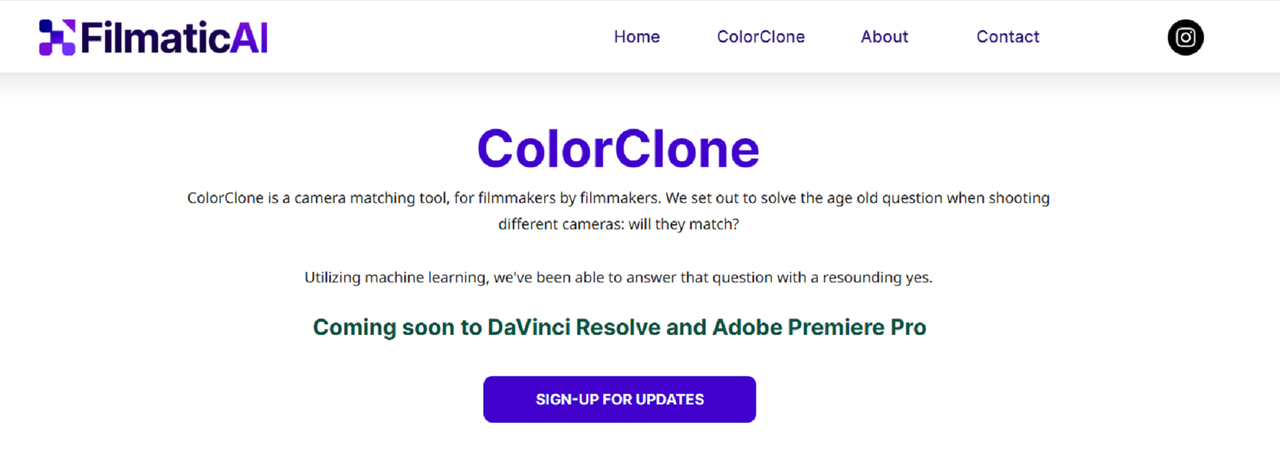
FilmaticAi ColorClone

rand thompson

Well-known member
Joined
Aug 9, 2011
Messages
18,910
Reaction score
615
Points
113
FilmaticAi ColorClone Website


Screenshot-11892.png


Screenshot-11891.png


Screenshot-11893.png


Screenshot-11894.png


Screenshot-11895.png


Andrew,

It seems like everyday some new AI program is getting closer and closer to replacing us,
 
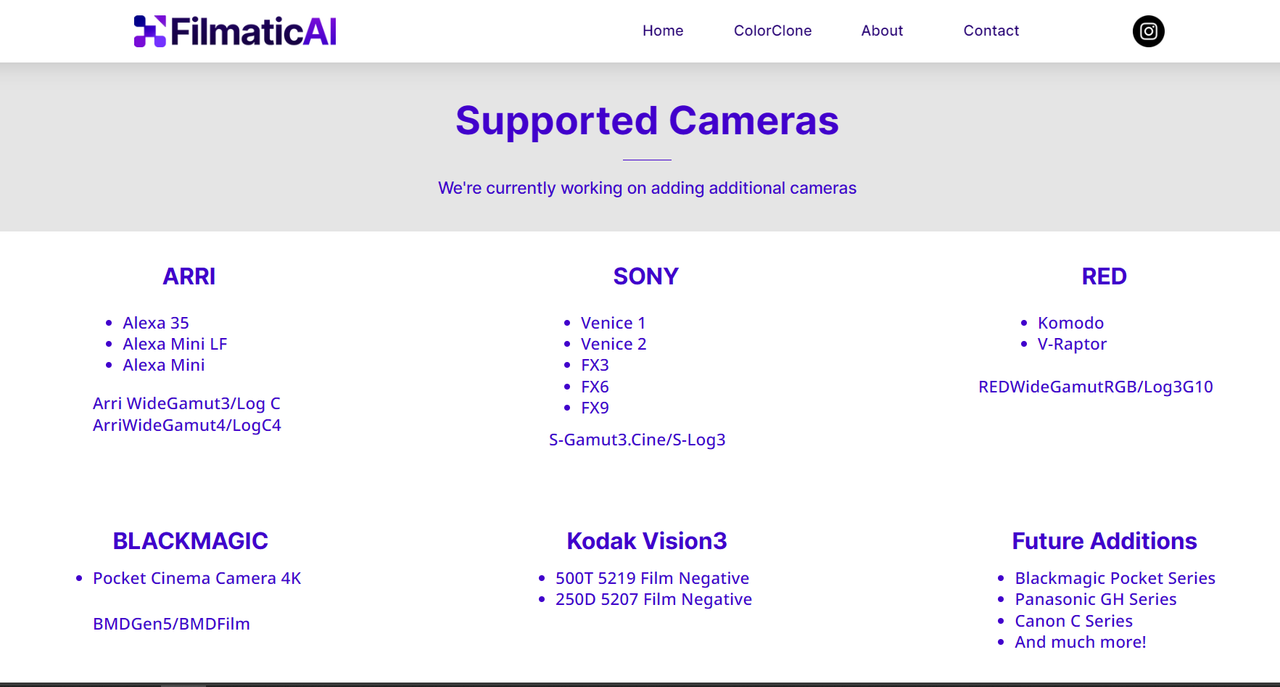
You mean you don't understand how a program that understands the actual color Transforms of the sensor of all the cameras listed above that it supports and to transfer that same color transform to the other cameras on that supported camera list above within a small margin of error in different lighting conditions and in a reasonable over and under exposure range would be considered AI? This program is based on " Machine Learning" which is one of the Hallmarks of any Ai oriented system. Could you give your definition of what constitutes an AI driven tool?
 
Isn't it only a better transform tool using math? Can I have a 5DmkII look from an Alexa35 raw file? Why is it camera based and only for some camera workflows ? Or does it analyse the picture and apply the look to the target picture?
How does it analyse? It detects skin and sky and grass and adapts it? Do the picture have to be from the same subject or can they be from different subjects?
 
Last edited:
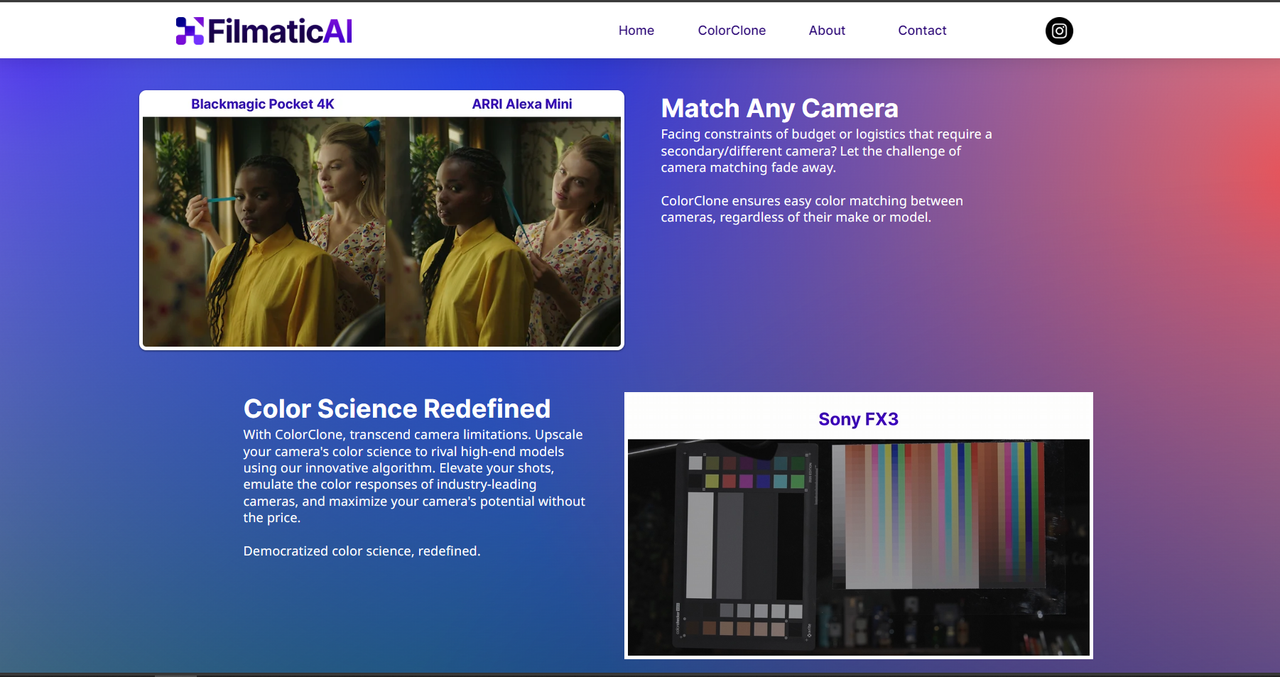
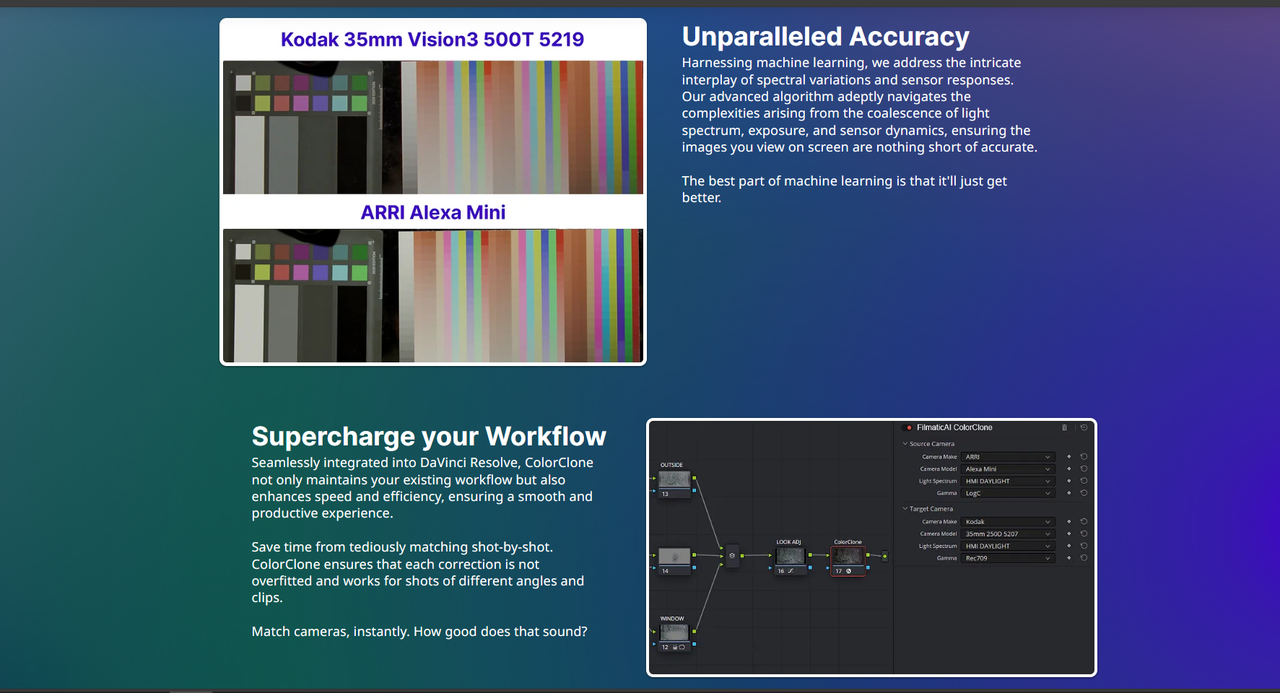
The program as it is explained bases it translation on how a given camera sensor interpret the Color Light spectrum and how a specific sensor Translates those colors and through a machine learning algorithm translates those properties from one camera to another as best it can. This program like many other Ai programs has to be taught how to interpret and apply a set of date from one camera to another. so that process takes time. From what I've seen it seems to only needs the Light source the camera used to film under , HMI etc. The perimeters you describe above is what lesser capable color matching tools use to duplicate color from one camera to another. This program tries in essence to match the Color Matrix of one camera to another under a given lighting condition and duplicates how one camera interprets and displays colors to that of another camera within a certain margin of error.
 
You mean you don't understand how a program that understands the actual color Transforms of the sensor of all the cameras listed above that it supports and to transfer that same color transform to the other cameras on that supported camera list above within a small margin of error in different lighting conditions and in a reasonable over and under exposure range would be considered AI?
What if it's shot really badly? What if it uses a different lens? What if part of the show is on film and part is on digital?

Camera matching is not the nightmare that people think it is. Colorists do it every day of the week, and it's not that big a deal. I think they're playing on the fears of inexperienced people. Hire a good colorist -- problem solved.

There's also so much relighting in what I typically do, and it's not going to be able to reproduce that kind of thing. There's just too much going on in the frame.
 
Marc,

If it's shot badly, that would be problem for both a human and AI. I don't know what perimeters this Ai program has been trained to compensate for currently and how big really would a lens choice affect the programs ability to compensate for data from another camera. I'm sure there will be some things that will need further corrections before or after the Ai program has been applied in the workflow chain. In the support list above, 2 Kodak Negative Stocks are supported. I don't know, since the program is still not available for Resolve or Premiere, if different PRINT films are selectable in the program's dropdown menu or not but I'm sure both Negative film stocks and Print Stocks could be added later after the Ai has been trained for them.

I'm sure any Colorist with any level of talent could reproduce the look of one camera to another based on the Native ISO of the cameras being matched over a limited exposure range. However this program appears to go further than just a Printer Light and or Primary Correction or Color Chart Matching or Color Matirices duplication. It appearsto be able to match how a specific cameras sensor translates the light Spectrum hitting the sensor and how that specific camera maps its chosen Color Space's XYZ coordinates on the CIE Chromicity Visible Light Spectrum chart, atleast in my opinion. How much time would that take Colorist or Color Scientist to do, maybe a few minutes or a few hours and at what hourly rate or fixed cost? I keep qualifying with " it appears" to be able to do this in seconds and at a one time fee or maybe it will be a subscription model. Since it is not currently available to test in Resolve which is what I use, we won't know what the AI is actually capable of and under what conditions it can accurate compensate for until it is released.
 
Last edited:
Since it is not currently available to test in Resolve which is what I use, we won't know what the AI is actually capable of and under what conditions it can accurate compensate for until it is released.
Well, if you lined up Shot A and Shot B in Resolve and matched them, then processed Shot A and Shot B in Color Clone, you could see very quickly buy eye which looked better (or worse). Again, so much of what we do in final color hinges on windows and curves and keys, it's not going to be something they can do quickly and easily.

I think too many people put a lot of faith in AI on stuff that's just not there. To me, you always need a skilled artist -- a DP, a colorist, a sound mixer, an editor, a VFX artist -- to do their individual tasks. I don't think A.I. is going to reasonably replace them. Of course, A.I. Tools will be valuable... in the service of those artists. If we had perfect tracking and noise reduction and automatic rotoscoping and so on, that would save us a ton of trouble. But inevitably, there has to be human intervention.

Production involves so much chaos on set, it takes a ton of effort to wrangle it all into a usable form in ost. And even worse when some of the material is shot under substandard conditions. So much of it is unpredictable and non-linear, I'm unconvinced that an automatic mode will magically fix it.

BTW, there's about 6 or 7 of these "A.I." color schemes out there on the net, and I haven't seen one that impresses me... "yet."
 
I think ColorClone is really only meant to match two cameras you still will have to do any color grading yourself.

I had the opportunity to be a beta tester recently for an actual AI Color grading program. I had the program installed on my computer, however when I tried to run it it wouldn't open. I soon found out that it was meant for Windows 11 and not Windows 10 which my computer's hardware was limited to. Unfortunately or fortunately I had to end my involvement in this Ai Beta testing program.

I said "unfortunately or fortunately " above because I realized that if my computer wasn't hardware limited to Windows 10, I probably would have started using that AI program. I came to the conclusion that if I had started using that AI program I would have relied on it more and more, and that some of the little Tips and Tricks that I've acquired over the years about Color Grading would have faded from me due to not using them anymore on a day to day basis. I would have relied completely on this AI program to solve my day to day color correcting problems.

All of those Tips and Tricks were gained over many years and long hours of hard work along with many failures until eventual success.

I was a painter in my teens mostly of some of the Dark Art that I have posted here over the years and a Photographer on and off. I use to think that no machine or program could ever reproduce what exists deep in the mind and soul of a human being in the realm of artistic expression, that was sacrosanct. When I first saw and tried Midjourney ,an Ai program that reproduced graphic art and photo realistic images, I thought that it was amazing. It was amazing for what it could create with just a command prompt only. However with its 6 or 7 fingered people with weird facial and body symmetry of the first Beta version it was more of a joke than anything to take seriously.

Now however the Digital paintings that have been produced by Midjourney, Dall-E and other AI programs have won art contests over real human artist. And Photos generated by these programs are becoming less and less discernable from photos taken by human photographers. I do sometimes worry how much further these programs will progress at duplicating what I thought was something I as a human should only be able to do.
 
Last edited:

FilmaticAI ColorClone - Film Emulation Demo (Kodak 500T 5219 and 250D 5207) - ARRI, Sony, RED, More!


By FilmaticAI


Back
Top