Welcome to our community

Be a part of something great, join today!

  • Hey all, just changed over the backend after 15 years I figured time to give it a bit of an update, its probably gonna be a bit weird for most of you and i am sure there is a few bugs to work out but it should kinda work the same as before... hopefully :)

Epic vs Alexa Producer Arguement

I would add that for cinema release, my own first inclination would be to shoot on a 4K+ camera.

Great to hear. If you were to shoot on say an Epic, but didn't want it to look too "clean" in theaters, how would you best go about that? Filtration/netting? Old lenses? Or just add the grain/texture in post?

I love what 4 & 5K can do, but I'm also trying to wrap my head around how best to add texture to a medium that is inherently so clean and pure.
 
...
Either way though - I guess my point is not that people won't watch "the avengers" in the future (of course they will). My point was more that what was seen in the cinema today is the maximum resolution that the film will ever be seen - vs Spiderman or Prometheus that could potentially spit out 4k releases someday in the future. Does this really matter when the film looked so great at the cinemas anyway? I don't know, but it seems a bit of a shame in my mind anyway.

...

Brad, I'll say that I'm surprised how much of a market there is for "Re-mastered" material. We went through this in audio with Digitally Remastered. We saw it with the first three Star Wars movies being re-released... even w/ new scenes added. I think that if you put a lot of effort into shooting a huge movie, having the 4K and beyond re-mastering option can be a nice reason to get hinies in the theatres for a second go around. JMHO.
 
I think your strongest arguments for the Epic are:

High resolution
Small size
HDRx
High frame rates

So the question is whether some or all of these qualities would be valuable or useful for your project? I mean, if you are making a commercial where a middle-aged woman sits on a couch and talks about some health problem she is having in a medium shot and a close-up, I doubt you'll be doing a lot of resizing, efx compositing, slow-motion, or handheld shots inside a tiny space, etc. -- but maybe you are doing a spot that needs what the Epic can deliver and the Alexa cannot.

(Oh I now see that Bruce made the same points that I did, and more...)

I'm sorry, but I have to do this:
DAVID MULLEN MENTIONED MY NAME! I FEEL AWESOME!

I'm sure everyone has their own moments of pride when David first tells them that they actually said something right on the Internet but I think this is the first time this has happened for me since like 2007. Not sure if I should be proud that it happened or more just sad that it took me 5 years of constant typing to get to this point :)

Thank you for bearing with me on that. OK, back to topic.

Thank you all for all the great info and options, all very useful. One point I think is being missed here is that last year we shot these spots on Alexa with SXS cards only, no Codex. So the theatrical portion of the job will be shot only on SXS cards if we shoot Alexa again. That being said, can I make a good case that the difference between Epic 5K and Alexa SXS (1080) would be noticeable on a big screen?

I'd say... in general, perhaps not. I'd say both will look great if you're projecting at 1080p. Sorry.

MAYBE if really fine details are super-important. If it is a tablecloth commercial selling fine color patterns or something. On the other hand the Alexa has more dynamic range (without HDRx complications) and does have a rather nice look out of the box that less-skilled or less-tech-savvy colorists sometimes find easier to work with.

You're gonna have to sell the Epic on other things.

I have finished stuff at 4K in the theatrical movie trailer title world (which you'd think would be rather important to have at the crispest, highest resolution possible).

However, most of the time, this gets sampled down to 2K in the finish. The finisher just wants 4K because we're doing a lot of CG with fine artificial lines and they want total control over the pixel-level blurring / sharpness when creating their 2K master.

- I think that the Ocean's 13 trailer title was the first thing we rendered at 4K. Which was ironic, because we were using Standard-Def quicktimes of movie fireworks for the background (the original film scans were unable to be located by the stock footage house when it was approved for finish)
- The Informant trailer title was 4K (I guess Soderbergh likes 4K :)
- The title for the Inception trailer was rendered at 4K (because... IMAX)
- Harold & Kumar trailer gfx I delivered at 4K (the teaser at 2K) because of all of the fine fabric textures in the orange jumpsuit backgrounds - they wanted to have control over that in the finish
- 3D files for the Avengers main trailer title were actually rendered at 6K but that was more to just combat aliasing / motion issues with the particular render technique used. Again, I think that the finishers just did a nice scale down / blur / sharpen to taste to make a 2K master. All VFX shots were delivered 2.1K.
- Underworld Awakening we delivered at like 2.8K because they were mastering the whole film that way for IMAX release

However, most of the theatrical stuff we deliver is 2K: Thor, Sherlock Holmes 2, District 9, The A-Team, The Vow, Harold & Kumar 3, The Smurfs, The Men Who Stare at Goats, Rio etc.

We did however just finish a bunch of in-movie graphics for The Dictator and these delivered 2.8K to match the Arri native resolution. My guess is that they just wanted to work at 2.8K and will scale down and make a 2K DCI at the end but you never know.

Yeah, I delivered Lifetimes "Client List" 30sec spot to Theaters two months ago, and the maximum resolution allowable was still 1080p.

Aye... may things change in 2013!

Bruce Allen
www.boacinema.com
 
If you were to shoot on say an Epic, but didn't want it to look too "clean" in theaters, how would you best go about that?

I love what 4 & 5K can do, but I'm also trying to wrap my head around how best to add texture to a medium that is inherently so clean and pure.

Do some tests shooting @ 1600 asa. You will see another picture and it's an "in camera" choice.
But keeping the same noise level throughout the picture is quite difficult as your exposure should be 100% spot on.

But worth the try.

Patrick
 
Well, to be precise, the recorded area of the sensor is 2880 pixels across in ARRIRAW.

It's a bit silly to say that "The Avengers" is not future-proofed though -- it looked great on a big theater screen. Many older 35mm titles are not going to resolve 4K worth of measurable detail either but one isn't going to say that they aren't future-proofed because of that. People rarely decide to re-watch old movies based on how much resolution they have. Does "Casablanca" resolve actual detail at 4K? Does "The Godfather"? Do those movies look sharper and more detailed than "The Avengers"? And what about movies shot in Super-16? No future for them?

I also saw some of "Think Like A Man" projected digitally before I went in to see "The Avengers", and that was shot on the Epic -- it looked great, but it was shot with Classic Softs and net filters and there is no way that the image is 4K in resolution even if it were mastered at 4K. So you end up seeing two movies, one shot at 2.8K with no diffusion and the other shot at 5K with diffusion, and the end result is about the same level of detail, so why is "Think Like A Man" future-proofed but "The Avengers" not?


David, while I do agree with you, let me say that I just watched the ROCKY series and in particular the first ROCKY, in a Blue Ray version...


IT WAS ABSOLUTELY HORRIBLE!!

The grain was so much that was really not a pleasure to watch it at all, this is what I mean as future proofing your material, now you can, so why NOT???

They are many titles out there which have been for ever ruined, but now that we do have the technology, I do wish for people to think of that, I do, and I always push for the maximum recording capacity any time all the time.


Alexa, can be upscaled to 4k with good results, I have seen it, but Epic does it natively and above that, so choosing Alexa over Epic for big projects, is just plain ridiculous, I don't care how big the director is, if I meet him I'll tell him strait out what a BIFG mistake that was.

The Avengers looks great... On Epic would have looked better, and for a much longer time on a different line of higher quality projected media or via 4k Displays... ;)


@STEVE... For Theatrical release... DON'T HESITATE... GO RED EPIC!!

Btw, if you are renting, Epic is not cheaper, Alexa at list here in Europe is literally been given away, half price with an additional discount which makes it actually cheaper then renting an Epic, reason why now some rent their Epic at 600 Euro per day full package, about $780 US.


I'm talking form DIRECT experience, go RED EPIC Seve, this tests were done in a big budget full day series of test shots, one against the other!!


And some times size those matter, but in the opposite way... ;)

278203_1854335838719_1250491988_31596583_1034855_o.jpg


280194_1854323518411_1250491988_31596537_973189_o.jpg
 
David, while I do agree with you, let me say that I just watched the ROCKY series and in particular the first ROCKY, in a Blue Ray version... The grain was so much that was really not a pleasure to watch it at all, this is what I mean as future proofing your material, now you can, so why NOT???
Rocky was a very modest-budget ($1.1M) movie that won 3 Oscars and made $220,000,000. I think we can assume it's future-proof in that it's an iconic movie that will be known for many decades to come, just like Godfather, Jaws, Star Wars, and many other culture-changing 1970s movies.

All movies shot on film have a degree of grain and noise. In particular, during the 1970s, film stocks were grainy, Kodak was going through a period of experimentation (including some very bad, unstable negative stock and intermediate stock), and it's the way things are. Hey, I guarantee you, 1976 videotape looks 1000 times worse. Great mastering and archival restoration can reduce or even eliminate grain to the point where it's not a factor, but the studios have to want to spend the necessary time and money to make that happen.

Future-proofing to me is more about popular culture. People aren't gonna care about the "K" -- they're gonna care about stories, characters, direction, and to some degree, the technical elements like lighting, editing, and color-correction. Blockbuster movies like Avengers ain't gonna vanish 20 years ago solely because they're not in 4K.

The Epic (and Scarlet) are perfectly valid tools, as is the Alexa, the Sony F65, and even the (not-yet-released) Canon C500. I bet in the right hands, they'll all make acceptable pictures for the o.p.'s project. To a producer, I'm not sure there's any valid reason to choose one camera over another except cost, time, and the preference by the DP.

My advice: shoot some camera tests with both, project them in a great room, and see what the director thinks. I know of a case with a major $200M film coming out this summer where the director (a former DP) did his own shoot-out with 5 digital cameras. Film won out, but the Alexa was a very, very close second. And the director was picking images without knowing what they were -- it was a "blind" test as far as what camera made what image. He didn't care about the technology at all; he only cared about the pictures.
 
Rocky was a very modest-budget ($1.1M) movie that won 3 Oscars and made $220,000,000. I think we can assume it's future-proof in that it's an iconic movie that will be known for many decades to come, just like Godfather, Jaws, Star Wars, and many other culture-changing 1970s movies.

All movies show on film have a degree of grain and noise. In particular, during the 1970s, film stocks were grainy, Kodak was going through a period of experimentation (including some very bad, unstable negative stock and intermediate stock), and it's the way things are. Hey, I guarantee you, 1976 videotape looks 1000 times worse. Great mastering and archival restoration can reduce or even eliminate grain to the point where it's not a factor, but the studios have to want to spend the necessary time and money to make that happen.

Future-proofing to me is more about popular culture. People aren't gonna care about the "K" -- they're gonna care about stories, characters, direction, and to some degree, the technical elements like lighting, editing, and color-correction. Blockbuster movies like Avengers ain't gonna vanish 20 years ago solely because they're not in 4K.

The Epic (and Scarlet) are perfectly valid tools, as is the Alexa, the Sony F65, and even the (not-yet-released) Canon C500. I bet in the right hands, they'll all make acceptable pictures for the o.p.'s project. To a producer, I'm not sure there's any valid reason to choose one camera over another except cost, time, and the preference by the DP.

My advice: shoot some camera tests with both, project them in a great room, and see what the director thinks. I know of a case with a major $200M film coming out this summer where the director (a former DP) did his own shoot-out with 5 digital cameras. Film won out, but the Alexa was a very, very close second. And the director was picking images without knowing what they were -- it was a "blind" test as far as what camera made what image. He didn't care about the technology at all; he only cared about the pictures.


Sorry Marc, while I know you are right, and made the same exact points which were well known to me when I posted this, I comletely disagree with your assestment, as to me is not about future proofing something as an ICONIC, I actually want to be able to enjoy seen the movie, not teh GRAIN... ;)
 
Just finished working on 2 Alexa tv-spots and am currently working on 3 web videos shot on Alexa right now. Here would be my personal opinion. Resolution doesn't matter. They're going to compress the living daylights out of whatever you deliver to them anyway. And let's be honest, those last years worth of spots probably don't see the light of day--shoot for today with commercials because tomorrow they go in the trash bin never to be seen again. Maybe you'll get a bit less moire if you shoot 5k instead of 2.5k. But I assume wardrobe and set will be run through camera tests anyway so that shouldn't be a problem either way.

If it's an open window and a slow dolly you might save some time with HDRx. Ultimately though... ask your post house and your DP what they're most comfortable with. What they know best they'll do best. Simple as that. If there was VFX work I would have a very different opinion but honestly it's pretty hard to screw up a stage shoot to the degree that there would be any difference between the two. Personally I like the look of RED better and I think it's easier to work with.

One argument you could make to try and tip the scales in RED's favor is that you are new to RED, you haven't shot anything on RED before so this would be a great "safe" opportunity to expand your options for a job where RED might be the clear choice. Build your network of post houses who understand the Red workflow and can get the most out of it.
 
Alexa RAW is 3.5K. Adding that extra 0.5K to get it to 4K RAW isn't going to change much, if anything.

Um, 2880 across. - quote from Arri website: "16:9 sensor mode: 2880 x 1620 for ARRIRAW, 2880 x 1620 down sampled to 1920 x 1080 for HD video and ProRes 4:3 sensor mode: 2880 x 2160 for ARRIRAW, 2880 x 2160 down sampled to 1440 x 1080 (pillar box) for monitoring in EVF-1 and HD video (MON OUT only)"

Measured resolution will of course be less.

Graeme
 
So you end up seeing two movies, one shot at 2.8K with no diffusion and the other shot at 5K with diffusion, and the end result is about the same level of detail,
- there appears to be some in-built diffusion on the Alexa's optical low pass filter stack though. You can clearly see this when you have a really bright light in the corner of the shot and the broad glow extends over most of the image, yet on other cameras (same lens) the glow is contained to the area of the light itself.

BTW, I saw some strongly filtered Epic visuals the other day and it was a very interesting combination of resolution and softness, no doubt because of the high MTF of the REDs are low and medium frequencies and how that interacts with the filtration. I should really make time to plot some MTF curves and see what is going on.

Graeme
 
Um, 2880 across. - quote from Arri website: "16:9 sensor mode: 2880 x 1620 for ARRIRAW, 2880 x 1620 down sampled to 1920 x 1080 for HD video and ProRes 4:3 sensor mode: 2880 x 2160 for ARRIRAW, 2880 x 2160 down sampled to 1440 x 1080 (pillar box) for monitoring in EVF-1 and HD video (MON OUT only)"

Measured resolution will of course be less.

Graeme


And that was why they went with Epic instead of Alexa, after seen the 4k footage, Alexa just simply does not do well in upscaling to 4k, but I do fill sorry for her especially against the Super crisp 4k Epic produces... ;)
 
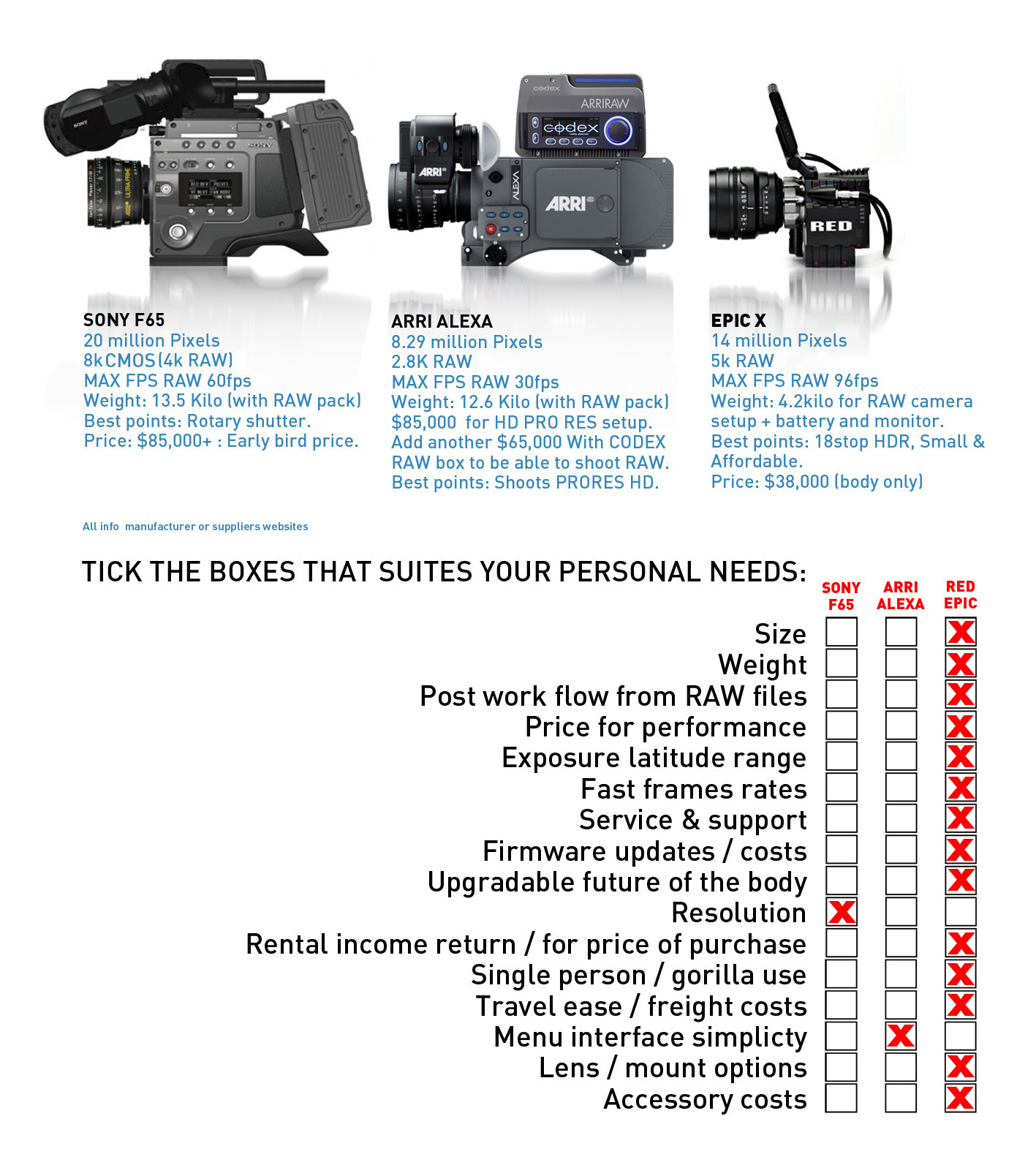
I hate to bring this out again... but just tick the boxes that suite you...

The problem with that list is it is hugely geared towards making Epic look the best.... For instance, you could throw a GH2 into the mix and it would arguably get as many ticks as the Epic, because you have set the list up to be biased towards a smaller, cheaper camera.

I'm not wading into an Epic/Alexa debate, as it is simply horses for courses..... But that list doesn't paint a very full picture, in my opinion (pitting HDRx against native DR, for instance).
 
For every camera there is the appropriate job to use it on. The goal of the Epic is that it's appropriate in a vast number of jobs by virtue of it's image quality, size, weight, fps, etc. etc.

Graeme
 
- there appears to be some in-built diffusion on the Alexa's optical low pass filter stack though. You can clearly see this when you have a really bright light in the corner of the shot and the broad glow extends over most of the image, yet on other cameras (same lens) the glow is contained to the area of the light itself.

BTW, I saw some strongly filtered Epic visuals the other day and it was a very interesting combination of resolution and softness, no doubt because of the high MTF of the REDs are low and medium frequencies and how that interacts with the filtration. I should really make time to plot some MTF curves and see what is going on.

Graeme

I reallly like to put old crappy glass in front of the Epic exactly because of this.
 
For every camera there is the appropriate job to use it on. The goal of the Epic is that it's appropriate in a vast number of jobs by virtue of it's image quality, size, weight, fps, etc. etc.

Graeme

I'm not dismissing that, in any way. I love using the R1-MX and Scarlet and look forward to using Epic, some day.

I just see that list appear every time there is a "versus" debate and it is set up in a way to deliberately make Epic come out on top... Makes me roll my eyes.
 
This is Reduser Jay. The name alone says it all. Biased? Of course. It would be weird if it wasn't. Red employees and enthusiasts cheering Red? Why not?
 
A wealth of knowledge and information, thanks to everyone. I feel that going into this discussion I'm much more prepared to try and "sell" my desire to shoot Epic, but at the same time not force them into it. I think I'll stress the larger frame size to be able to push in on shots, the 5K resolution for the theatrical versions, and the b-roll (small crew) aspects.

As far as workflow goes, in the past he's done edits "in house" before final color correction and delivery. Will transcoding to an Avid friendly format out of RCX be anything more then the time needed to do the transcoding (no Red Rocket)? BTW, we don't shoot all that much footage. After which, will he be able to work with all the footage as he has when shooting Alexa. Sorry for my post ignorance.
 
Back
Top