Welcome to our community

Be a part of something great, join today!

  • Hey all, just changed over the backend after 15 years I figured time to give it a bit of an update, its probably gonna be a bit weird for most of you and i am sure there is a few bugs to work out but it should kinda work the same as before... hopefully :)

EPIC Timelapse Functions - coming soon?

Ah.

I see. Thanks for that Deanan. That helps me understand it better. Must be tricky stuff. This explains the hot pixels too.

Wonder if it would be possible if the camera is set to single frame capture. Like if it was capturing a 1 frame r3d as comparable to a single frame on a DSLR. Or is it more that the shutter is electronic and the way the sensor scans?


David.
 
Last edited:
Glad to know you guys are working on it. :)
 
Ah.

I see. Thanks for that Deanan. That helps me understand it better. Must be tricky stuff. This explains the hot pixels too.

Wonder if it would be possible if the camera is set to single frame capture. Like if it was capturing a 1 frame r3d as comparable to a single frame on a DSLR. Or is it more that the shutter is electronic and the way the sensor scans?


David.

it's the physical shutter, not the electronic one...
 
I'd still prefer to have Playback right now...
 
it's the physical shutter, not the electronic one...

I guess i was asking this.

Is it possible to open the shutter longer if you are only recording one frame (like a bulb exposure). So you'd only record a one frame r3d with a bulb type exposre (same principle as recording a RAW image sequence to multiple files, but those files are 1 frame r3d instead of long exposures one file.

For example. 300 one frame r3d's instead of 300 frames in one r3d.

Might that allow the shutter to be open for longer than a half second.

Also, please understand that I am trying to better understand how it is different in RED than it would be in FILM or a DSLR.

Thanks,
David
 
It all has to do with that dark frame extraction bit. With a DSLR, there is a physical shutter, so a dark exposure for sensor profiling and noise reduction can be used for long exposure work. The new "mirrorless" SLR cameras still have a shutter, even if it's a switching LCD mask or other other electronic means of blocking light. With a camera like the RED One or EPIC, there is no physical shutter to actually block light from passing to the sensor. This is why we do black shade calibration for the cameras and need to do subsequent shading calibrations any time we drastically change our settings for exposure time or environmental factors. The electronic "shutter" or setting for exposure time on the M or MX sensor is just the interval between the sensor reset and the next polling or read of the exposure data.

I do think long-exposure should be possible, but it's probably going to take a more involved approach to profiling the sensor and accounting for exposure errors and the degradation of signal to noise as the exposure time grows longer.

Even with DSLRs, long-exposure is a crap shoot at times. Most of them do significant in-camera noise reduction and image processing and we still end up with lots of hot pixel and fixed-pattern noise issues, especially with under-exposed images like night sky, star-trail type exposures.

With the increased sensitivity of these new sensors and good fast lenses, it's possible to achieve many of the same effects we get from long exposure by shooting higher frame rates and then combining frames in post. To use the star-trail example, this can be done easily with multiple exposures as an alternative to individual long exposures. Other results of long exposure photography are not so easily achieved...

@ Tom, I think playback is the number one feature on the to-do list as far as all of us are concerned.
 
@ Jeff.

THis completes my understanding of the difference from the technical perspcective I was looking for.

It makes a lot of sense.

I have had excellent results with the R1 and R1 MX when the shutter is set to 1/2 second and the black shading is done at temperature with that setting.

Your explaination helps a lot.

Thank you.

David
 
@ Tom, I think playback is the number one feature on the to-do list as far as all of us are concerned.

Agreed, although RED has shown an uncanny ability to mult-task and surprise us with quantum leap upgrades. I'm very interested in this timelapse function so that I can stick with an all-R3D workflow, as far down the delivery pipeline as possible.
 
It all has to do with that dark frame extraction bit. With a DSLR, there is a physical shutter, so a dark exposure for sensor profiling and noise reduction can be used for long exposure work. The new "mirrorless" SLR cameras still have a shutter, even if it's a switching LCD mask or other other electronic means of blocking light. With a camera like the RED One or EPIC, there is no physical shutter to actually block light from passing to the sensor. This is why we do black shade calibration for the cameras and need to do subsequent shading calibrations any time we drastically change our settings for exposure time or environmental factors. The electronic "shutter" or setting for exposure time on the M or MX sensor is just the interval between the sensor reset and the next polling or read of the exposure data.

I do think long-exposure should be possible, but it's probably going to take a more involved approach to profiling the sensor and accounting for exposure errors and the degradation of signal to noise as the exposure time grows longer.

Even with DSLRs, long-exposure is a crap shoot at times. Most of them do significant in-camera noise reduction and image processing and we still end up with lots of hot pixel and fixed-pattern noise issues, especially with under-exposed images like night sky, star-trail type exposures.

With the increased sensitivity of these new sensors and good fast lenses, it's possible to achieve many of the same effects we get from long exposure by shooting higher frame rates and then combining frames in post. To use the star-trail example, this can be done easily with multiple exposures as an alternative to individual long exposures. Other results of long exposure photography are not so easily achieved...

Wow. I never thought that way. Thank you for such detailed information, very helpful. Do you know if the EPIC (after fully functioned) would have the same functions as the R1?.. Or some functions that only the R1 has and they will be discontinued for the EPIC?.
 
a coupla questions about shooting timelapses with the EPIC-M...

I finally had a chance to run a few experiments. The results were not too shabby, the test shots turned out smooth, good color rendering and virtually flicker-free, but raised a couple of questions.

I set my camera to 1fps - shutter 1/1

Three attempts at black shading calibration failed (sensor cap on, outdoors). I reset the shutter to 1/8 and the calibration succeeded, and then I reset shutter back to 1/1. This seemed to do the trick. (I did shoot a test shot at 1/8, but it seemed a little stuttery in broad daylight)

Questions for Deanan, if he is still reading this thread - first, what would cause the 3x failure? Is the camera supposed to black shade at 1/1 - is this a possible bug in my camera?

Black shading takes much longer on the EPIC - about 11 minutes - and so 3 failures = 1/2 hour just trying to get the camera re-calibrated without success (almost 40 minutes, if you count the successful one)

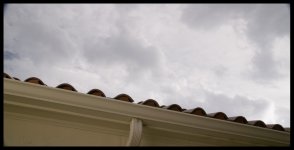
here is a screen grab of the test - I shot part of my roof, so that I could get some idea of color rendering...ND 1.2 to stop down enough to accommodate the 1/1 shutter at T8 and ASA 800- I'm going to try some night/moon shots soon, because I'm pretty impressed with how much light hits the sensor.

Not a bad start, RED, I'm very interested to see how far you can take this timelapse function, considering this is just the beginning.

But the thing that impressed me most (having nothing to do with timelapse) is that I shot this with my 18-50mm RED lens at 18mm and the vignetting is not terrible - I expected much worse. Though I've had the camera several months, it has been busy on a couple of features, shooting primes, and I haven't had time to do basic testing of the gear I have. This is a pleasant surprise. I can deal with it, for many applications, where I'll be framing and cropping anyway.
 

Attachments

  • TimelapseGrab.jpg
    TimelapseGrab.jpg
    95.4 KB · Views: 0
The shutter on a DSLR lets the cameras do a dark frame subtraction
automatically. Without that, it's way harder to do longer exposures
but it is something we are working on.

Sounds great. Hopefully you can do this. However, if this proves impossible, what if it was done in conjunction with a capping shutter (obviously prefer not to use a capping shutter)?
 
Back
Top