Welcome to our community

Be a part of something great, join today!

  • Hey all, just changed over the backend after 15 years I figured time to give it a bit of an update, its probably gonna be a bit weird for most of you and i am sure there is a few bugs to work out but it should kinda work the same as before... hopefully :)

Dynamic Range Capabilities of RED MX Digital Camera

I like to know theoretical limits and expect a manufacturer to give me scientific lab results. I personally use a methodology like David's with both charts and scenes on location. Each has it's own value and both need to be considered together. Well rounded conclusions can only be drawn from multiple, reliable data sources.

Remember when you were in school and you turned in a research paper with only one or two resources? You either got the paper back with instructions to quote more sources, or you got a D or F. Some folks didn't learn the lesson that exercise was meant to teach. I would naturally question their conclusions.

Graeme and I got similar results :)
 
My plan for DR testing is use every chart and method I have available. I have Stouffer wedges (multiple ones), Arri chart, DSC102 18stop chart, and then I have DSC charts for shooting bracketed exposures. I have precise measurement gear, and more commonly used light meters. Jim will tell you I'm never happy until the image looks good and it measures good. Just measuring good or looking good is not good enough for me. For DR testing I'm only happy when I'm getting similar results from all the methods I have available.

Graeme
 
12bits = 11.5 stops, 14bits = 13.5stops - 5 stops = latitude

12bits = 11.5 stops, 14bits = 13.5stops - 5 stops = latitude

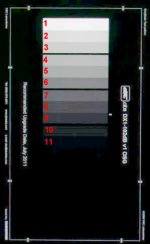
I was wondering if you have a TIF of the backlight test chart full size, in the jpg its hard to see more than 11 stops (see attached).

This does not seem to be something that requires debate,

When you reduce a large image with "noise" the noise averages so you get more usable shadow detail if things are working right.

If you have a good sensor, preamp, and ADC you get about the number of bits minus one half step if the gain is set to one stop per bit, so,

12bits = 11.5 stops (with maybe 25pixels averaged in a DVD size image from 4K source)

14bits = 13.5 stops (also with a reduced size image, if you look at just one pixel the range is lower in any single frame, but with temporal noise reduction you can regain the stops, if you reduce and use temporal noise reduction such as NeatVideo or ARRI relativity you gain dynamic range because the noise is less noticable, including some of the compression artifacts.)

To get a useful latitude value you subtract 5 stops because the delta between 90% white and 18% gray, and between 18% gray and ~2% black is about 2.5+ stops.

If you look at the DPX standard, 18% gray is 470, and 90% white is 685, and black is 95.

Each stop is 90 points, so for a film scan Kodak uses this standard,

(685-470)/90 = 2.388 stops between mid-tone and full white.

(470-95)/90 = 4.166 stops between mid-tone and full black

(685-95)/90 = 6.55 stops between white clip and black clip

2.38+4.16 = 6.5 stops dynamic range in graded results without softclip used. (the scanner is in ratio, but the film can have toe compression)

That is a bit more than the 5 stops you get using +/- 2.5 stops, but the dark end on the DPX log curve can loose a stop and a half before you notice that the black is gone very gray, so 5 stops can be taken as the minimum range needed maybe, anything less would not look right on normal subjects with flat lighting even if you boost the contrast a bit in grading.

So to take photos of real subjects you need 2.5 stops above midtone at the top end, and 2.5 stops above usable black (between dark gray and mid-tone) at the bottom end.

so with 12bits ADC as in M you get 11.5-5= 6.5 stops for low contrast subjects with flat lighting.

and for 14bits ADC as in MX you get 13.5-5= 8.5 stops for low contrast subjects with flat lighting.

If you think that the wavelet compression is having some extra macro noise, then maybe the MX is closer to a usable exposure latitude of 7 to 7.5 stops for small results and about 5 to 6 stops for full size use with more normal subjects and lighting.

Most of the time movie film cannot be under-exposed 2.5-3 stops without pushing it in the lab, nor would you overexpose it 2.5-3 stops without pull processing it in the lab.

Although film will do better with bright highlights if processed right, the sensors have an advantage at the lower end since film goes very rough at 3 stops under, so for today film vs. MX is not such a big issue if you know what you are doing, use an 80 series filter for low K, and have enough fill light, one would think...

Because you can use temporal noise reduction on film as well as digital source frames, its a bit like Anabolic Steroids, if film scans are processed with temporal noise reduction to get "better than real" results, then if digital footage is NOT processed in temporal noise reduction then it may look worse, but its not a fair game, film looks VERY bad without digital beautification, as I have found out with much sorrow, our film scanner sees each grain in great detail, and all the muck, and dust, and scratches, its almost better to scan with the lens out of focus and a vibrator on the gate to get the resolution down so you don't see what film really looks like.

Film now is so processed and mixed with CGI that people do not know what part of the image was film and what part is digital processing.

The same goes with "RAW" images from a digital cinema camera, if you run them through the same processing steps used to "clean up" film scans, then the usable dynamic range goes up because you gain a stop or two at the bottom end before the "noise" becomes to heavy.

If you average 65535 or more frames you can then measure the dynamic range without noise other than the fixed pattern noise in the sensor. Dynamic range is for a single tone subject, to get usable latitude you must subtract between 5 and 6.5 stops from the dynamic range.
To get latitude for exposure tolerance you divide the latitude by two, so:

13.5 - 6.5 = 7 / 2 = +/- 3.5 stops.

11.0 - 6.5 = 4.5 / 2 = +/- 2.25 stops

So something between +/- 2 and 3 stops depending on if you temporal noise reduction or not?
 

Attachments

  • REDDMXB.JPG
    REDDMXB.JPG
    28.9 KB · Views: 0
Most of the time movie film cannot be under-exposed 2.5-3 stops without pushing it in the lab, nor would you overexpose it 2.5-3 stops without pull processing it in the lab.

Very very true!

Although film will do better with bright highlights if processed right, the sensors have an advantage at the lower end since film goes very rough at 3 stops under

Also true

Film now is so processed and mixed with CGI that people do not know what part of the image was film and what part is digital processing. The same goes with "RAW" images from a digital cinema camera

Good point

Prost,
Rich
 
There is a video presentation like a slide show about that G & D MX DR test

“Film And Digital Cinematographers Technologies And Its Synergies”

Video>>>
 
Yes, and it makes even less sense than his article.

Graeme
 
I
If you think that the wavelet compression is having some extra macro noise, then maybe the MX is closer to a usable exposure latitude of 7 to 7.5 stops for small results and about 5 to 6 stops for full size use with more normal subjects and lighting.

Most of the time movie film cannot be under-exposed 2.5-3 stops without pushing it in the lab, nor would you overexpose it 2.5-3 stops without pull processing it in the lab.

I don't know if you are implying that the M-X Red has more DR or latitude than a scan of a film negative, but if so, this does not relate to any real-world experience I have had. However, if you are suggesting that you cannot rate a film stock much beyond its optimal rating in order to retain maximum usable dynamic range because it's not linear, I agree.
 
What everybody forgets is that we have to squeeze all that available DR/&latitude into a deliverable that will carry 7 stops AT BEST! 3over, 4under. Ask Ansel. Embrace contrast.

Yep- and what is interesting is that Ansel "measured" DR by evaluating it in the final print ...

Knowing how much range there is in the capture medium, and then knowing how to most effectively distribute that range in the delivery medium to get the desired results is what is key IMO.
 
Ya know, I want as much DR as I can get, when shooting, but then in post I let highlights blow out and I crush the blacks :) I want it all, I want my cake...
 
Back
Top