Welcome to our community

Be a part of something great, join today!

  • Hey all, just changed over the backend after 15 years I figured time to give it a bit of an update, its probably gonna be a bit weird for most of you and i am sure there is a few bugs to work out but it should kinda work the same as before... hopefully :)

Dragon Sensor, Tungsten or HMI (Native WB?)

Ron Michaels

Well-known member
Joined
Apr 17, 2016
Messages
104
Reaction score
0
Points
0
Sorry guys, I have read a few posts on this topic, however I am a little more confused now. I have read conflicting reports on the issue. I have contacted Red support, however I haven't heard back from them yet. Question is, what is the native White Balance for the Dragon Sensor? Is it 5600k, 5000k or is it around 4400k? It seems most prefer using HMI lights with RED's, not only for the obvious reasons (power, GEL's, heat), but because I've read that Dragon Sensors may have a native daylight WB. Is it true that Tungsten causes a loss in the blue channel and introduces noise? From my understanding, Tungsten is and always has been the best light for reproducing true color, but it seems to be the opposite for digital. I have also read that dragoncolor2 does a much better job at compensating for this. True, False, other?

Thanks again guys, lots of input here,
Ron
 
Ron,

I too am unsure of the native white balance of the Dragon Sensor. I have read it is more like 4400K but I have seen no actual proof or testing. Regardless in day to day work there is little practical difference. Assuming you are correctly exposed the blue channel in tungsten should be no issue and it never is for me. If I am shooting in studio and it's all about skin I prefer tungsten as its a smooth and continuous source with no spikes. If you are ever worried by blue channel noise you can always also drop your ASA to put a little bit more light on your sensor.

Don't underexpose and you never need to worry.
 
Most digital sensors don't like lower kelvin temperatures. I'm not sure exactly where the native WB falls, but an ISO 800 image at 5600K will be generally cleaner than at 3200k. The STH OLPF seems to introduce a bit more red channel noise at higher ISOs than the STD or LL versions. If I'm shooting indoors and can control tungsten light I will expose to a 320 ISO, if I am shooting outdoors I will push the ISO a bit higher. I also find its a bit critical to light for 5500k at low ISO for green/blue screen to keep the noise manageable. Shooting in 6K helps compress the issues quite a bit though. The resolution is definitely your friend.
 
Everywhere I look it seems people recommend shooting tungsten with a 80c CTB filter on the lens to get the best color, like film...
 
The signal-to-noise ratio of a silicon pixel drops as the signal drops. Thus, to minimize noise, you want the largest possible signal (without clipping other pixels).

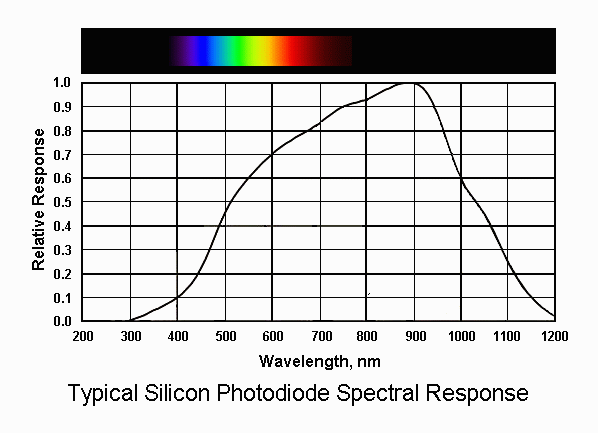
The typical spectral sensitivity of silicon looks like this:

sipdresp.gif


Which means it is typically 2x more sensitive to red light than blue light. The tungsten spectrum has more than 4x more energy in the reds than in the blues, whereas the daylight spectrum has about 25% more energy in the blues than the reds:

SB8opNy.png


The daylight curve *almost* offsets the natural silicon sensitivity curve, meaning that daylight white (or perhaps open shade) provides the most consistent levels of signal to noise across all photosites. Tungsten, on the other hand, starves the hell out of the blue channel, which is then amplified by silicon's reduced sensitivity to that part of the spectrum.

If you multiply the spectral sensitivity curve of silicon by the spectral energy curve of the light source, you can see how flat the overall function is--flatter is better for more consistent signal/noise ratios.

Just eyeballing the above graphs you can be fairly certain that daylight, not tungsten, is the preferred color temperature source for RED and any other silicon-based sensor technology.
 
Insane, Love the folks on here! You are awesome Michael.
 
So does this mean CRI is not as important?
 
The signal-to-noise ratio of a silicon pixel drops as the signal drops. Thus, to minimize noise, you want the largest possible signal (without clipping other pixels).

The typical spectral sensitivity of silicon looks like this:

sipdresp.gif


Which means it is typically 2x more sensitive to red light than blue light. The tungsten spectrum has more than 4x more energy in the reds than in the blues, whereas the daylight spectrum has about 25% more energy in the blues than the reds:

SB8opNy.png


The daylight curve *almost* offsets the natural silicon sensitivity curve, meaning that daylight white (or perhaps open shade) provides the most consistent levels of signal to noise across all photosites. Tungsten, on the other hand, starves the hell out of the blue channel, which is then amplified by silicon's reduced sensitivity to that part of the spectrum.

If you multiply the spectral sensitivity curve of silicon by the spectral energy curve of the light source, you can see how flat the overall function is--flatter is better for more consistent signal/noise ratios.

Just eyeballing the above graphs you can be fairly certain that daylight, not tungsten, is the preferred color temperature source for RED and any other silicon-based sensor technology.

So would adding a cooling filter like a CTB help remove noise if shooting in tungsten environment?
 
So would adding a cooling filter like a CTB help remove noise if shooting in tungsten environment?


This will decrease RED and Green channel levels so if you can compensate the whole exposure and give the sensor more light (opening your lens stop) yes this would remove noise (in the blue channel) as your RGB channels will have the same ammount of light. Clipping would also appear at the same RGB point for a white subject. But this only if you can compensate by giving more light to your sensor. Other wise it's best to give your sensor as much light as possible (city night scene) and not starve the other channels (RG) therefore not filtering your shot with a CTB.

Pat
 
It's also worth clarifying that this is a characteristic of *all* silicon/CMOS sensors (CCDs were perceptibly less susceptible because they had an entire chip tweaked and dedicated to R,G, and B [or at least that's what I was told]). MX is noticeably less sensitive in the blue channel than Dragon, and Dragon still isn't quite as good as ALEV (likely due to Alexa's lower resolution = bigger photo sites = better light gathering).

But, yes, 80/CTB will definitely help, if only because it'll force you to supply ~1/3 to ~1.3 stops more light. With MX the results are substantially better (less noisy and more saturated) when using 80 filters to daylight balance light sources (compared to balancing to white via whitebalance.)

MX is a 5000k balanced sensor. Though I don't recall RED officially saying it, I believe Dragon is the same, however different OLPFs might make it (negligibly) happier at 4400k (anecdotal hypothesis/take with a grain of salt). In any case, Dragon is pretty comfortable from 3200k and higher (pretty much as good as MX was at 5000k), so unless you're rocking low-light tungsten dimmed down to 1800k, you shouldn't have too much trouble. (Read: shoot HMI if you can -- you'll have a cleaner image regardless of light levels -- just don't expect a massive improvement).
 
Last edited:
So does this mean CRI is not as important?

Low CRI is the result of entirely missing parts (usually combined with heavy spikes somewhere else) of the spectrum. Unfortunately there is no way of filtering to get those non lit parts of the light, so no CRI does matter. That said also a low CRI can have an appealing look and might add a look to the image (like those gritty green fluorescents).
To your original question, I´d rate the dragon at 5000K, you are correct, tungsten is an excellent light source with a continuous spectrum, it just needs to be filtered either on the lamp or on the lens to not underexpose the blue channel.
 
Gel the Lights or filter the lens? Which to choose? What do you guys recommend?
 
Low CRI is the result of entirely missing parts (usually combined with heavy spikes somewhere else) of the spectrum. Unfortunately there is no way of filtering to get those non lit parts of the light, so no CRI does matter. That said also a low CRI can have an appealing look and might add a look to the image (like those gritty green fluorescents).
To your original question, I´d rate the dragon at 5000K, you are correct, tungsten is an excellent light source with a continuous spectrum, it just needs to be filtered either on the lamp or on the lens to not underexpose the blue channel.
Thanks Ulf!
 
I had some admittedly very amateur ideas about finding a native color temp for dragon with skintone hightlght, and I found it to be 4100k. That's where the red and blue channels seem to perform equally.

If you have variable color temperature LEDs with high CRI / TLCI you can just shoot through their range on a color chart in a single clip, white balance for each frame, and also shoot with the lens cap on to see pure sensor noise on each channel. RCX histograms will let you see what's really going on.
 
Gel the Lights or filter the lens? Which to choose? What do you guys recommend?

Depends; personally, if I were shooting in a studio, with all tungsten, I'd probably use a filter. If the sources were a mix of tungsten and HMI/Daylight, I'd obviously gel the lights.
 
Depends; personally, if I were shooting in a studio, with all tungsten, I'd probably use a filter. If the sources were a mix of tungsten and HMI/Daylight, I'd obviously gel the lights.
Makes perfect sense..
 
So from what I am gathering, Tungsten (filtered either by gels or glass) would essentially produce the best color rendition. Being as how tungsten are the closest to a "black body radiator" making them equivalent to a CRI rating of 100, and using filters to bring them to the sensors "native WB" would essentially produce the "best" results? Of course this would mean having to deal with all the fall backs of tungsten; i.e. light loss, more heat, watts and all the rest...
 
Early on with Dragon we tested the ST OLPF and found there was a strong argument to say that 4400k gave similar noise between blue and Red (in the dark shadows). That said it is pretty great anywhere between 3800 and 8000+..

We basically nearly never use tunsten lights not as tungsten coloured sources (leaving them warm in colour) and therefore always have great noise performance.. If we are forced to shoot tungsten and then balance it to daylight white we knock the asa of the camera down a little so to ensure we don't starve the blue channel. We have years ago (back on MX chips) when shooting blue/green screen with tungsten lights optical filtered the camera... This worked well but I would probably not bother now unless I was diming the lights a little. (And therefore reducing the temp further )

One thing to note: Alexa when at 3200 looks warmer than Dragon at 3200 therefore it is applying less gain to the blue channel... This may contribute to its good performance under tungsten.
 
FYI here is my email to RED....

Me : I've been reading that red sensors work better with daylight balanced light such as HMI's. Whereas tungsten can introduce more noise and under expose the blue channel. Is this true? Are the dragon sensors designed with a native white balance of 5600k?Thanks,
Ron

RED : The default setting for the DRAGON sensor is at 5600K. Since you are recording RAW, you are able to change this value after recording, and there is a great deal of leeway in this setting before you will begin to experience any given color channel noise. However, even if you are shooting using Tungsten, you should be OK, but will want to ensure the Blue channel is not being cut off, and the Histogram shows all three color channels are properly exposed. This may also change depending on which specific type of OLPF you have installed. I would be particularly careful of using the SKINTONE-HIGHLIGHT OLPF, in darker tungsten environments, where underexposure can lead to additional noise issues.
 
Low CRI is the result of entirely missing parts (usually combined with heavy spikes somewhere else) of the spectrum. Unfortunately there is no way of filtering to get those non lit parts of the light, so no CRI does matter. That said also a low CRI can have an appealing look and might add a look to the image (like those gritty green fluorescents).
To your original question, I´d rate the dragon at 5000K, you are correct, tungsten is an excellent light source with a continuous spectrum, it just needs to be filtered either on the lamp or on the lens to not underexpose the blue channel.
Does a CTB or CTO filter alter the CRI rating? I'm assuming it does...
 
Back
Top