Welcome to our community

Be a part of something great, join today!

  • Hey all, just changed over the backend after 15 years I figured time to give it a bit of an update, its probably gonna be a bit weird for most of you and i am sure there is a few bugs to work out but it should kinda work the same as before... hopefully :)

Dragon/Epic comparison

I think that you should most likely get the WB right in metadata from start.

And then Hans and I can make our "silly geeky WB" thread somewhere else! :)


Sounds great Gunleik...Make the thread so we all have fun learning more technical stuff. I must confess I am a bit confused still about the WB stuff. LOL. Although I am happy with what/how I am capturing footage in my Scarlet, new tips and understanding everything about RED is great and fun to learn.

Thanks Gun!
 
Definitely WB on set and keep that through!

Some tech mumbojumbo, is exactly that.

If it sounds like Voodoo, it probably is and there is little to gain.
 
I must confess I am a bit confused still about the WB stuff. LOL.

Alain, no intention to hijack Gunleik's thread ... but since WB is not that difficult issue, perhaps two figures manage to explain the main idea. This is all you need to know about the background: The cmos sensor reads the amount of light in each colour channel and the stored digital value is directly proportional to the amount of light. Every stop of light multiplies the amount of data by factor two.

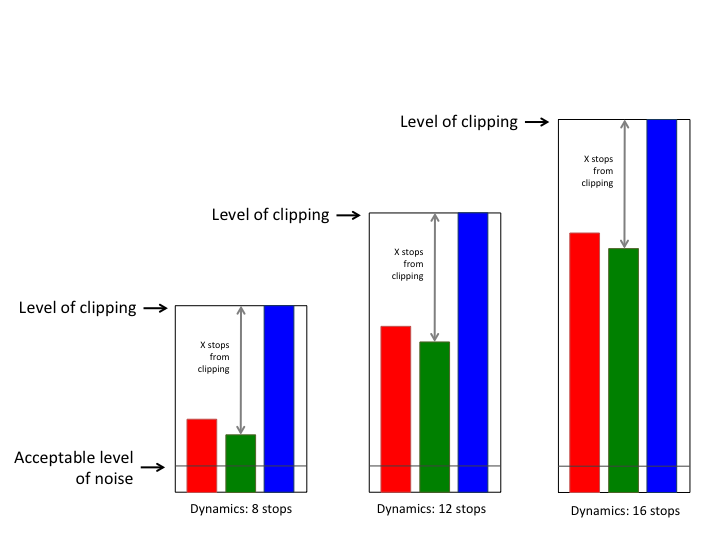
The figure below represents a typically situation when shooting outdoors in this part of the world in December. The blue channel dominates, and hence, it also dictates the exposure implying the level of red and green is lower. The dynamics of your camera specify the margin of the red and green channel to the acceptable level of noise. More dynamics mean bigger margin, and this is why white balancing (using filters) with Dragon is less critical than with the MX sensor (which is better than the old M sensor, and so on).

WB.png


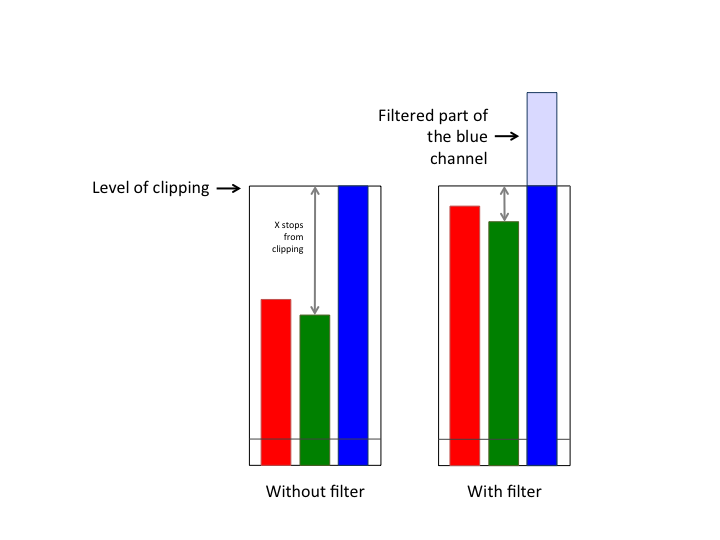
If one sets a filter to cut down the blue channel, one may open the iris and lift the blue and green channels upwards as shown below.

WB2.png


But notice, if one is not able to lift the red and green channels by opening the iris or using a longer exposure time, using the filter is a rather dumb choice as it just removes information: there is no trade-off. With film the situation is bit different as the "data" is not directly proportional to the amount of light. Therefore with film having it almost right while shooting to minimise the need of colour grading may well be a justified move.
 
I am hoping some new Dragon owners will be posting some more MX vs Dragon outdoor images soon. The more the merrier.

For the fun of it I compared the MX with a z-100 Sony the other day. ( z-100 is a 4k camcorder with some of the same internal guts as the F55, but has a tiny 1/2.3 sensor ).
Needless to say, the noise was way worse on the small chip, and the shadow detail was about one and a half stops different. The sharpness is comparable however.
 
For those (of us '-) who are fascinated by this thread, but may not follow everything said... can we just expose to the right and make the necessary adjustments in Redcine X?

Will we be losing (what?) percentages of total information, if not in the camera, in post?
 
.. can we just expose to the right and make the necessary adjustments in Redcine X?

If the colour temperature is close to the range 5600-6500K, as a rule of thumb, yes, you may adjust everything in post. That's the major advantage of raw images. But, if you you are far away from this, and you are after the ultimate image quality, you probably want to use filters to balance the data among different channels. As a result you get more subtle colour tones.
 
If the colour temperature is close to the range 5600-6500K, as a rule of thumb, yes, you may adjust everything in post. That's the major advantage of raw images. But, if you you are far away from this, and you are after the ultimate image quality, you probably want to use filters to balance the data among different channels. As a result you get more subtle colour tones.

Exactly.

(This is the mentioned film approach doing the WB physically with filters - meaning filling up the channels evenly right from the start by feeding the sensor with daylight. Silicon is most sensitive around 5000k. Sorry Gunleik, couldn't resist, haha!)

Hans
 
My approach is to trust Graeme's de-bayering algorithm and color science for most shooting situations. Essentially believing that scientifically modulated channel imbalance compensation will yield superior results to what I can do ad hoc. That said, some more extreme scenarios can benefit from a bit of smart optical path filtration.

I carry a 1/4 CTB Schneider filter for low color temperature scenes, especially with practicals playing in the shot that can't be re-lamped, to avoid a starved blue channel. As a rule I don't believe in removing potentially useful image information in a doctrinaire quest for channel balance, but under 2800K CT things can get a bit janky. Note: I would never go beyond 1/4 strength and 1/8 seems like too little help to justify the extra piece of glass in the optical path.

Cutting out some blue on a bright day exterior might make sense, though I prefer to just put on a Pola and watch my shadows. YMMV.

Cheers - #19
 
Hi Lauri,
isnt it 5600-6500 is too conservative?
what about if i am around 5000K or 4500K. Do i still need filter?

THX Lauri for the charts.
And they also describes the challenges pretty well.

"Need the filters"... :)
Not if you are happy with what you get.

And my point about WBing here, is that I actually think the in-camera WB is very good. Never said that about any camera before... :)
 
isnt it 5600-6500 is too conservative?
what about if i am around 5000K or 4500K. Do i still need filter?

Hi Ergin, as Gunleik says, it's a matter of taste, but to be explicit, I wouldn't use filters around 4.500–5.000K, but rather when it gets above 10.000K or below 3.200–3.400K.

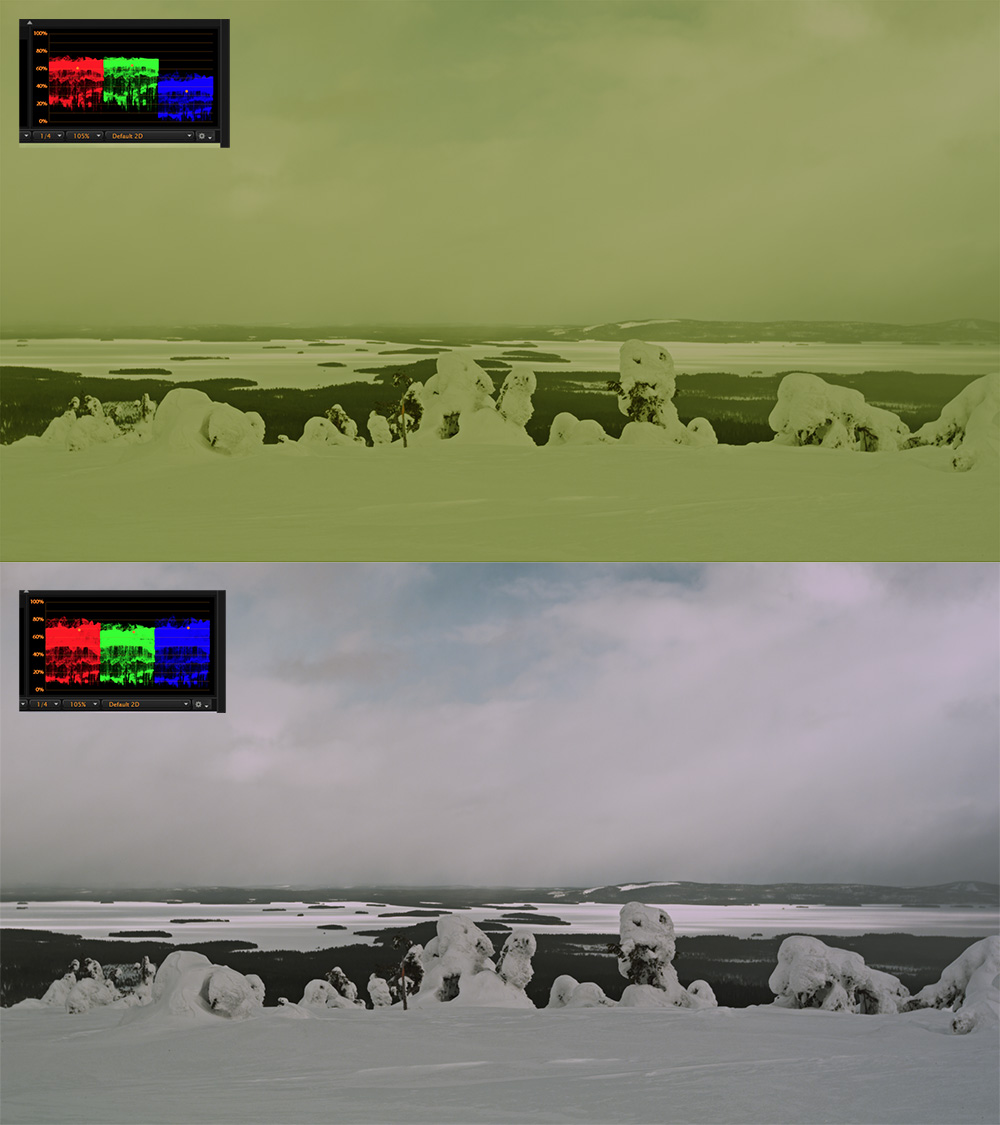
In the example below once tested a yellow filter with R1 with M-sensor to knock down the blue channel. The upper images shows what the image look liked on the LCD and in post when WB is set to 5.600K. The histogram suggests the yellow filter was even too effective. The lower color graded image captures nicely the different grey tones, and I just happened to like these tones, especially the rich tones of grey clouds. With hindsight, perhaps could say, this particular case with the yellow filter resulted in the most pleasing tones of grey cloud I ever took with R1. Still, difficult to take sides whether one really needed filtering in this case. In any case, with Dragon there should and will be less need for such filtering.

Filter.jpg
 
On Epic, when I tested, there was a "safezone" from about 4400 to 6000.

On the Dragon it works a lot better.

But this can easilly be a bit "geeky" and confuse more than help.

Lauris illustration is VERY good, though, especially taking DR/Bit-depth into consideration
 
Today I did play with some old footage, 5 years ago, RED ONE M, my jaws drops and I feel my heart beat in love again...... the images are so clean, no noise even in underexposed, and the colors are really great. Come on Red, do the magic again.
 
Today I did play with some old footage, 5 years ago, RED ONE M, my jaws drops and I feel my heart beat in love again...... the images are so clean, no noise even in underexposed, and the colors are really great. Come on Red, do the magic again.

IMHO they just did.

I loved the R1 M for many things. Latitude is not necessarily one of them, but how gentle the image was when within range... That was beautiful!.

Dragon has all that + the best DR and "whatever" you can imagine.
 
So at the end what are the conclusions here? if you don't know how to exposed corectly the MX you better upgrade to a Dragon? Honestly I was hopping to see a huge different here... but is so close that I can't justify expending that much for the dragon upgrade. I seriously think RED need to do something about it (drop prices for the dragon upgrade or Something) I think $9500 is a lot of money for the lower end Pros that owns Epics and Scarlets.
 
Last edited:
So at the end what are the conclusions here?

The conclusions are:


1. There is more latitude/dynamic range coming from the DRAGON sensor (more detail in both the highlights and shadow of your shots). In fact, early testers are basically saying that they agree with REDs claims that there is useable detail all the way out to 16+ stops.


2. There is more useable information throughout the range, but especially in the middle, where most of the information resides and, arguably, where it matters most.


3. There is better color fidelity. The color science can "squeeze" more accurate tones from the new sensor (even without yet being customized for the DRAGON).


4. The noise coming from the new sensor is more pleasing when down sampled.


5. The IR shift has been greatly reduced and, when the OLPF is replaced with the new one that's in the lab, this will virtually eliminate the IR shift and provide even better color fidelity.


if you don't know how to exposed corectly the MX you better upgrade to a Dragon?

No.
_
If one doesn't know how to expose the MX correctly, he or she should take some cinematography classes, or read up on the subject, and then practice their craft. The DRAGON will be slightly more forgiving but it's not suppose to be a substitute for not knowing how to attain proper exposure.

...Honestly I was hopping to see a huge different here... but is so close that I can't justify expending that much for the dragon upgrade. I seriously think RED need to do something about it (drop prices for the dragon upgrade or Something) I think $9500 is a lot of money for the lower end Pros that owns Epics and Scarlets.
Unfortunately These Days professionals are trusting more ARRI. just read the Oscars nominees list (BTW Please don't even mention "The Hobbit" that film looks awful to my eyes)

The improvements might seem subtle to some. Nevertheless, these subtle differences are what closes the gap between digital and film. …a fact that is very important to a lot cinematographers out there. I agree. $9,500 is a lot of money. But IF they have the money, many will gladly pay for the subtle improvements they will get from their images. IF they don't, then they won't.
In that case, the MX is still a viable alternative for the "lower end Pros that own Epics and Scarlets". …so is the MX in the R1 for that matter.


You can argue that the ALEXA makes a prettier image, but NO ONE can deny that (with proper grading) countless BEAUTIFUL AND VERY FILMIC images have been derived from MX EPIC footage. …and now, with the DRAGON, it's only going to get better.
 
Back
Top