Welcome to our community

Be a part of something great, join today!

  • Hey all, just changed over the backend after 15 years I figured time to give it a bit of an update, its probably gonna be a bit weird for most of you and i am sure there is a few bugs to work out but it should kinda work the same as before... hopefully :)

Dragon Dynamic Range Test - 21 stop chart

Great test guys. While it is nice to see 18 stops, there is no way in hell they are all usable. My estimate would be around 14 usable. I hate noise so those lower chips would be unusable to me...

From your initial look Gavin, would you say 14 usable stops is very close to accurate? I'm tired of hearing Dragon has more DR than Alexa but example after example shows less DR with Dragon and significantly more noise on the low end... Don't get me wrong, I love Dragon, just tired of fanboyism and misinformation. It doesn't make any of us look professional.
THANK YOU!
 
Added MX Chart. Also added R3Ds and EXRs.


I don't think this test will really provide a great "usable" rating which is why I wanted to shy away from subjective decisions like that. I personally always rate MX at 200-320ISO because I hate noise too. Then again I've seen people shooting 1,000 who are happy as a clam. What I can say from my first looks at the charts is that at 15 stops that there is footage that's not just noisy even with 7 stops of noise reducation but entirely missing. If you have a still frame and over the course of 2 seconds of rolling none of the noise resolves the actual image in some locations then you've officially descended below the top of the noise floor and the variability of the noise itself is greater than the intensity of the image.

If we had an Alexa we would probably find at least as much dynamic range as Dragon if your comparison image above is accurate. *Wild speculation*. As to the image you provided, it does demonstrate the undesirable color casts of Epic, but without the RAW footage I couldn't say whether it's a fair fight or not.

Hey Gavin, Thanks for the response. You can find both the Alexa RAW file and R3D here from that comparison by Florian Stadler: http://www.reduser.net/forum/showthread.php?117070-First-Day-with-Dragon

 
I'm not trying to sound unprofessional here, but I could give a schlitz what Alexa can do. My focus is totally and completely on what my Dragon can do.

Sorry if that pisses anyone off by ruining the Dragon-owner reputation rating. '-)
 
Elsie N said:
I'm not trying to sound unprofessional here, but I could give a schlitz what Alexa can do. My focus is totally and completely on what my Dragon can do... Sorry if that pisses anyone off by ruining the Dragon-owner reputation rating. '-)

I think it is perfectly okay to express your opinion. :) People are always going to ask how something preforms against something else under the same condition. If we would have had an Alexa, we would have included it. From my point of you, the more data you can provide to a manufacturer, the better they can make their products. Arri will introduce new sensor technology at some point that will be better than Dragon. Red will in turn release new sensor technology that will be better than Arri. The two, and other as well, will keep advancing the technology and we will all benefit. Many years ago I created the DVD Benchmark and Progressive Scan shootout because I wanted better image quality from my DVD player at the time. The original Faroudja line doubler, as they called it, was $15k and made laser disc look great at 480p. Many years later, that Faroudja technology was available in a $100 DVD player from Panasonic. With companies like DVDO and Silicon Optix (HQV) things advanced further. Competition is good and providing reproducible feedback is important. Now that more Dragons are in the field, Red will get more feedback under scenarios they may have never considered.

Everyone has the little things they care about. On the display side, I have a friend who's number one obsession is contrast ratio. On the capture side that would probably be the equivalent of dynamic range. Some care about color, some care about sharpness, etc... Right now, I want a sharper image from Dragon. It can be done as Les has demonstrated. Of course others think it is too sharp. We all have different needs.

Matt commented in another thread that he would like to see the new OLPF with the old calibration. I kind of whish we could switch between the calibrations with a user setting. Maybe one optimized for low light and another for highlights. I don't know what the calibration actually changed, so it might not be possible.

Gavin has put a lot of time into going through all of the content and putting it together and presenting it. I had the easy part, I provided the chart, dark room, and Dragon. :) I consider this our first attempt. The chart arrived a few days before we shot it. We had no formal plan in place. We can always do it again as Red tunes the camera or if someone has another camera and they want to provide it for testing. I also have the TE42 chart and IQ Analyzer software from Image Engineering that would be fun to use at some point.
 
Hey Gavin, Thanks for the response. You can find both the Alexa RAW file and R3D here from that comparison by Florian Stadler: http://www.reduser.net/forum/showthread.php?117070-First-Day-with-Dragon

Thanks for the link. After looking at both, neither is clipping. Without either sensor clipping they both could have been exposed higher. To really compare the bottom end you would want to match the top-end so that the noise falls relative to the top. It's possible that Dragon needed to be rated a stop lower than Alexa--or it's possible Alexa would have done even better. No way to know without an updated test.
 
I think it is perfectly okay to express your opinion. :) People are always going to ask how something preforms against something else under the same condition. If we would have had an Alexa, we would have included it. From my point of you, the more data you can provide to a manufacturer, the better they can make their products. Arri will introduce new sensor technology at some point that will be better than Dragon. Red will in turn release new sensor technology that will be better than Arri. The two, and other as well, will keep advancing the technology and we will all benefit. Many years ago I created the DVD Benchmark and Progressive Scan shootout because I wanted better image quality from my DVD player at the time. The original Faroudja line doubler, as they called it, was $15k and made laser disc look great at 480p. Many years later, that Faroudja technology was available in a $100 DVD player from Panasonic. With companies like DVDO and Silicon Optix (HQV) things advanced further. Competition is good and providing reproducible feedback is important. Now that more Dragons are in the field, Red will get more feedback under scenarios they may have never considered.

Everyone has the little things they care about. On the display side, I have a friend who's number one obsession is contrast ratio. On the capture side that would probably be the equivalent of dynamic range. Some care about color, some care about sharpness, etc... Right now, I want a sharper image from Dragon. It can be done as Les has demonstrated. Of course others think it is too sharp. We all have different needs.

Matt commented in another thread that he would like to see the new OLPF with the old calibration. I kind of whish we could switch between the calibrations with a user setting. Maybe one optimized for low light and another for highlights. I don't know what the calibration actually changed, so it might not be possible.

Gavin has put a lot of time into going through all of the content and putting it together and presenting it. I had the easy part, I provided the chart, dark room, and Dragon. :) I consider this our first attempt. The chart arrived a few days before we shot it. We had no formal plan in place. We can always do it again as Red tunes the camera or if someone has another camera and they want to provide it for testing. I also have the TE42 chart and IQ Analyzer software from Image Engineering that would be fun to use at some point.
Stacey, You and Gavin have done a great service to the community and I certainly have no quarrel with anything you've said above.

I do take issue with Matt's implications that those who see 16 1/2 stops DR from the Dragon are "liars" because he sees no more than Alexa which, I think he said (without checking) has only 14. It's as if he was saying "how dare anyone claim to be better than Alexa!"

And furthermore, he has accused many highly professional people here on Reduser of making false claims in re: the DR of the Dragon.

And if that's what HE believes about the RED/Alexa comparison, I have no problem with that. I do think he should keep those sentiments between himself and anyone he's actually dealing with when trying to decide which camera to use.

Thanks for getting personal Elsie. As a professional it is my job to know the limits of every system and how they compare to one another. I have shot with Dragon both new and old olpf, so I have first hand knowledge. You claim I dispute other "professionals" in their claims, you better believe I do (maybe you can enlighten me in who I dispute and pretty sure I've never called anyone a "liar"?). While there very well is 16.5 stops of DR available, it is not all usable in a single shot. I stand by that claim and you are more than welcome to test it yourself. If I wanted to use a bunch of noise reduction then sure, maybe 16 stops can be squeezed out. I don't know where you get off in saying that people here are not allowed to compare other systems to RED, that's how we push RED as a company. Not kiss each others asses and say we are the best...

You can sit back all you want and pretend we are the best now, or push to be the best not just now but in the future as well. I never claimed the system couldn't be better than Alexa so I don't know where you get off saying that. What I have been simply stating is that if Arri claims Alexa is only 14 stops, then how come Dragon has slightly less DR? That would mean Alexa could be 15 stops, 18 stops, whatever. It's not a matter of me professing Dragon can't be superior, it is in many regards, just still not in terms of DR (Although it's very close.). You happen to own a Dragon and shoot your own stuff, and that's cool for you. But as a professional I have to pitch cameras for jobs and understand how to sell them, not lie. Therefore I look for the truth, not the misinformation by your said "professionals." Maybe you don't know my work but 95% of it is RED, so don't ever criticize me and say I'm anti RED or an Alexa fanboy.
 
Yep. What i web published is more or less a "practical use" measurement aimed at how people traditionally work on REDCODE. Either way we are getting the 16+ and 18 or 19 total visible stops depending on where you start and stop counting.

What you do with all that captured dynamic range in terms of a curve after the fact is also relevant, though will never be consistent due to exposure technique variations and there are indeed benefits from having "more and going to less" in this case. Especially in regards to an organic looking image.

This is a good and important point you make.
 
Matt Ryan said:
What I have been simply stating is that if Arri claims Alexa is only 14 stops, then how come Dragon has slightly less DR?

It would be nice if there were a published standard, that everyone agreed on, with the exact steps on how to properly/accurately measure DR. Because there is not, its hard to compare A to B when different techniques are used. I suppose a bunch of experts could get together and propose something.

In the display space, manufactures throw out some questionable claims for contrast ratio. Each year they get even larger. e.g. I knew of one display manufacturer that would turn the display off and measure black, then turn on, max contrast (everything was clipped), and then measure white and then publish the number in their spec sheet. I have seen claims of 3,00,000:1 contrast and when I measure using an LS-100 light meter, I might be 2000:1 (on/off) and 500:1 ANSI. No one really questions them on it like they do camera manufacturers and number of stops. :)
 
Gavin,

Could you post one of the Xyla shots when the rolloff chips were blown out so we can see the shoulder curve?

And did the Xyla chart match your spot meter until it dropped below .5? Did you happen to notice how many candelas you were reading on the top chip?

I concur that the exposures below 14 are noisy, but it's a nice toe - there would be quite a bit of detail in the shadows, I think.

Thanks.
 
Mark Wilkinson said:
And did the Xyla chart match your spot meter until it dropped below .5?

Sadly neither of us had a meter on hand this time around. I know, I know! :) When I get my Minolta back, I will measure each step with it. At least as low as I trust the meter.
 
Thanks for getting personal Elsie. your words... (Don't get me wrong, I love Dragon, just tired of fanboyism and misinformation.)
I just felt I had to counteract your (seeming) Alexa fanboy misinformation... nothing personal. (How does it feel being labeled as a fanboi just because you see things one way? All this labeling a person a fanboi if they do not see what you see is a bullying tactic, IMO, and is meant to destroy any other POV than your own.)

As a professional it is my job to know the limits of every system and how they compare to one another. I have shot with Dragon both new and old olpf, so I have first hand knowledge. You claim I dispute other "professionals" in their claims, you better believe I do. While there very well is 16.5 stops of DR available, it is not all usable in a single shot. I stand by that claim and you are more than welcome to test it yourself.
This has been pointed out time and time again on Reduser. I specifically asked that rhetorical question in a Mark L. Pederson thread and the resounding answer was no, you (seldom, if ever) use the full dynamic range of the Dragon.

However! it was pointed out that you can use any portion of that dynamic range. That is, you can use the upper "14" or less stops or you can use the lower "14" or less. Middle gray is a moving target on Dragon.

If I wanted to use a bunch of noise reduction then sure, maybe 16 stops can be squeezed out. I don't know where you get off in saying that people here are not allowed to compare other systems to RED, that's how we push RED as a company. Not kiss each others asses and say we are the best...
There you go labeling people again... that is, anyone happy with their camera and saying so is an ass kisser? Again... Wooly Bully.
You can sit back all you want and pretend we are the best now, or push to be the best not just now but in the future as well. I never claimed the system couldn't be better than Alexa so I don't know where you get off saying that. What I have been simply stating is that if Arri claims Alexa is only 14 stops, then how come Dragon has slightly less DR? That would mean Alexa could be 15 stops, 18 stops, whatever.
Now you are just setting yourself up as being superior. I saw the charts presented and by moving middle gray around I'll have 16 stops to use in whatever chunks I choose. You are not allowed to define the Dragon. (Go ahead, define the Alexa all you want... I have no time to spend on Alexa business. '-)
It's not a matter of me professing Dragon can't be superior, it is in many regards, just still not in terms of DR (Although it's very close.). You happen to own a Dragon and shoot your own stuff, and that's cool for you. But as a professional I have to pitch cameras for jobs and understand how to sell them, not lie. Therefore I look for the truth, not the misinformation by your said "professionals." Maybe you don't know my work but 95% of it is RED, so don't ever criticize me and say I'm anti RED or an Alexa fanboy.
Oops! sorry on that Alexa fanboi request. too late now. And like I said in an earlier post, what you say between you and the people on your jobs is fair game. But there are people on Reduser who are here to learn, and I just felt the need to offer another side to your argument, apparently based on your POV.
 
Stacey - That would be brilliant if you could post the meter readings. In another thread, we were discussing how much light would have to punch through that bright chip to make the lower chips even measurable...

And I'm very curious if the chips are a stop each on the Xyla - having never actually seen one in person.

Very often people misunderstand the gray scales on DSC charts represent stops and if you meter them in a real world situation, there is actually a 4 stop difference over 10 steps - obviously different charts vary, as well.
 
Next round of testing...

Next week I will have the opportunity to use my Dragon and an Alexa with Arriraw. So, I will simply have somebody stand right outside under sunlight and have somebody else inside. I will try to place them right where the Dragon clips on both ends. I will measure it with a light meter.

For me its important to know how skin tones behave at the highest and lowest end of the range. I will ask them to wear colorful clothing to notice how colors behave.

Any suggestions... feel free to let me know.

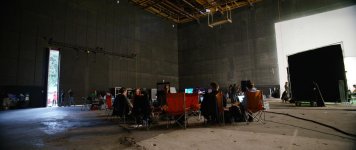
But in the mean time I just want to share a small still from yesterday. It is a Master Prime 16mm of a soundstage with the door open. Please notice that outside we hold a lot of information. And there is tons of detail on the every wall. Not trying to be a fanboy, but it is hard not to be one with such incredible and outstanding results.

What I am saying is that the Alexa has good DR, but it does not have enough color at the highlights, and I think Dragon does.
 

Attachments

  • foro.0.0000000F.jpg
    foro.0.0000000F.jpg
    94 KB · Views: 0
Done Mark.
 
And please ride the Iris/ND up and down, so that we can see how much can be recovered by an ISO adjustment. What you can recover via a power window to another ISO setting is to some degree valid DR.
 
Mark Wilkinson said:
Very often people misunderstand the gray scales on DSC charts represent stops and if you meter them in a real world situation, there is actually a 4 stop difference over 10 steps - obviously different charts vary, as well.

That is true. The steps on their ChromaDuMonde charts are not in full stops. According to DSC, the steps on Xyla-21 are true 1-stop increments.
 
My one request would be just for a test where a white board is jusssst barely blown out (1/4 stop ND gel strips taped to it that are visible) on both cameras using the shutter. Then someone maybe 3 stops under and one person maybe 10 stops under clipping. I would also be curious to see the Dragon with 1/4 lowcon to give the same effect as the Alexa OLPF.

From that point then increasing exposure duration until the darker exposed camera matches the metered exposure for the camera with the brighter clip point.
 
Back
Top